


How Do You Document Antique Furniture Value?
Last Updated: November 1, 2026
Quick Summary
Furniture value documentation means keeping a written record that proves what an antique piece is, who made it, its age, condition and ownership history. Record each value figure with its type and date, and back every claim with photos, receipts or an appraisal. Insurers, executors and buyers rely on this record.
- Record fair market value for estate and tax purposes, and replacement value for insurance.
- Photograph every maker's mark, label or stamp with a tight close-up and a wider shot.
- Measure height, width and depth in inches to the nearest quarter inch.
- Keep original receipts, invoices and auction catalog pages to trace ownership history.
- Review and update each record yearly and after any sale, repair or move.
Table of Contents
- Why Antique Furniture Value Documentation Matters
- Understanding the Different Value Types and Which One to Record
- Identifying the Maker, Age, Period and Style
- Building an Antique Furniture Appraisal With Photos
- Recording Provenance and Verifying Documented History
- Writing a Clear Antique Furniture Condition Report
- Setting Up Your Antique Furniture Inventory Template and Keeping It Current
- Frequently Asked Questions
Why Antique Furniture Value Documentation Matters
Antique furniture can be worth far more than it looks, but only if you can prove what it is through solid furniture value documentation.
Documentation does three jobs at once. It supports insurance claims, it helps with estate planning, and it gives buyers the confidence to pay a fair price. Many collectors also find that good records make resale easier later.
- Insurance replacement claims need proof of what you owned
- Estate executors need a clear inventory to divide items fairly
- Future buyers want evidence of age, maker and condition
Antique value comes from several things working together: age, maker, condition, rarity and history. Documenting each one separately keeps your record useful. A short, organized file beats a pile of loose receipts every time.
Understanding the Different Value Types and Which One to Record
Not every value figure means the same thing. Insurance appraisers, estate lawyers and buyers each use different terms, and mixing them up causes problems. Before you write anything down, decide which value type you need.
- Record fair market value for estate and tax purposes, and compare against current cabinet price and value benchmarks before settling on a figure.
- Record replacement value for insurance coverage
- Record liquidation value only as a realistic floor
Write the value type next to every number. A figure with no label is hard to use later, and it can be read as a promise you never made.
Identifying the Maker, Age, Period and Style
Start with what the piece actually shows. Look for a maker's mark, label or stamp, usually on the underside, back panel or inside a drawer. Confirm genuine antiquity with a method for checking age and period against these marks.
Age and period are easier to judge when you compare details against known references. To tell Victorian from Edwardian pieces when recording a piece's period and style, check the specific design features.
- Note any marks, labels or inscriptions, with photos
- Record the wood species if you can identify it
- List construction methods such as hand tools or machine work
- Describe the style and say how confident you are
A common mistake is to state a date as fact when the evidence only supports a range.
The article's guidance on describing a piece's maker, age and style comes down to a few checks, summarised below.
| Clue | What to look for | Note |
|---|---|---|
| Maker's mark | Label, stamp or inscription, usually underneath or inside a drawer | Photograph it with any marks |
| Joinery | Hand-cut dovetails and pegged joints | Earlier than machine-cut work |
| Age evidence | Wood checking, patina and wear on high-touch areas | Compare against references |
| Style words | Baroque, Rococo, Renaissance Revival | Describe design, not exact dates |
| Dating | Date as a range based on construction | Avoid stating an unsupported year |
Building an Antique Furniture Appraisal With Photos
Photos are the backbone of any appraisal, but only if they are shot and labeled the same way every time. A loose camera roll is not documentation; a consistent photo set plus recorded dimensions is what lets an appraiser, insurer, or buyer verify a piece without seeing it in person. Treat this section as a production checklist, not a photography tip list.
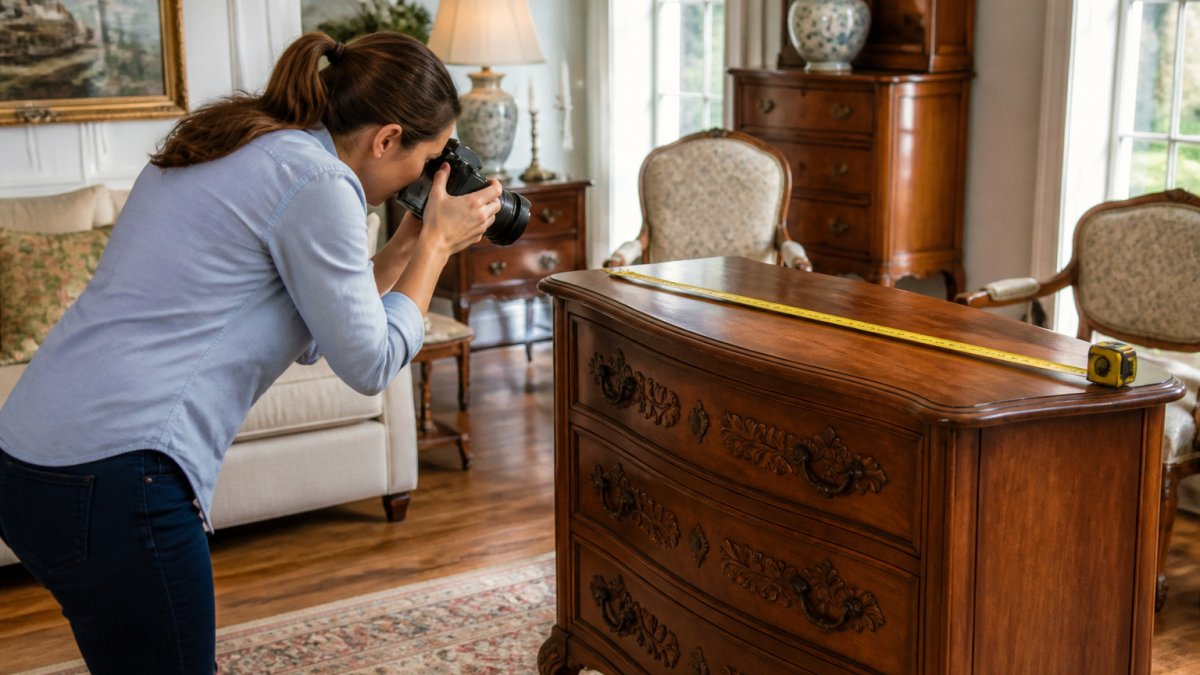
The standard shot list
For every piece, capture these views in this order so files sort predictably:
- Full front elevation, camera level with the piece's midpoint, entire piece in frame with a small margin.
- Full side elevation (both sides if asymmetric, such as a desk or settee).
- Three-quarter view to show depth and form.
- Top surface, shot from slightly above.
Scale, lighting, and color
Place a ruler or tape measure in frame for every close-up so size is unambiguous. For full views, stand a tape measure against the piece's height or lay one across the width. Use soft, even daylight or two diffused lights at roughly 45 degrees; avoid direct flash, which flattens patina and creates hot spots. Include one shot with a neutral gray card or a plain white sheet of paper so finish color can be judged later, phone cameras shift wood tones badly under mixed light.
Measure and record in inches
Record height, width, and depth in inches to the nearest quarter inch, and note which dimension is which (a common error is swapping depth and width on case pieces). Note weight only if the piece is light enough to move safely. Record seat height on chairs and clearance under aprons on tables, since buyers and insurers ask for these.
File naming and metadata
Use a single naming pattern for every piece, for example: [ItemID]_[View]_[YYYY-MM-DD].jpg. Keep a master log that maps each ItemID to the piece's name, location in the home, and the date the set was shot. Store originals in one backup location and working copies in another; do not edit or crop the originals, because an unaltered file is stronger evidence.
What a written appraisal should contain
Photos show what the piece looks like; a written appraisal explains what it is worth and why. A usable report generally includes:
- The appraiser's name, credentials, and the date and scope of the inspection (in-person vs. desktop).
- A full description of each item: maker, period, materials, construction, dimensions, condition, and any repairs.
- The value type being reported (fair market, replacement, liquidation, or retail) and the effective date of value.
- The comparable sales or listings relied on, with source, date, and how the appraiser adjusted for differences in condition, maker, and completeness.
Ask the appraiser which comparables were used and how they were adjusted. A report that lists sales without explaining the adjustments is hard to defend if an insurer or the IRS questions it. For insurance scheduling, confirm the report states replacement value; for estate and tax work, confirm it states fair market value as of a specific date.
Recording Provenance and Verifying Documented History
Provenance is the ownership history of a piece. It can include former owners, sale records, auction catalogs, old invoices and family letters.
Collect every document you can, and make copies of anything fragile. Record names, dates and places as completely as you can.
- Keep original receipts, invoices and bills of sale
- Save auction catalog pages that list the piece
- Write down what family members remember, dated and signed
- Note any gaps in the chain of ownership
For more on how this works, see How to Verify 16th Century Antique Authenticity and What Is Provenance in Antique Collecting: A Complete Guide.
Writing a Clear Antique Furniture Condition Report
A condition report describes the piece as it is today. Be honest about damage, repairs and restoration. Buyers and insurers trust records that admit flaws far more than ones that hide them.
Use plain terms. Describe cracks, losses, missing hardware, veneer lifting and finish wear, and state each one's location and size.
- Structural condition: joints, legs, panels and drawers
- Surface condition: finish, patina, scratches and stains
- Restoration history: what was done, when and by whom
Many collectors find that a clear condition report helps a sale go more smoothly. Disclosing problems early prevents disputes later.
Setting Up Your Antique Furniture Inventory Template and Keeping It Current
A simple spreadsheet or binder works for most collectors, but the value is in the fields, not the format. Build one record per piece with a consistent structure so any appraiser, insurer, executor, or heir can read it without you there to explain it. The template below is the minimum that survives a side-by-side comparison with a professional inventory.
The record fields
Use these as column headers in a spreadsheet, or as labeled sections on a one-page form per piece:
-
Item ID, a short unique code (e.g.,
CHR-014) used in every photo filename and document. - Item name and form, e.g., 'walnut side chair,' 'mahogany chest of drawers.'
- Maker or attribution, name if marked; 'attributed to' or 'unmarked' if not, with the basis for the attribution.
- Period or date range, stated as a range with a confidence note, not a single year unless documented.
- Style, e.g., Chippendale, Renaissance Revival, Arts and Crafts.
A worked example
A single row might read: CHR-014 | walnut side chair | attributed to [maker], unmarked | c. 1880-1900, based on construction | Renaissance Revival | walnut primary, ash secondary, original horsehair upholstery | 38 × 19 × 21 in., seat height 18 in. | stable joints; veneer loss 2 in. on rear left leg; later finish | purchased at estate sale 2019, receipt on file; family states prior owner in [region] | CHR-014_front_2026-05-01.jpg, etc. | replacement value $1,850 as of 2026-05-01, per appraiser | receipt 2019, appraisal 2026 | parlor, north wall | reviewed 2026-05-01.
That single row carries every fact an insurer, executor, or buyer needs, and every fact is traceable to a source.
Keeping it current
- Annual review: re-check values and condition once a year, and note the review date in the record.
- Event-driven updates: update after any sale, acquisition, repair, restoration, move, or damage, and add a fresh photo set.
- Market shifts: refresh replacement values when comparable sale prices move materially, and note the source of the new figure.
- Version control: keep the prior version of each record rather than overwriting it, so the history of changes is visible.
Storage and sharing
Keep a paper copy and a digital copy in separate locations, and back up the digital set to a second drive or cloud account. Limit edit access to one or two people, and give read-only copies to your insurer, attorney, or executor as needed. A short cover sheet, total item count, total insured value by value type, and the date of the last full review, makes the file usable at a glance.
If you are unsure which value type to record for a given piece, For current pricing on specific pieces, please contact us directly through our website, since values depend on the item and its condition. Browse the full catalog and start building your record today.
Frequently Asked Questions
How do I find the value of antique furniture?
Start by identifying the maker, age, period and condition, then compare the piece against recent auction results and comparable sales for similar items. Record each finding with photos and measurements. For a figure you can rely on for insurance or an estate, a written appraisal from a qualified professional appraiser is the standard. Online estimates can point you in a direction, but they rarely include the inspection and documented evidence that a formal appraisal report provides.
What photos help an appraiser value antique furniture?
Take a full view of each side, a close-up of the maker's mark or label if one exists, and detail shots of joinery, hardware, wood grain and any damage or repairs. Include a photo with a tape measure showing overall height, width and depth. Shoot in even daylight without flash glare, and keep the same angles for every piece so your records stay consistent over time.
What is the difference between an appraisal and an online estimate?
An online estimate is a quick guess based on photos and descriptions, usually with no physical inspection. A written appraisal from a professional appraiser involves examining the piece in person, researching comparable sales, stating the value type and purpose, and producing a signed report. The report is what insurers, estate attorneys and courts typically request when they need a defensible value.
How often should antique furniture be reappraised?
Many owners reappraise every three to five years, and sooner after a restoration, a change in ownership, a significant shift in market demand, or a move that changes your insurance coverage. Keep your inventory template updated whenever a piece changes condition or location so the record matches the object you actually own.
