


How to Tell Victorian Furniture from Edwardian Furniture
Last Updated: October 30, 2026
Quick Summary
Victorian furniture is heavy, dark and densely carved, with thick legs and shell or floral crests. Edwardian furniture is lighter, with slender legs, inlay in contrasting woods and painted decoration. Checking the wood tone, carving density and joinery usually separates the two.
- Victorian pieces (1837 to 1901) often use dark, heavy woods such as walnut, mahogany and oak.
- Edwardian pieces (roughly 1901 to 1910) favour lighter frames, slender legs and inlay.
- Dense carving covering most surfaces points toward the Victorian era.
- Hand-cut dovetails and hand-filed screws suggest earlier construction, while Phillips-head screws point to a later date.
- Three or more matching features in a checklist usually settle which era a piece belongs to.
Table of Contents
- Why Victorian and Edwardian Furniture Gets Confused
- Victorian Furniture Characteristics: Heavy Forms and Dense Ornament
- Edwardian Furniture Characteristics: Light Lines and Inlay
- How to Date Antique Furniture by Construction and Hardware
- A Checklist for Identifying Victorian or Edwardian Pieces
- Antique Furniture Identification Guide: Wood, Upholstery and Reproductions
- Booking Your Next Piece: Examine Our Victorian and Edwardian Pieces
- Frequently Asked Questions
Why Victorian and Edwardian Furniture Gets Confused
Victorian and Edwardian furniture look alike to most people, and that is the real problem. Both styles share ornate carving, rich upholstery and decorative wood finishes, so a buyer can easily mistake one for the other. Knowing the difference helps you price a piece correctly, care for it properly and avoid overpaying for a reproduction.
The Victorian era ran from 1837 to 1901. The Edwardian period covered roughly 1901 to 1910. That short gap is why a single piece can sit in a grey zone. Many late-Victorian pieces were built in the early 1900s and carry features of both styles.
The good news is that a few clear markers separate the two.
Victorian Furniture Characteristics: Heavy Forms and Dense Ornament
Victorian furniture is heavy, dark and crowded with detail. Carvers filled nearly every surface with motifs, and frames tend to look solid and substantial.
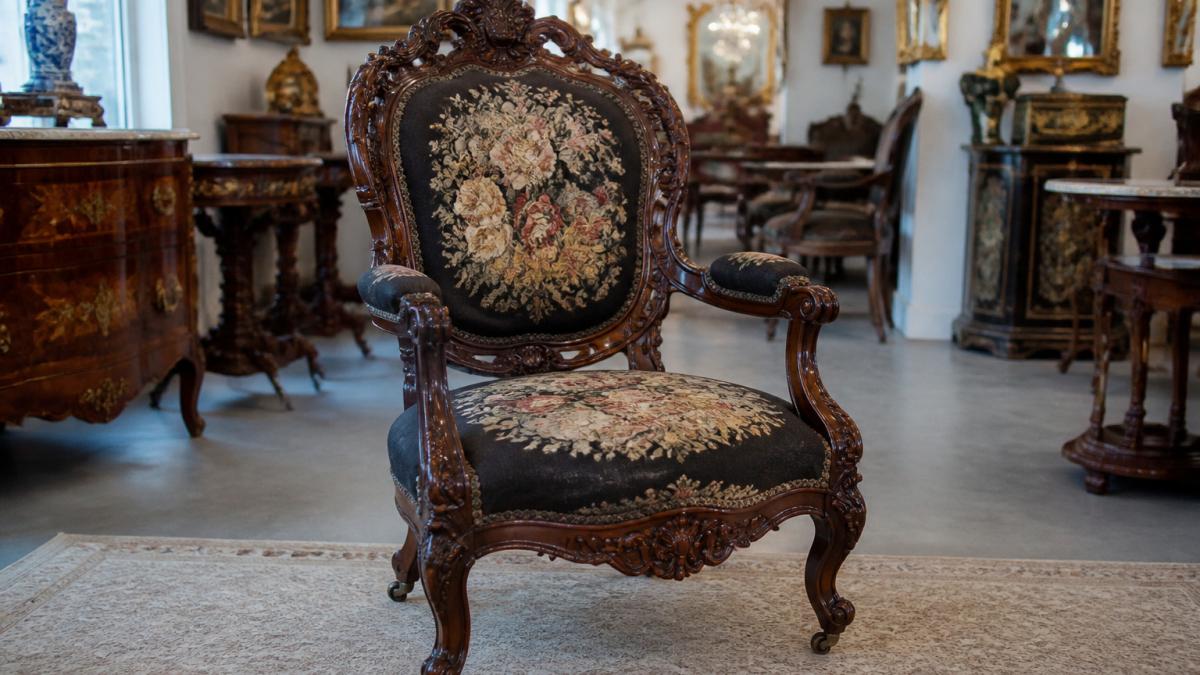
Look for these traits:
- Dark, heavy woods such as walnut, mahogany and oak, often stained deep brown
- Dense carving covering crest rails, legs and arms
- Shell, scroll and floral crests on chair backs
- Turned finials and thick legs with a sturdy, grounded profile
- Upholstery in florals or multicolor patterns
Our Victorian furniture reference guide notes that this carving density is one of the strongest visual markers of the period.
Victorian makers also favored sheer visual weight. See how these traits look in practice in a walnut American Victorian parlor set. A Victorian chair usually feels heavier in hand than an Edwardian one. You can compare this with a carved Victorian chair set with shell crest detailing. [PRODUCT: Chairs, Victorian, Set of Four, Carved, English, Shell Crest, Floral Upholstery! | https://www.oldeuropeantiques.com/products/chairs-victorian-set-of-four-carved-english-shell-crest-floral-upholstery] is a good example of these heavy, carved forms with a shell crest and floral upholstery.


The two periods differ in a few clear, checkable ways, summarised below.
| Feature | Victorian | Edwardian |
|---|---|---|
| Wood | Dark, heavy woods such as walnut, mahogany and oak | Lighter woods such as mahogany, satinwood and light oak |
| Decoration | Dense carving covering most surfaces | Inlay in contrasting woods and painted detail |
| Frame proportion | Thick legs and a heavy, grounded profile | Slender legs and lighter proportions |
| Upholstery | Florals or multicolor patterns | Striped or light-coloured silk |
| Chair crest | Shell, scroll and floral crests | Painted garlands, cupids or subtle highlights |
Edwardian Furniture Characteristics: Light Lines and Inlay
Edwardian furniture moved away from the heaviness of the Victorian era. Designers chose lighter frames, cleaner lines and more delicate decoration.
Watch for these features:
- Lighter woods such as mahogany, satinwood and light oak
- Inlay work in contrasting woods, often in geometric or floral patterns
- Painted decoration with garlands, cupids or subtle highlights
- Slender legs and lighter proportions
- Striped or light-colored silk upholstery
Edwardian pieces often combine painted detail with a lighter wood frame. Take the Edwardian painted dining chair set for a close look at these features. Take the [PRODUCT: Antique Chairs, Dining, Silk, Set of Six, Edwardian Paint Decorated, Early 1900s!! | https://www.oldeuropeantiques.com/products/antique-chairs-dining-silk-set-of-six-edwardian-paint-decorated-early-1900s-condition] set. It has painted highlights, cupid-decorated crest rails and striped silk upholstery, all typical of the Edwardian look.

The biggest tell is usually the combination of lightness and decoration. Edwardian makers kept the forms airy and put their detail into inlay and paint instead of heavy carving.
Antique Chairs, Dining, Silk, Set of Six, Edwardian Paint Decorated, Early →
How to Date Antique Furniture by Construction and Hardware
Style alone is not enough. Construction methods and hardware often reveal a piece's real age. Here is a simple process to follow:
- Check the joinery. Hand-cut dovetails and irregular pegs point to earlier work. Machine-cut joints with uniform spacing usually suggest later production.
- Look at the screws. Hand-filed screws with uneven threads and slotted heads generally predate the 1900s. Phillips-head screws point to a later date.
- Examine the hardware. Hand-forged hinges and pulls suggest older pieces. Stamped metal and standardized fittings are more typical of later work.
- Inspect the wood surfaces. Saw marks, planed surfaces and wear in unlikely places all help. Natural wear tends to appear where hands and weight have touched.
Many buyers skip these checks. A few minutes with a flashlight and a magnifying glass can save you a costly mistake.
A Checklist for Identifying Victorian or Edwardian Pieces
Use this quick checklist when you evaluate a piece:
- Is the wood dark and heavy, or light and airy?
- Is the carving dense and all over, or restrained and focused?
- Is there inlay in contrasting woods?
- Does the decoration look painted, carved or both?
- Do the joints look hand-cut or machine-cut?
- Are the screws hand-filed or standardized?
- Does the upholstery match the period's typical patterns?
- Does the overall proportion feel heavy or slender?
Three or more Victorian answers point toward that era. Three or more Edwardian answers point toward the early 1900s. Mixed results often mean a late-Victorian piece built during the transition.
Antique Furniture Identification Guide: Wood, Upholstery and Reproductions
Wood and upholstery offer more clues. Hardwoods that show natural grain variation and age-appropriate patina usually come from real antiques. Reproductions often use uniform stains and wood that looks too perfect.
Upholstery deserves attention too. Original silk and wool fabrics show wear consistent with age and use. Modern reproductions tend to have crisp, unworn fabric even when the frame looks old. Some wear and staining is normal.
Be wary of pieces that look too clean for their supposed age. Authentic antiques usually carry the marks of their history.
Booking Your Next Piece: Examine Our Victorian and Edwardian Pieces
Seeing these traits in person is the best way to learn them. At Old Europe Antique Home Furnishings, we invite you to examine our Victorian and Edwardian pieces firsthand. Our showroom is available for viewing by appointment, so you can check joinery, hardware and upholstery up close before you buy.
Once you know what to look for, you will tell these two styles apart with confidence.
Frequently Asked Questions
What are the main differences between Victorian and Edwardian furniture?
Victorian furniture, roughly 1837 to 1901, tends toward heavier proportions, dense carving, deep walnut and mahogany tones, and busy upholstery. Edwardian furniture, roughly 1901 to 1910, is lighter and more refined, with slender legs, satinwood or mahogany inlay, painted decoration and delicate, open lines. Comparing the silhouette and the amount of ornament is usually the fastest first test before you examine construction in detail.
How can you identify Victorian furniture?
Look for solid, heavy forms, carved crest rails and shell or floral motifs, and dark American walnut or English oak. Victorian pieces often show turned finials, spring-filled upholstery and hand-cut dovetails or pegged joints. Check the hardware as well: hand-forged or early machine-made screws and irregular saw marks point toward the nineteenth century rather than later production.
How can you identify Edwardian furniture?
Edwardian pieces are lighter in scale, with tapered legs, painted highlights and inlaid patterns in satinwood or mahogany. Chairs from this period often have striped silk upholstery and painted cupid or floral crest rails, as seen on early 1900s dining sets. Look for a more restrained overall profile than Victorian work, and check that construction matches a period of mass manufacturing rather than hand-cut joinery throughout.
How can I tell whether antique furniture is original or a reproduction?
Examine wear patterns, tool marks and screw types. Original pieces show wear consistent with age and use, such as softened edges and uneven patina, while reproductions often have uniform finishes. Inspect joinery for hand-cut dovetails versus machine-cut ones, and look for modern staples or fasteners inside upholstery. Ask the seller for provenance and condition details in writing before you buy.
