


How to Identify Genuine 16th Century Antiques
Last Updated: October 26, 2026
Quick Summary
To identify genuine 16th century antiques, examine the wood type, joinery construction, and surface patina for characteristics that only develop over centuries. Authentic pieces feature hand-cut mortise-and-tenon joints with wooden pegs, regional woods like oak or walnut, and natural aging patterns that cannot be artificially replicated.
- Genuine 16th-century furniture uses mortise-and-tenon joints secured with wooden pegs, not nails or screws.
- Authentic pieces show hand-carved details with visible tool marks and irregular cuts from hand chisels.
- Original finishes developed from oil, wax, or natural lacquer show natural patina deeper in crevices and lighter on raised surfaces.
- Check hidden areas like backs and undersides for consistent construction and aged wood throughout the piece.
- Plywood and machine-made nails are definitive proof of modern manufacture and rule out 16th-century authenticity.
Table of Contents
- Understanding 16th-Century Furniture Characteristics and Period Styles
- Inspecting Antique Furniture Construction Methods
- Examining Surface Wear, Patina, and Finish Authentication
- How to Spot Fake Antique Furniture and Modern Reproductions
- Using Antique Provenance and Authentication Records
- A Practical 16th-Century Authentication Checklist
- Verifying Your 16th Century Antique Purchase
- Frequently Asked Questions
Understanding 16th-Century Furniture Characteristics and Period Styles
To identify genuine 16th century antiques, you must understand the design language of the Renaissance and early Baroque periods. The 16th century marked a dramatic shift in European craftsmanship, where regional styles developed distinct characteristics that collectors can learn to recognize. At Old Europe Antique Home Furnishings, we help buyers distinguish authentic period pieces from later reproductions.
Renaissance Design Elements
Renaissance furniture reflects a fundamental change in how craftspeople approached their work. During this period, design moved away from purely functional forms toward pieces that displayed artistic intent and classical inspiration.
Authentic 16th-century pieces feature specific ornamental patterns. Look for carved rosettes, acanthus leaves, and architectural elements like pilasters and columns. These weren't random decorations but deliberate references to classical design.
Wood selection tells you something important about authenticity. Craftspeople in the 16th century favored oak, walnut, and chestnut. They chose these woods for durability and workability.
Regional Variations in 16th-Century Craftsmanship
Spanish furniture from this era displays Moorish influences mixed with Renaissance elements. Leather-clad trunks with nail head trim became iconic Spanish pieces.
Italian craftsmen developed their own vocabulary. Florentine work emphasized architectural forms and inlay techniques. Venetian pieces often incorporated marble tops and elaborate carved supports.
Understanding these regional differences helps you identify genuine 16th century antiques and spot inconsistencies. A piece claiming Spanish origin but showing Italian design elements raises immediate questions about authenticity.
Different regions of Europe developed distinct furniture styles during the 16th century, each with recognizable characteristics.
| Region | Design Influences | Key Characteristics |
|---|---|---|
| Spain | Moorish and Renaissance | Leather-clad trunks with nail head trim |
| Italy | Classical architecture | Inlay techniques, marble tops, carved supports |
| Germany and Flanders | Renaissance | Sturdy rectilinear forms with bold carved decoration |
| France | Increasing refinement | Moving toward Baroque style as century progressed |
Inspecting Antique Furniture Construction Methods
The way a piece is built reveals its age more reliably than appearance alone. Genuine 16th-century furniture shows construction techniques that differ fundamentally from later methods. Machine tools didn't exist during this period, so every joint, surface, and detail bears marks of hand work.
Hand-Cut Joinery and Mortise-and-Tenon Joints
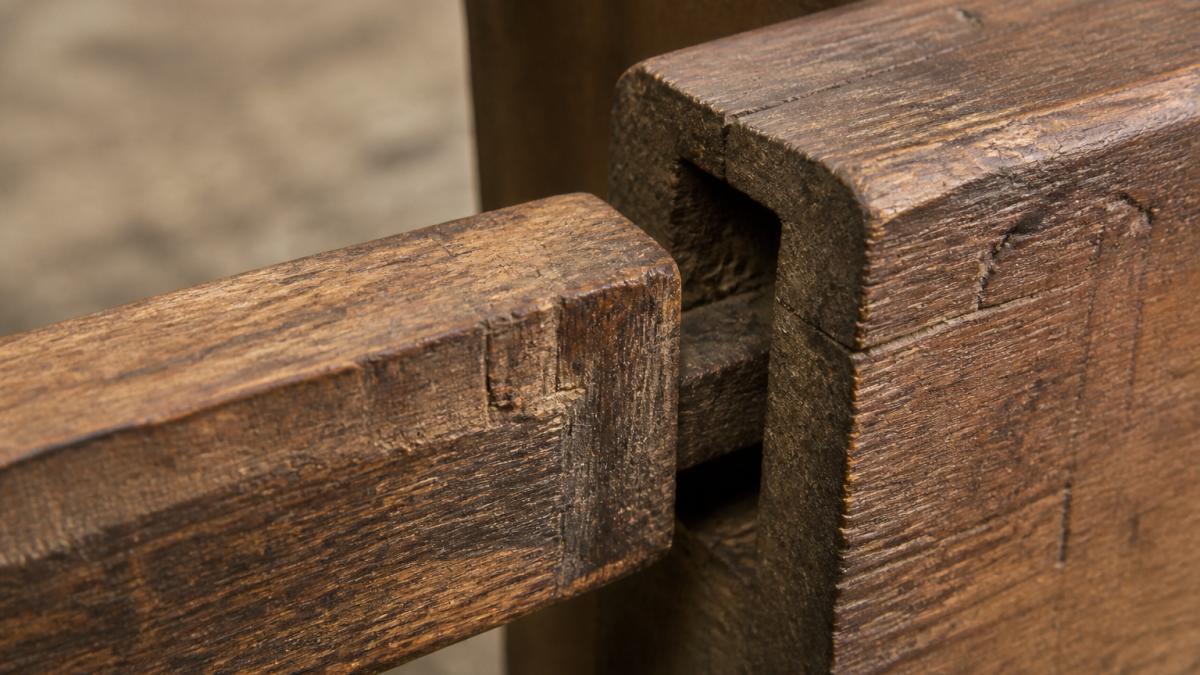
The mortise-and-tenon joint is the foundation of authentic 16th-century furniture construction. This technique involves cutting a rectangular hole (mortise) in one piece of wood and a matching projection (tenon) on another piece.
Genuine period joints show specific characteristics. The cuts are irregular because they were made by hand with saws and chisels. You'll see variation in depth, angle, and fit.
Look closely at how pieces are fastened together. Authentic work uses wooden pegs to lock mortise-and-tenon joints. These pegs are slightly tapered and often driven through the joint from the outside.
Wood Selection and Age Assessment
The wood itself provides documentary evidence. Genuine 16th-century pieces use primary woods available in their region during that time. Oak was dominant in Northern Europe. Walnut became increasingly popular as the century progressed.
Examine the wood grain under good light. Aged wood shows a patina that develops over centuries, a subtle darkening and mellowing that cannot be rushed. The color is never uniform.
Watch out: modern staining and finishing techniques can mimic aged wood deceptively well. Run your hand across the surface. Genuine aged wood feels smooth but slightly irregular.
Examining Surface Wear, Patina, and Finish Authentication
The surface tells a story about how a piece has lived. Genuine 16th-century antiques show specific patterns of wear that accumulate only through centuries of use. Understanding these patterns helps you separate authentic pieces from artificially aged reproductions.
Distinguishing Original Finishes from Applied Aging
Original finishes on 16th-century furniture were typically oil, wax, or natural lacquer. These finishes developed character over time, darkening and becoming more complex.
Modern aging techniques cannot replicate this authenticity. Artificial patinas look uniform and applied. Real patina shows natural variation. It's deeper in crevices and carved areas where dust and oils accumulated.
Run your fingers along carved details. Genuine aged finishes have been worn smooth by centuries of dust and handling. Modern reproductions show crisp edges on carving because the finish hasn't worn away. The difference becomes obvious once you feel it.
Checking Backs, Undersides, and Hidden Surfaces
This is where reproduction work often fails. Collectors frequently examine the front and sides of a piece but neglect hidden areas. Genuine 16th-century work shows consistent construction throughout, even where nobody sees it.
Look at the back of a piece. On authentic work, the back shows the same construction techniques as the front. The wood is the same age.
Examine the underside of tables, chairs, and chests. Genuine period work shows wood that has aged naturally.
How to Spot Fake Antique Furniture and Modern Reproductions
The antique market includes many well-made reproductions. Some are deliberately deceptive. Others are honest reproductions but misrepresented as period pieces. Learning to distinguish them protects your investment.
Identifying Plywood and Modern Materials
Plywood didn't exist in the 16th century. Finding plywood in a piece claiming to be from that era is definitive proof of modern manufacture. Check the edges of panels and boards.
Antique Books, Law 1664, Dutch Corvinus DIGEST Aphorisms Roman Jurisprudence!! →
Modern nails and screws are another red flag. Genuine 16th-century work uses wooden pegs or hand-forged iron nails. Machine-made nails, with their uniform size and perfect symmetry, didn't exist during this period. Hand-forged nails show irregularities.
Watch out: some reproduction makers deliberately use old techniques to deceive buyers. Examine the nails closely. Even hand-forged reproductions show subtle differences from period nails.
Recognizing Historicist Reproductions from Later Periods
The 19th century saw a revival of Renaissance and medieval styles. Historicist furniture reproduced 16th-century designs but with 19th-century construction methods and materials. These pieces can be valuable antiques themselves, but they're not 16th-century originals.
Historicist work often shows exaggerated carving. Makers of the 1800s pushed decorative elements further than 16th-century craftsmen typically did. The proportions feel slightly off compared to genuine period work. Carving appears more uniform and machine-assisted.
The wood in historicist pieces shows different aging patterns. It hasn't had 400+ years to develop patina. The color is often too uniform.
Using Antique Provenance and Authentication Records
Documentation transforms a beautiful old piece into a historically significant artifact. Provenance, the ownership history of an object, adds credibility and value to your purchase.
Evaluating Ownership History and Documentation
Genuine provenance includes names, dates, and places. It traces the piece's journey from creation through subsequent owners. The best provenance includes contemporary documentation: bills of sale, auction records, museum catalogs, or published references.
Each documented owner adds credibility. A piece that appears in a 1920s auction catalog carries more weight than one with no documentation. Museum deaccessioning records provide strong provenance.
Gaps in provenance don't necessarily indicate problems. Many pieces changed hands privately without formal documentation. What matters is whether the documented history is consistent and verifiable.
Maker's Marks, Signatures, and Stamps
Some 16th-century craftsmen marked their work with stamps, signatures, or maker's marks. These identifying marks add significant value and authenticity. However, most 16th-century pieces bear no maker's mark.
Marks that do appear show specific characteristics. Genuine maker's marks are often subtle, small stamps or carved initials. They appear in logical locations like the back of a panel or the underside of a piece.
Research the mark if you find one. Documented makers from the 16th century are cataloged in scholarly references. A mark that doesn't appear in any historical record suggests modern fabrication.
A Practical 16th-Century Authentication Checklist
Use this systematic approach when evaluating a piece claiming to be genuine 16th-century work:
- Wood Type: Identify oak, walnut, or chestnut. Check for regional appropriateness. Examine grain patterns for natural aging.
- Joinery: Look for mortise-and-tenon joints. Check for wooden pegs. Verify hand-cut characteristics with visible irregularities.
- Carving: Assess depth and confidence of cuts. Look for tool marks from hand chisels. Verify design consistency with period style.
- Finish: Examine patina for natural aging patterns. Check for wear consistent with centuries of use. Verify original finish characteristics.
- Hidden Areas: Inspect backs and undersides. Verify consistent construction throughout. Look for aged wood and natural dust accumulation.
- Materials: Rule out plywood and modern materials. Check for hand-forged nails or wooden pegs. Verify absence of machine-made fasteners.
- Design: Confirm period-appropriate style elements. Check for regional consistency. Verify proportions match documented examples.
- Provenance: Research ownership history. Verify documented references. Check for museum or auction records.
- Maker's Mark: Research any marks found. Verify against historical databases. Note absence as normal for most pieces.
This checklist provides a framework for systematic evaluation. No single indicator proves authenticity. Genuine pieces show consistency across multiple factors. Reproductions typically fail several checks.
Verifying Your 16th Century Antique Purchase
Before committing to a purchase, take time for thorough verification. Genuine 16th-century pieces represent significant investments. They deserve careful evaluation.
Request detailed photographs showing construction details, joints, and undersides. Ask about provenance documentation. Reputable dealers provide this information willingly.
Consider professional appraisal for significant purchases. Certified antique appraisers have examined hundreds of pieces.
Handle the piece if possible. Genuine 16th-century antiques have a tactile quality that photographs cannot convey.
Examine pieces like Antique Oil Paintings, Portraits, (2) French Noble Females, 16th / 17 Century subject matter!! that Old Europe Antique Home Furnishings offers.

When evaluating authenticity, remember that genuine 16th-century pieces show the accumulated evidence of centuries.
Frequently Asked Questions
How can you tell if an antique is genuinely from the 16th century?
Examine multiple factors together: hand-cut joinery with visible saw marks, wood species appropriate to the period, natural patina and wear consistent with 500 years of age, period-appropriate design elements, and documented provenance. No single feature proves authenticity, genuine 16th century antiques show a combination of construction methods, material choices, and aging patterns that reproductions struggle to replicate convincingly. Check undersides and hidden surfaces where reproduction makers often cut corners.
What construction details help identify 16th-century furniture?
Look for mortise-and-tenon joints rather than nails or screws, hand-planed wood surfaces with subtle irregularities, wood grain patterns consistent with period sawing techniques, and carving or decoration executed with hand tools. 16th-century furniture lacks the uniform precision of machine-made pieces. Inside rails, drawer bottoms, and underside surfaces reveal authentic construction, these areas show original tool marks, wood shrinkage patterns, and aging that modern reproductions cannot accurately simulate.
How can you distinguish an original antique from a reproduction?
Original 16th-century antiques display natural patina that has developed gradually over centuries, while reproductions often have artificially aged surfaces. Check for plywood or modern materials like particle board, which did not exist in the 16th century. Examine joints for machine-made uniformity versus hand-cut irregularities. Genuine antiques show uneven wear patterns matching their use history, while reproductions typically display uniform aging. Inspect gilding, paint, and finishes, authentic pieces show layered aging and wear consistent with centuries of handling and environmental exposure.
Does an antique need a signature or maker's mark to be authentic?
No. Most 16th-century antiques lack signatures or maker's marks. Artisans from that period rarely signed their work, particularly on furniture. Maker's marks, stamps, or signatures increase value when present and documented, but their absence does not indicate a piece is inauthentic. Focus instead on construction methods, materials, design consistency, and provenance. If marks are present, verify them against known maker records and period documentation. Beware of marks that appear artificially added or inconsistent with period metalworking techniques.
Authenticating 16th-century antiques requires patience and systematic observation. The pieces you acquire become part of your home's history. Old Europe Antique Home Furnishings curates authentic European antiques that reward careful study. Our showroom invites you to examine genuine period work firsthand, where you can apply these authentication principles to real pieces. SHOP NOW!
