


Where Can You Find Authentic Antique Furniture Online?
Last Updated: November 2, 2026
Quick Summary
Authentic antique furniture is found through specialist dealers, curated collections, estate and auction channels, and general marketplaces, though each shifts different verification work onto the buyer. Before buying, examine joinery, wear and hardware, ask for photos of the underside and drawers, and request documented provenance.
- Specialist sellers usually give more detailed age, origin and condition notes than general marketplaces.
- Hand-cut dovetails and irregular pin spacing are generally more consistent with earlier handwork.
- Ask sellers for photos of the underside, drawer interiors, joinery and any repairs before buying.
- Build a landed-cost estimate covering freight, insurance, restoration and return shipping before comparing prices.
- Never rely on a verbal assurance; get return terms and condition notes in writing.
Table of Contents
- Why Access to Historical Home Furnishings Is Harder Than It Looks
- Where to Buy Vintage and Antique Furniture Online
- How to Identify Antique Furniture Before You Buy
- Antique Furniture Buying Guide: Price, Shipping, Returns and Buyer Protection
- Mixing Antique and Modern Furniture in a Real Home
- Caring for Antique Wood Furniture and Protecting Its Value
- Booking Your Next Piece: Visit the Showroom or Shop the Catalog
- Frequently Asked Questions
Why Access to Historical Home Furnishings Is Harder Than It Looks
Finding authentic antique furniture online is harder than a quick search suggests. Many listings use words like "antique," "vintage," and "period style" interchangeably, and a photograph rarely shows what a buyer most needs to know. Buyers often arrive wanting genuine historical craftsmanship and leave uncertain whether they got it.
Most of the difficulty comes down to three gaps. The first is authenticity: a high-quality reproduction can look convincing in photos. The second is condition: wear that is normal for a 100-year-old cabinet can look like damage in a thumbnail, or hide real structural problems. The third is provenance, the documented history that tells you where a piece has been.
The good news is that these gaps can be managed. The rest of this guide explains where to look, how to read a listing, and what to check before you commit.
Where to Buy Vintage and Antique Furniture Online
Online antique shopping ranges from large general marketplaces to small specialist dealers, and the two behave very differently. Specialist sellers and curated collections can be useful sources, since the seller has often already made judgments about age, origin and condition. But the source you choose also determines how much verification work falls on you, so it helps to map the landscape before you start clicking.
The Four Source Types and What Each One Costs You
General marketplaces. Broad platforms offer enormous selection and frequently low prices, but the burden of verification falls almost entirely on you.
Curated specialist sellers. Specialist sellers typically narrow the field.
Pre-owned luxury and estate channels. Estate-sourced items often arrive with a story, though the story itself is not proof of authenticity.
Local and regional listings. Local marketplaces and classifieds are where rare pieces sometimes appear at the lowest prices, because the seller is optimizing for a quick pickup rather than a national audience.
A practical rule: the more specific a seller is about age, origin and condition, the easier it is to evaluate their listing.
A Search Strategy for Rare and Hard-to-Find Pieces
- Search by construction and period vocabulary, not just the category. Terms like "hand-cut dovetail," "period" plus a specific era, "case piece," "commode," "marquetry," or a named wood such as walnut or mahogany surface listings that generic "antique cabinet" searches bury.
- Save searches and turn on alerts. Set saved searches on the platforms you use and let notifications do the scanning. Check alerts on a schedule rather than refreshing listings all day.
- Search misspellings and regional terms. Sellers sometimes list a piece under a term you would not use, so try alternate spellings and older trade words.
- Ask sellers a short, specific question set. A message that asks for photos of the underside, drawer interiors, joinery and any repairs, plus the piece's documented history, filters out sellers who cannot answer and surfaces the ones who can.
- Keep a short list of specialist dealers and ask to be notified. Many dealers will contact repeat buyers when a piece in their area of focus arrives.
Pre-Owned Luxury Sources and Estate Pieces
Pre-owned luxury furniture and estate pieces can offer value, but they require more homework. Estate-sourced items often arrive with a story, though the story itself is not proof of authenticity. Ask what the seller knows about the piece's history and whether that knowledge is documented or simply remembered. When a piece is sold as part of an estate, request the condition report, any appraisal on file, and clear photographs of damage. Those three items tell you more than the provenance narrative alone.
The four source types differ in how much verification falls on the buyer, and the article lays out what each one costs you.
| Source type | Main benefit | Trade-off |
|---|---|---|
| General marketplaces | Enormous selection, often low prices | Buyer carries most verification work |
| Curated specialist sellers | Detailed age, origin and condition notes | Narrower inventory, often firmer pricing |
| Pre-owned luxury and estate channels | Exceptional pieces with a history | Condition reports vary; premiums and shipping change the math |
| Local and regional listings | Lowest prices on rare pieces | Usually requires in-person inspection and own transport |
How to Identify Antique Furniture Before You Buy
Identifying antique furniture comes down to examining construction rather than trusting the label. Look at how the piece is joined, how the surfaces show wear, and whether the hardware matches the period it claims to represent.
Start with joinery. Genuine age shows softened edges, polish worn where hands would naturally touch, and aging in places a dealer could not easily fake. Signs of high-quality antique craftsmanship lists more concrete markers to check on a piece before you buy.
Be cautious of signs that a piece has been heavily refinished or altered. Mismatched screws, new glue residue in hidden joints and drawer runners that look too uniform can all indicate later work.
Ask for the seller's documentation on provenance. Understanding provenance in antique collecting explains how documented ownership history serves as evidence of authenticity. Written records of prior ownership, auction history or a dealer's appraisal carry far more weight than a verbal assurance.
Bombe Commode, Venetian, Parcel Gilt, Paint-decorated, Vintage / Antique! →
Antique Furniture Buying Guide: Price, Shipping, Returns and Buyer Protection
The sticker price is rarely the full cost of an antique. Before you buy, build a landed-cost estimate: the item price, delivery or freight, packing, insurance, any restoration you expect to need, and the cost of returning the piece if it does not match its description. Large pieces such as a cabinet or sideboard can be expensive to ship, so confirm whether delivery is included or quoted separately, and ask whether the quote covers inside delivery or curbside drop-off only.
Building a Landed-Cost Estimate
A simple worksheet keeps the numbers honest:
- Item price as listed, before any negotiation.
- Freight or delivery quoted for your address and access type (stairs, elevator, narrow doorway).
- Packing and crating if the seller or shipper charges separately.
- Transit insurance, confirm the declared value and who holds the policy.
- Restoration or repair you expect after arrival.
- Return shipping if the piece is not as described.
Add those lines before you compare two pieces. A lower sticker price with uncrated freight and no insurance can cost more than a higher-priced piece with delivery included.
Shipping, Insurance and Access
Ask the seller who arranges shipping and who is responsible until the piece is in your room. Confirm the declared value on the insurance and keep the tracking and condition photos. Measure doorways, stairwells and turns before the piece ships; a delivery that cannot get inside is a return, not a delivery. For heavy case pieces, ask whether the carrier provides two-person inside delivery and whether the seller will note any pre-existing damage on the bill of lading.
Returns and Buyer Protection
Read the return policy before purchasing. Antique furniture is often sold with the notation that some wear and imperfections are expected given age and use. A return policy should explain what happens if a piece arrives damaged in transit, and whether a piece that does not match its description can be sent back.
For buyer protection, keep every listing, photograph and written communication. If a dispute arises, a complete record makes it far easier to resolve. Where payment is made through a platform, understand what that platform's own protections cover, and pay by a method that leaves a trace.
The cheapest antique is the one you can verify, insure and return. Build the landed cost, confirm the paperwork, and keep the record.
Mixing Antique and Modern Furniture in a Real Home
Antique pieces work best when they are given room to breathe. A carved walnut cabinet or a Venetian commode can anchor a contemporary room when surrounded by clean lines, neutral textiles and fewer competing objects. The contrast between old craftsmanship and modern simplicity is often what makes both look better.
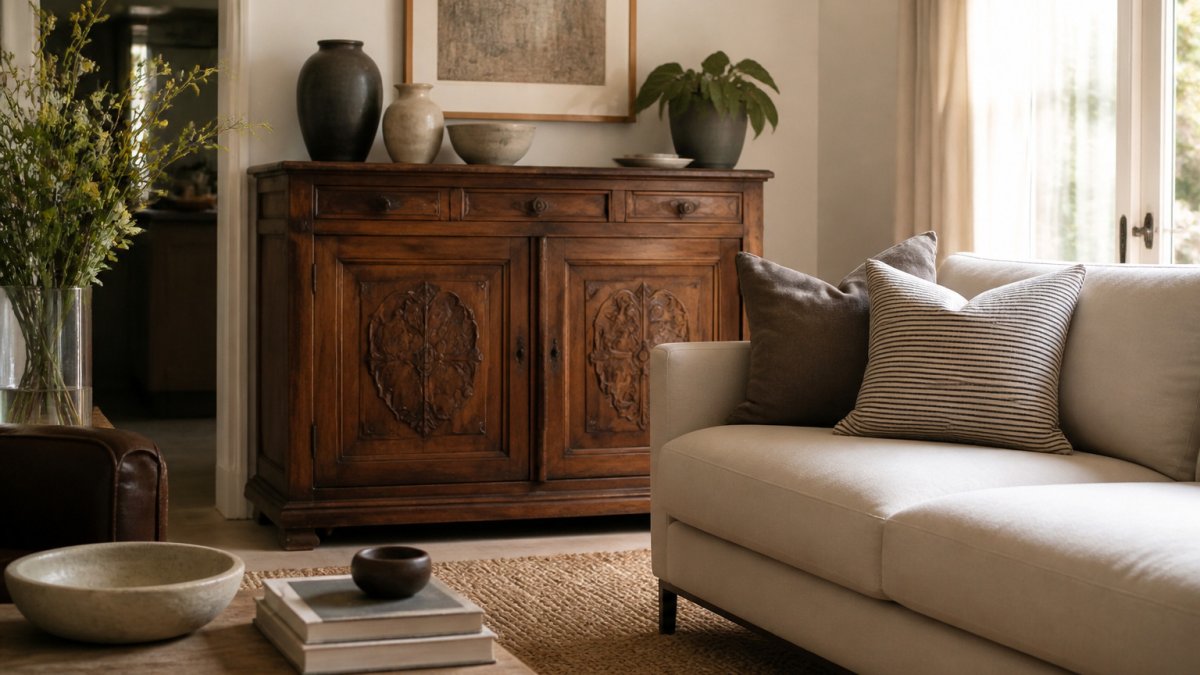
Scale matters as much as style. A tall antique cabinet can dominate a small room, so measure both the piece and the space before committing. Balance heavy, ornate pieces with lighter modern furniture, and repeat a color or material somewhere else in the room so the old and new feel connected rather than accidental.
Caring for Antique Wood Furniture and Protecting Its Value
Caring for antique wood furniture is mostly about restraint. Keep pieces away from direct sunlight, radiators and rapid changes in humidity, since these can crack finishes and warp wood. Dust gently with a soft cloth, and avoid harsh household cleaners that can strip patina.
Preserving a piece's value means preserving its original character. Resist the urge to refinish a surface, because removing old finish can reduce both the historical integrity and the market value of a piece. If repair is needed, consult a qualified conservator, particularly for veneer, marquetry or gilded details.
Booking Your Next Piece: Visit the Showroom or Shop the Catalog
Buying antique furniture online is convenient, but some buyers prefer to see a piece in person before deciding. If you are in the Austin area, you can visit our showroom by appointment to examine pieces up close. You can also shop our catalog online.
Whichever route you choose, the goal is the same: a piece you can verify, understand and live with for decades. Browse our current antique cabinets and commodes for period pieces with detailed condition notes, or read our buying guide for antique furniture before you make your decision.
Frequently Asked Questions
Where can I find authentic antique and vintage furniture?
Look for specialist antique dealers that publish provenance details, dimensions and clear condition notes for each piece. Curated sellers often list European antiques with approximate measurements and descriptions of wear, which makes it easier to judge authenticity before buying. General marketplaces can work too, but they require more checking: ask the seller for close-up photos of joinery, hardware and underside markings, and compare the listing against the way the piece is described. Estate sales and auctions are other options, though they usually offer less buyer protection.
How can I tell whether a piece of furniture is genuinely antique?
Start with construction. Hand-cut dovetails, irregular saw marks, wooden pegs and screws with uneven slots point to earlier manufacture, while machine-cut joints and uniform hardware usually indicate later work. Check wear in logical places, such as the edges of drawer fronts, the feet and the inside of doors, rather than only on the top surface. Ask for dimensions and the seller's description of age; a reputable dealer will explain any restoration or replacement parts. Where a claim about age matters to your purchase, request written documentation before you pay.
What is the difference between antique and vintage furniture?
Antique furniture is generally at least 100 years old, while vintage furniture is typically from a more recent period, often 20 to 99 years old, depending on who is using the term. The distinction matters for value and for how a piece is described. Many sellers use both words loosely, so ask for a specific date range or a description of the period style, such as a 1900s French neoclassical cabinet, rather than relying on the label alone.
How do I choose vintage furniture that works with my existing decor?
Begin with scale and finish. Measure the wall or floor space where the piece will sit, and choose wood tones that echo at least one other element in the room, such as a door frame, a rug or a light fixture. A walnut or rosewood cabinet with marquetry can anchor a space that already has clean modern lines, provided the surrounding colors are neutral enough to let the piece stand out.
