


Signs of High Quality Antique Craftsmanship
Table of Contents
- How to Assess Overall Antique Craftsmanship Quality
- Solid Wood Versus Veneer Construction
- How to Tell If Antique Furniture Is High Quality Through Joinery
- Antique Furniture Construction Methods: Handmade Versus Machine-Made
- Patina, Natural Wear, and Authentic Age Signs
- How to Spot Fake Antique Furniture
- Structural Soundness and Stability Inspection
- A Room-by-Room Inspection Checklist for Antique Furniture
- Frequently Asked Questions
Last Updated: October 12, 2026
How to Assess Overall Antique Craftsmanship Quality
The difference between a well-made antique and a mass-produced piece comes down to intentionality. Old Europe Antique Home Furnishings has spent decades sourcing European antiques, and the best pieces share unmistakable signs of skilled hands and careful construction.
Antique craftsmanship isn't just about age, a piece can be old and still poorly made. What matters is whether the maker invested time, skill, and care into every detail, visible in the joints, wood grain, hardware, and wear patterns.
The Difference Between Age, Condition, and Craftsmanship
These three factors often get confused, but they're separate.
Age is how long ago the piece was made. Age alone doesn't determine value or quality.
Condition is the current state. It affects price and usability, but not how well the piece was originally made.
Craftsmanship is the quality of the original construction, what you're really evaluating. A poorly made piece from 1750 is still poorly made; a beautifully crafted piece from 1900 is still beautifully crafted.
The best antiques combine all three, but craftsmanship separates a museum-quality piece from a curiosity.
Solid Wood Versus Veneer Construction
Open any drawer and look at the sides and bottom.
Solid wood means the entire piece is made from one type of wood throughout, with grain running consistently and edges matching the surfaces.
Veneer is a thin layer of quality wood glued to a cheaper base.
Check thickness: solid wood drawer bottoms are typically 0.5 to 1 inch thick, veneered bottoms often just 0.25 inches.
Quality makers used veneer deliberately, choosing specific grain patterns and applying it evenly with no bubbles or separation. Poor-quality pieces show uneven veneer, gaps, or lifting.
How to Tell If Antique Furniture Is High Quality Through Joinery
The joints are where craftsmanship becomes undeniable.
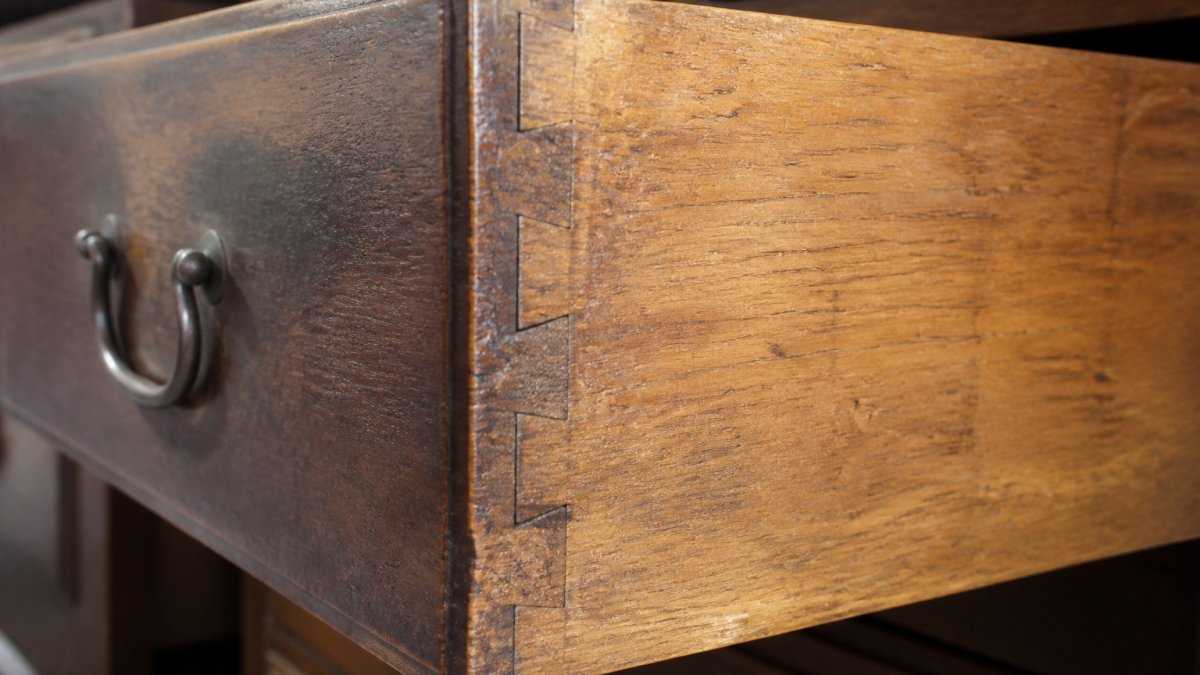
Dovetail Joints and Hand-Cut Marks
Dovetail joints are the gold standard, connecting drawer sides to the front and back with interlocking angled cuts.
Hand-cut dovetails are instantly recognizable: each is slightly different, angles vary, spacing isn't uniform, and you'll see saw marks. The fit is snug but not machine-perfect.
On hand-cut dovetails, the pins (protruding parts) are often thicker than the tails (recessed parts), which distributes stress better; machine-cut ones are perfectly balanced. Hand-cut pieces often have fewer, larger dovetails, since more dovetails take more time by hand.
Mortise and Tenon Joinery
Mortise and tenon joints connect legs to rails and other frame pieces: a mortise is a rectangular hole, a tenon a rectangular projection that fits into it.
Hand-cut mortises are slightly irregular, a bit wider on one end, sides not perfectly parallel, which is a sign of hand work. Machine-cut mortises are perfectly rectangular and identical.
On quality antiques, the tenon slides in smoothly but requires pressure, with no gap; poor-quality pieces have a loose fit or a shaved-down tenon.
Antique Furniture Construction Methods: Handmade Versus Machine-Made
Construction method reveals when a piece was made and how much skill went into it.
Hand-Carved Details and Soft Edges
Hand-carved details are unmistakable once you know what to look for.
Depth variation shows handwork: a hand carver naturally varies depth, so one side of a leaf might be deeper, and the background slightly uneven.
Tool marks are visible on close inspection, small gouges and lines consistent with the tool used, following the design rather than random.
Repetition without perfection is key: on a handmade piece, each element in a repeating pattern is slightly different; on machine-made pieces, they're identical.
Look at the undercuts, where carving goes deeper than the surrounding surface.
Machine-Made Construction Clues
Machine tools became common in furniture making around 1880 to 1920, depending on region and workshop.
Perfect uniformity is the biggest clue: identical spindles, precisely replicated carvings, and perfectly straight grain alignment in veneers all suggest machine work, since hand-cut veneer varies slightly in thickness and alignment.
Nail holes tell a story: hand-forged nails are irregular, so the holes are too, while machine-made nails and their holes are perfectly uniform.
Stenciled or printed details instead of hand-carved ones indicate machine production, hand painters varied slightly, while machine stenciling creates perfect repetition.
Patina, Natural Wear, and Authentic Age Signs
Patina is the color, texture, and finish that develops over decades or centuries. Real patina cannot be rushed or faked convincingly.
Surface Imperfections and Wood Grain Patterns
Color changes happen naturally: wood exposed to light gradually darkens, so a drawer front that was always exposed looks different from the interior that stayed dark.
Antique Cupboard, French Renaissance Revival, Carved Oak, Shelf, Drawers, 1800s →
Dents and dings accumulate randomly, not concentrated in one area or following a pattern, unlike artificial distressing.
Patinated bronze hardware shows authentic age: real bronze develops an uneven green or brown patina, thicker in crevices and lighter on high points, while fake patina is often uniform.
Distinguishing Authentic Wear From Artificial Distressing
This is where many reproductions fail.
Artificial distressing is often obvious: concentrated on edges, uniform around the piece, and not matching the piece's function.
Check the finish underneath. Authentic wear leaves the original finish visible in layers beneath worn areas; artificial distressing cuts through the finish unevenly, sometimes too deep, sometimes not deep enough.
Look at the grain exposure. Authentic wear exposes grain gradually; artificial distressing exposes it suddenly and too uniformly.
Feel the edges. Authentic wear creates smooth, rounded edges; artificial distressing leaves sharp edges where the damage stops abruptly.
How to Spot Fake Antique Furniture
Some reproductions are honest; others are deliberately misrepresented as authentic antiques. Here's how to tell the difference.
Hardware, Nails, and Screws as Authenticity Markers
Hardware is one of the easiest ways to verify age, since fasteners changed dramatically over time.
Screws changed too: hand-made screws from the 1700s and early 1800s have irregular slots, uneven threads, and off-center heads, while machine-made screws from the mid-1800s onward are perfectly centered and regular.
Brass hardware on genuine antiques shows authentic patina that darkens unevenly and wears where polished; fake brass is often too bright or too uniform.
Maker's Marks, Labels, and Signatures
Authentic antiques often carry marks from the maker.
Branded marks on the underside or back are irregular, with slightly uneven letters and varying depth. Paper labels on the underside identify the maker or retailer and are aged, yellowed, and brittle with period-appropriate printing. Carved signatures on some handmade pieces are irregular and personal. Stenciled marks on factory-made pieces are uniform and perfectly executed, indicating machine production.
Authentic maker's marks are usually hidden on the underside, back, or inside; marks placed prominently on the front are often added later. Look for multiple marks, a piece might have the original maker's mark plus a retailer's label, indicating a real history.
Structural Soundness and Stability Inspection
Age doesn't mean weakness. Well-made antiques are structurally sound; poor-quality ones fall apart.
Test the joints by gently applying pressure, a solid joint doesn't move, while a loose joint clicks or shifts.
Check for woodworm or insect damage: a few pin-head-sized holes are normal in old wood, but extensive holes suggest active infestation.
Inspect the finish for lifting or peeling, which means the piece needs restoration, not that it's low quality.
Test stability on a level surface: a slight rock is normal and adjustable, but significant rocking indicates structural issues.
A Room-by-Room Inspection Checklist for Antique Furniture
Use this checklist when evaluating pieces.
Dining Room and Seating Pieces
Dining tables:
- Check the top for solid wood or veneer
- Inspect the underside for hand-cut joinery
- Look for maker's marks or labels
- Test stability by pressing down on corners
- Examine the legs for hand-carved details or machine marks
- Check for authentic wear on the top surface
- Verify hardware is period-appropriate

- Examine the back for hand-carved details
- Check the seat frame joints for dovetails or mortise-and-tenon construction
- Look for hand-woven rush or original upholstery
- Test the frame for stability by twisting
- Check the legs for hand-turned details
- Inspect the underside for maker's marks
- Verify all joints are tight and secure
Sideboards and servers:
- Check drawer construction for hand-cut dovetails
- Inspect the doors for solid wood or veneer
- Look for hand-carved decorative elements
- Test hardware for authenticity
- Examine the base for hand-turned or carved details
- Check structural soundness by applying gentle pressure
Bedroom and Storage Furniture
Dressers:
- Check drawer construction and joinery
- Inspect the top for authentic wear patterns
- Look for maker's marks on the underside
- Test drawer slides for smooth operation
- Examine hardware for period-appropriate design
- Check the back panel for construction clues
- Verify all drawers are structurally sound
Wardrobes and armoires:
- Check the doors for solid wood or veneer
- Inspect interior shelving and hardware
- Look for hand-carved decorative elements
- Test the door hinges for authenticity and function
- Examine the base for hand-turned details
- Check for maker's marks or labels
- Verify structural stability
Beds:
- Inspect the frame joints for hand-cut construction
- Check the headboard for hand-carved details
- Look for maker's marks on the frame
- Test the structural integrity of the frame
- Examine the rails and posts for hand-turned details
- Verify hardware is period-appropriate
- Check for authentic wear
When evaluating antique furniture, remember that craftsmanship tells the real story. Age matters, but quality matters more, and the best pieces combine authentic age with excellent construction and good condition. At Old Europe Antique Home Furnishings, we focus on pieces that meet all three criteria. Our curated selection of European antiques, including pieces like the Antique Cupboard, French Renaissance Revival, Carved Oak and the Antique French Breton Dining Chairs, showcases the hand-cut joinery, solid wood construction, and authentic wear patterns that define genuine antique craftsmanship.

Frequently Asked Questions
What are the key signs of high quality antique craftsmanship?
High quality antique craftsmanship shows itself through hand-cut joinery like dovetail joints with visible tool marks, solid wood construction without veneer, hand-carved details with soft edges, and authentic patina with natural wear patterns. Look for maker's marks or labels, original hardware with period-appropriate nails or screws, and structural soundness. The Antique French Breton Dining Chairs from Old Europe exemplify this, featuring deeply carved figural back panels and handwoven rush seats that reflect genuine 1900s craftsmanship.
How can you tell if antique furniture is authentic or a reproduction?
Authentic antique furniture shows uneven hand-cut joinery, period-correct hardware, natural patina with soft edges and surface imperfections, and maker's marks or labels. Reproductions have uniform machine-made joints, modern fasteners, artificial distressing that looks uniform, and no authentic wear patterns. Examine the wood grain, check for inconsistent aging, and inspect hardware closely. When in doubt, request documentation or certificates of authenticity from reputable dealers like Old Europe Antique Home Furnishings.
What's the difference between solid wood and veneer in antique furniture construction?
Solid wood construction means the entire piece is made from one type of wood throughout, while veneer involves a thin layer of quality wood glued over a cheaper wood base. High quality antique pieces typically use solid wood for structural elements like frames and legs, though veneer on surfaces was common in fine furniture from the 1800s onward. You can identify veneer by checking the edges of panels and looking for grain patterns that don't match the underlying wood. The Antique Desk from Old Europe features burled walnut with ormolu mounting, showcasing quality veneer work combined with solid construction.
How do I know if an antique piece will hold its value?
Pieces with documented provenance, exceptional craftsmanship, solid construction, and historical significance tend to hold value. Look for maker's marks, original condition with minimal restoration, and authenticity verified by reputable dealers. Craftsmanship quality, shown through hand joinery, hand-carved details, and quality materials, matters more than age alone. Pieces from recognized makers or specific historical periods command higher prices. Request documentation and appraisals from specialists. Old Europe Antique Home Furnishings provides expertly sourced pieces with historical context, helping ensure you're investing in genuine quality.