


Investing in Antique Italian Baroque Writing Desks
Last Updated: November 25, 2026
Quick Summary
Investing in antique Italian Baroque writing desks works because scarce period craftsmanship, finite supply and steady collector demand keep values supported. Originality and provenance often move value more than age alone, so a documented desk with an original surface can outperform an undocumented earlier piece.
- Baroque is heavy, symmetrical and architectural, while Rococo is lighter and built around asymmetric curves.
- A 19th-century revival can be genuinely old yet should be priced as a revival, not a period piece.
- An insurance appraisal reflects replacement cost, which runs higher than fair market value.
- Compare at least three recent realized sales, not asking prices, before treating a listing as evidence of value.
- Budget for shipping, insurance and import costs as part of your total basis, not an afterthought.
Table of Contents
- Why Antique Italian Baroque Writing Desks Hold Their Value
- Italian Baroque Furniture Characteristics That Signal Quality
- How to Identify Antique Furniture and Spot Later Revivals
- Provenance, Regional Origins, and Authenticity Checks
- Antique Desk Appraisal: What Drives Market Value
- Condition, Restoration, and Conservation Costs
- A Step-by-Step Buying and Investment Framework
- Choosing the Right Desk for Your Collection
- Frequently Asked Questions
Why Antique Italian Baroque Writing Desks Hold Their Value
Antique Italian Baroque writing desks hold their value because they combine scarce period craftsmanship with a finite supply and steady collector demand. Pieces with documented age, original surfaces, and strong carving tend to command attention from buyers who want furniture that functions as both decor and a store of value.
The antique Italian writing desk sits at a useful intersection. It is furniture you can actually use in a home office, and it is a historical object with a paper trail worth building. That dual appeal is what separates a desk from a decorative curiosity.
Below, we explain what drives value, how to spot a later revival, and how to buy without overpaying. But first, here is what most guides get wrong: they treat age as the whole story. Age is only the starting point.
Italian Baroque Furniture Characteristics That Signal Quality
Italian Baroque furniture is defined by dramatic movement: deeply carved scrollwork, curved legs, giltwood accents, and ornament meant to be seen from across a room. A genuine period piece shows carving with depth and irregularity, not the shallow, uniform cuts of machine work.
Look closely at three things. First, the gold gilt or painted finish should show wear that follows how hands and light actually touched the piece. Second, brass hardware should sit in holes that match its age, not freshly drilled. Third, the wood surface underneath should show grain that has darkened with time.
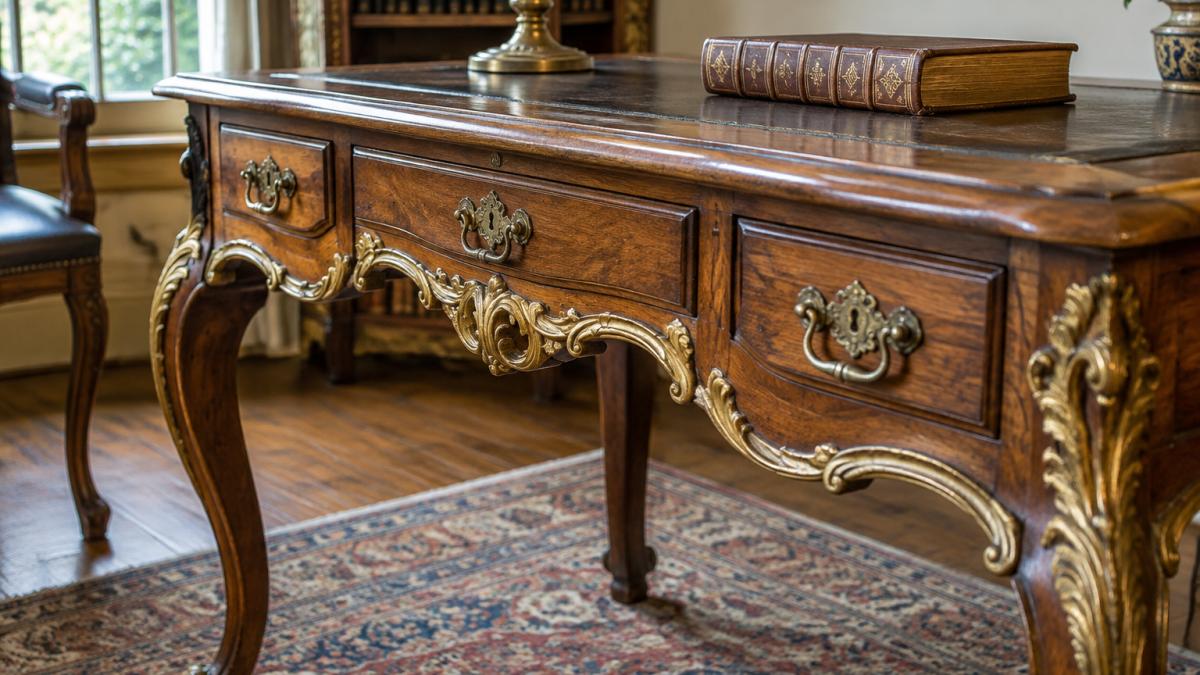
The carved decoration on authentic pieces tends to be slightly asymmetrical. That is a good sign, not a flaw. For a deeper walkthrough, see our guide on how to identify Italian Baroque furniture.
How to Identify Antique Furniture and Spot Later Revivals
Learning how to identify antique furniture comes down to construction, not decoration. Revivals copy the look of the Baroque period but usually reveal themselves in the joinery, the fasteners, and the finish.
Here is where most buyers get fooled: a 19th-century revival can be genuinely old and still not be Baroque. It may be 150 years old and worth buying, but it should be priced as a revival, not as a period piece.
Baroque Versus Rococo and 19th-Century Revival Styles
Baroque is heavy, symmetrical, and architectural. Rococo, which followed it, is lighter and more playful, built around rocaille shell forms and asymmetric curves. A 19th-century revival borrows from both but often mixes them.
A Spanish Renaissance Revival vargueno desk shows the difference clearly: it uses a fall-front case and iron mounts rather than the sweeping carved aprons of Italian Baroque work. You can see a Renaissance Revival vargueno desk as a concrete comparison point when you are weighing revival forms against true period pieces.
Provenance, Regional Origins, and Authenticity Checks
Provenance is the documented history of a piece, and it is the single strongest defense of authenticity. Regional origin matters too: Lombardy, Venice, and Tuscany each produced recognizable carving traditions.
Ask for paperwork before you fall in love with a desk. Auction records, old photographs, family inventories, and dealer receipts all help. A piece with no history is not automatically fake, but it should be priced with that uncertainty built in.
Watch out: a convincing aged finish can be applied in a workshop. Check drawer bottoms, the backs of panels, and the underside of the top, where fakers rarely bother to match the wear.
Antique Desk Appraisal: What Drives Market Value
An antique desk appraisal is not a single number. It is a range built from five factors that pull in different directions: age, region, condition, originality, and provenance. Originality and provenance often move value more than age alone, because a documented 18th-century desk with an original surface can outperform an undocumented earlier piece.
Here is how the factors actually interact in practice:
- Age sets the ceiling, not the floor. A period Baroque desk carries a premium over a 19th-century revival, but only when the other four factors support it.
- Region narrows the buyer pool. Lombard, Venetian, and Tuscan carving traditions each have dedicated collectors, and a desk from a recognized center will draw stronger bids than an unattributed regional piece of similar quality.
- Condition is the fastest value lever. Structural integrity preserves value; heavy veneer loss, replaced legs, or a collapsed carcass can cut the range sharply.
- Originality is where most negotiations turn. Original finish, original hardware, and untouched drawer bottoms raise value. Replaced brasses, a later refinish, or a rebuilt top lower it, even on a genuine period piece.
- Provenance is the multiplier. Auction records, old inventories, and dealer receipts do not just prove authenticity; they widen the buyer pool to include institutions and serious collectors.
Appraisal methods differ by purpose. An insurance appraisal typically reflects replacement cost, which runs higher than fair market value because it assumes you must buy a comparable piece on the open market.
Watch out: an asking price is not an appraisal. Dealers price to the top of the range and leave room to negotiate, so compare at least three recent sales of similar desks before you treat any listing price as evidence of value.
Market value also depends on the buyer pool. A large library desk appeals to home-office buyers, while a compact slant-front desk moves faster among collectors with limited space.
Five factors pull an appraisal range in different directions, and they do not carry equal weight.
| Factor | Effect on value | Note |
|---|---|---|
| Age | Sets the ceiling, not the floor | Period premium only when other factors support it |
| Region | Narrows the buyer pool | Lombard, Venetian, and Tuscan centers draw stronger bids |
| Condition | Fastest value lever | Structural integrity preserves value; veneer loss cuts it |
| Originality | Where most negotiations turn | Original finish and hardware raise value; later refinish lowers it |
| Provenance | The multiplier | Records widen the buyer pool to institutions and collectors |
Condition, Restoration, and Conservation Costs
Condition drives cost more than any other factor. Wear and patina are expected and often desirable; structural failure is not. Loose joints, replaced legs, and heavy veneer loss are expensive to correct.
Restoration should preserve, not erase. A sympathetic cleaning and waxing is cheap and safe. Full refinishing can strip away the very patina that proves age and protects value.
A desk with a leather top is a useful benchmark here. Studying an Empire carved desk with a leather top helps you judge what healthy, well-kept leather and wood should look like before you commit to a restoration budget.
A Step-by-Step Buying and Investment Framework
A disciplined buying process beats instinct every time, but the framework has to account for what happens after the sale, not just the negotiation. Most guides stop at the purchase price. The real investment case includes restoration, transport, insurance, and resale liquidity, and those costs are where returns are quietly lost.
Use this sequence before you make an offer:
- Confirm period and region, and price accordingly. Decide whether you are buying a period piece or a revival, and make sure the asking price reflects that distinction. A 19th-century revival can be a fine purchase, but it should not carry a Baroque premium.
- Inspect construction, not decoration. Photograph the joinery, the hardware, and the underside of the top. Look for fastener types, tool marks, and wear patterns that match the claimed age.
- Request provenance and any prior appraisal. Auction records, old photographs, family inventories, and dealer receipts all support authenticity and widen the resale buyer pool.
- Get a restoration quote before negotiating. Loose joints, replaced legs, and veneer loss are expensive to correct, and a quote gives you a concrete number to subtract from the asking price.
- Compare at least three recent sales. Use realized prices, not asking prices, to build a defensible value range.
- Budget for shipping, insurance, and any applicable import costs. Large antique furniture requires crating, specialty carriers, and transit insurance, and those costs should be part of your total basis, not an afterthought.
- Set your walk-away price in advance. Write it down before you see the desk in person, because a dramatic piece in a well-lit showroom is designed to move that number.
Watch out: restoration that erases patina can destroy the very evidence that proves age, so a cheap refinish is often the most expensive mistake in the transaction.
Resale liquidity deserves its own line in the framework. These desks are not liquid assets. A period piece with strong provenance may take time to sell, while a revival desk may resell faster but at a lower multiple. Factor that friction into your expected return before you commit capital.
When you are ready to act, you can browse authentic 17th-century European wood pieces to compare real examples against your shortlist.
Choosing the Right Desk for Your Collection
The right desk depends on how you will use it. A library desk suits a dedicated study; a slant-front or fall-front form suits smaller rooms and doubles as a display piece. Scale matters as much as style.
Measure your space and your doorway before anything else. A magnificent desk that will not fit through the door is a costly mistake.
If you want a period-style reference point, you can view a Louis XV style bureau plat to see how a classic writing desk is proportioned and finished.
Finding a desk with a history you can document is often the hardest part of collecting. Old Europe Antique Home Furnishings offers a curated selection of European antiques dating back to the 16th century, with showroom viewing available by appointment. The collection includes carved walnut library tables and desks. Get started with Old Europe Antique Home Furnishings and add a piece of Old World craftsmanship to your home.
Frequently Asked Questions
How much is an antique Italian writing desk worth?
Value depends on age, region, condition, and provenance. A documented 17th- or 18th-century Baroque piece with original giltwood and carving can reach five figures, while 19th-century walnut revival desks often sit in the low thousands. At Old Europe Antique Home Furnishings, an Italian walnut trestle library desk from the 17-1800s is listed at $2,906.98, and a large 19th-century Renaissance Revival library table is $2,777.00. An antique desk appraisal from a qualified specialist confirms what a specific piece should bring.
How can you tell if a Baroque writing desk is authentic?
Look for hand-cut joinery, uneven patina in recesses, tool marks under carving, and oxidation patterns on brass hardware that match the wood's age. Original giltwood shows wear at high-touch points and flaking consistent with centuries of use. Ask for provenance documents, prior sale records, and a written condition report. Reproduction desks often use uniform finishes, machine-cut dovetails, and modern screws. A professional appraisal and documented chain of ownership remain the strongest authenticity signals before you buy.
Are antique writing desks a good investment?
They can hold value well when you buy documented, high-quality pieces in good original condition. Rarity, regional origin, and intact carving drive long-term demand, while heavily restored or unsigned revival pieces tend to appreciate slowly. Resale liquidity is thinner than for mainstream assets, so plan to hold for years and buy from a dealer who provides provenance and condition details. Treat the desk as a collectible with aesthetic value first and a financial asset second.
What should you check before buying an antique writing desk?
Inspect the wood surface for active splits, check that drawers and secret compartments open smoothly, and confirm the legs and stretcher are original rather than later replacements. Ask about wear and patina, restoration history, and any losses to leather, veneer, or finish. Request dimensions in inches and confirm shipping and insurance terms before you commit. A detailed written description protects you when buying online without seeing the piece in person.
