


6 Steps to Identify Italian Baroque Furniture
Last Updated: October 26, 2026
Quick Summary
To identify Italian Baroque furniture requires recognizing its historical period from roughly 1580 to 1780, examining ornate hand-carved details with organic scrollwork and figural elements, assessing curved sculptural legs, selective gilding, walnut materials with authentic patina, and distinguishing Italian characteristics from French, Spanish, and Northern European Baroque styles.
- Italian Baroque furniture dates from approximately 1580 to 1780 and emphasizes theatrical grandeur over Renaissance restraint.
- Authentic hand-carved details show organic variation and asymmetry, while reproductions display mechanical uniformity and artificial precision.
- Curved cabriole legs, scrollwork, and sculptural forms distinguish Italian Baroque from the more geometric French and Spanish styles.
- Walnut wood develops warm chocolate and honey tones with natural patina that cannot be artificially replicated convincingly.
- Selective parcel gilding on carved elements shows irregular wear patterns and oxidation that indicate authenticity.
Table of Contents
- Step 1: Recognize the Historical Period and Italian Baroque Context
- Step 2: Look for Ornate Carving and Elaborate Decoration
- Step 3: Examine Curved and Sculpted Legs and Scrollwork
- Step 4: Identify Gilding, Gold Leaf, and Metallic Finishes
- Step 5: Assess Materials, Especially Walnut and Wood Types
- Step 6: Distinguish Italian Baroque from French, Spanish, and Northern European Styles
- Italian Baroque Furniture Characteristics: What Sets It Apart
- How to Authenticate Italian Baroque Furniture and Spot Reproductions
- Frequently Asked Questions
To identify Italian Baroque furniture requires a systematic approach grounded in historical knowledge and visual literacy. The 6 steps to identify Italian Baroque furniture move from historical context through materials, construction, and regional distinctions.
Step 1: Recognize the Historical Period and Italian Baroque Context
Italian Baroque emerged in the late 16th century and dominated through the 18th century, representing a dramatic departure from Renaissance restraint. An Italian Baroque walnut collectors cabinet exemplifies the period's theatrical grandeur and ornamental excess. This period coincided with the Counter-Reformation, when the Catholic Church commissioned grand, emotionally expressive artwork and furnishings to inspire awe and devotion. Understanding this context is essential: Baroque furniture was designed to evoke grandeur, opulence, and theatrical drama, not the balanced harmony of Renaissance design.
Italian Baroque furniture differs fundamentally from earlier periods. Where Renaissance pieces emphasized classical proportion and symmetry, Baroque embraced exaggeration, movement, and ornamental excess. The style prioritized emotional impact over functional simplicity. Curved lines, bulging forms, and elaborate carving became hallmarks. This theatrical sensibility extended to every surface: legs, aprons, stretchers, and cornices received equal decorative attention.
The historical timeline matters for authentication. Authentic Italian Baroque furniture dates from roughly 1580 to 1780. Later pieces, 19th-century Renaissance Revival furniture or 20th-century reproductions, mimic Baroque vocabulary but lack the authentic construction methods and wear patterns of period examples.
Step 2: Look for Ornate Carving and Elaborate Decoration
Ornate carving is the visual signature of Italian Baroque furniture. Unlike Renaissance pieces, which used carving sparingly, Baroque furniture layers carved detail across every available surface. This isn't decoration applied as an afterthought, it's integral to the structure and design intent.
Authentic Italian Baroque carving exhibits specific motifs. Plant forms dominate: acanthus leaves, scrolling vines, and foliate designs appear repeatedly. Figural elements, masks, cherubs, caryatids (sculpted female figures), and allegorical representations, convey narrative and emotion. Shell forms (rocaille) and scrollwork create flowing, organic rhythms. These motifs weren't random; they carried symbolic meaning tied to classical learning and religious allegory.
The depth and quality of carving signals authenticity. Hand-carved Baroque pieces show variation in depth, asymmetry in repetition, and evidence of individual carver technique. Machine-cut reproductions display mechanical uniformity, identical depths, perfect repetition, and an artificial precision that period work never achieves. Run your hand across the surface: authentic carving feels organic, with natural irregularities. Reproductions feel uniform and sterile.
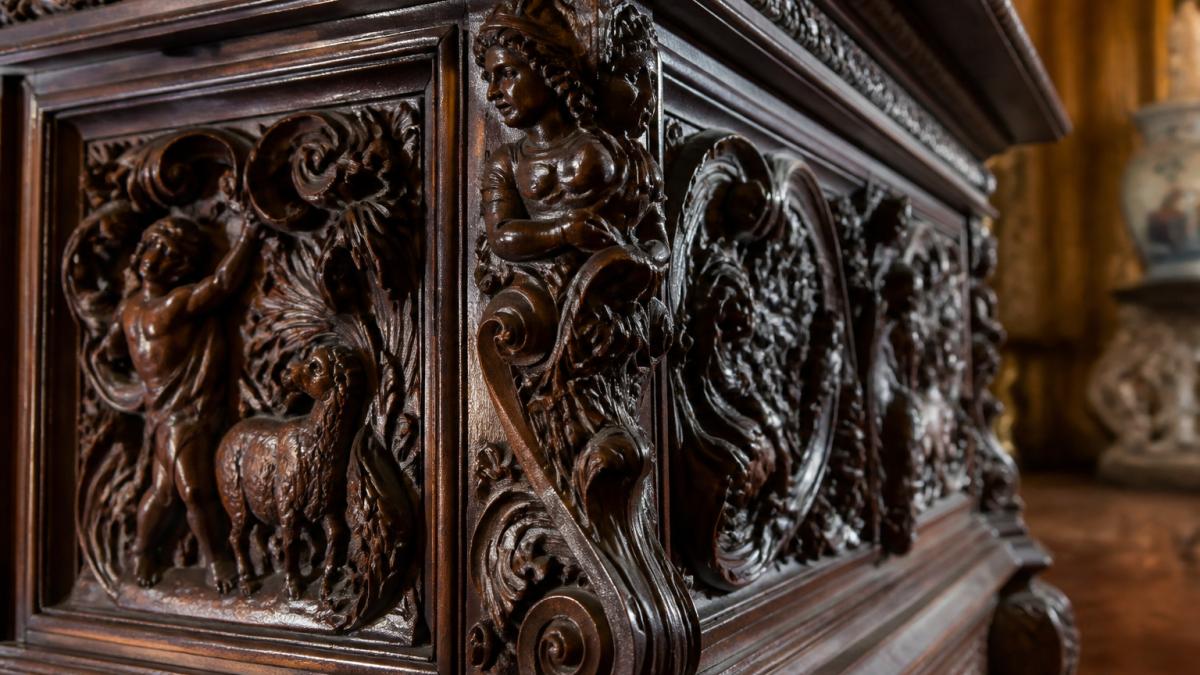
Watch out: Modern reproductions often exaggerate carving depth to appear "more Baroque," creating an artificial, almost grotesque appearance that period pieces avoid.
Step 3: Examine Curved and Sculpted Legs and Scrollwork
Legs are a primary identifier of Italian Baroque furniture. Where Renaissance legs were straight and tapered, Baroque legs curve, bulge, and scroll. This fundamental shift reflects the period's embrace of movement and organic form over geometric restraint.
Italian Baroque legs typically feature several characteristics. Curved forms, cabriole legs with S-curves, scrolled supports, and bulging silhouettes, dominate. A very nice Italian walnut gondola style chair demonstrates these curved legs and sculptural elements characteristic of the period. Legs often terminate in claw feet, paw feet, or volute (scroll) feet carved as animal or mythological references. The apron (the horizontal section connecting the legs) receives elaborate carving: scrollwork, shells, masks, and figural elements. Stretchers (horizontal braces joining the legs) are similarly ornate, not purely functional but decorative.

Scrollwork deserves specific attention. Italian Baroque scrollwork flows with organic fluidity, creating C-curves and S-curves that suggest movement and energy. These aren't rigid geometric forms, they're asymmetrical, varied, and hand-carved to appear as if growing naturally.
Compare this to French Baroque, which tends toward more geometric, symmetrical scrollwork. Spanish and Northern European Baroque employ different leg profiles and carving vocabularies. Italian pieces emphasize sculptural drama and organic curves; French pieces favor architectural geometry; Spanish pieces incorporate Moorish influences; Northern European pieces show different proportional relationships.
Step 4: Identify Gilding, Gold Leaf, and Metallic Finishes
Gilding transforms Italian Baroque furniture into objects of theatrical splendor. Gold leaf, silver leaf, and gilded metalwork catch light, creating visual drama and conveying wealth and status. Authentic Baroque pieces often combine painted finishes with selective gilding, not entire surfaces covered in gold, but strategic application to enhance carved details and create visual hierarchy.
Parcel gilding (partial gilding applied selectively to carved elements) is common in Italian Baroque. A painted ground, cream, green, or darker tones, provides contrast; gilded carving stands out against it. This technique creates visual complexity and depth. Ormolu (gilded bronze or brass) hardware, handles, lock plates, corner mounts, adds metallic accents.
Authentic gilding shows age-related wear. Gold leaf oxidizes, patinates, and wears away unevenly. Areas of heavy contact, handles, edges, show more wear. Gilding may flake, revealing the ground layer beneath. This irregular wear pattern is a hallmark of authenticity. Modern reproductions often apply uniform, pristine gilding that looks artificial and lacks historical wear patterns.
Watch out: Reproductions sometimes apply new gilding to simulate age, but the gilding is too uniform and too perfect. Authentic aged gilding shows genuine wear, loss, and oxidation that cannot be artificially replicated convincingly.
Step 5: Assess Materials, Especially Walnut and Wood Types
Material composition is critical for authentication. Italian Baroque furniture predominantly used walnut, a wood prized for its rich color, workability, and durability. An antique cabinet in Italian Baroque style walnut shows the walnut materials and construction methods of authentic period pieces. Walnut accepts carving beautifully and develops a warm patina over centuries. Oak, chestnut, and fruitwoods appear in some pieces, but walnut dominates high-quality Italian work.
Examine the wood grain, color, and patina. Walnut ages to deep chocolate and honey tones, developing surface complexity and depth. The grain structure shows natural variation. Reproductions often use lighter woods or apply stains to simulate age, the result looks artificial and lacks the organic depth of authentic aging.
Antique Trunk, Spanish Baroque Leather-Clad, Fabric Lined, Nailhead Trim →
Modern reproductions cut corners: thin veneers, machine-cut joinery, plywood backs, and uniform machine marks throughout. Inspect the underside, interior surfaces, and joints closely. Authentic pieces show individual carver and craftsperson variation; reproductions show industrial uniformity.
Step 6: Distinguish Italian Baroque from French, Spanish, and Northern European Styles
Regional distinctions matter enormously for authentication and attribution. Italian Baroque shares visual DNA with French, Spanish, and Northern European Baroque, but each tradition developed distinct characteristics.
Italian Baroque emphasizes sculptural drama, organic scrollwork, and emotional expressionism. Legs curve and bulge; carving flows with natural rhythm. Figural elements, masks, caryatids, allegorical forms, appear frequently. Gilding is selective and strategic. The overall effect is theatrical and visually complex.
French Baroque (Louis XIV, Louis XV styles) favors architectural geometry and symmetry. Scrollwork is more geometric and controlled. Legs are often straighter or follow more predictable curves. Carving is refined but less exuberant. Gilding is more extensive and uniform. The overall effect is elegant and ordered.
Spanish Baroque incorporates Moorish influences, geometric patterns, arabesques, and different carving vocabularies. Legs and supports often show different proportional relationships. Carving emphasizes pattern and geometry over sculptural drama. The visual effect is more austere and geometric than Italian work.
Northern European Baroque (German, Flemish, Dutch traditions) shows different construction methods and carving styles. Legs and supports often employ different forms. Carving emphasizes different motifs. The overall aesthetic is more restrained than Italian work.
Study comparative examples.
Italian Baroque Furniture Characteristics: What Sets It Apart
Italian Baroque furniture stands apart through a constellation of characteristics working in concert. No single feature defines the style; rather, the combination creates unmistakable visual identity.
Opulence and grandeur dominate the aesthetic. Every surface receives attention: legs, aprons, stretchers, cornices, panels, and doors all carry carved detail. This isn't restraint or balance, it's deliberate visual excess designed to impress and inspire awe. The emotional intent is theatrical and dramatic.
Curved and bulging forms replace Renaissance geometry. S-curves, C-curves, and organic scrollwork create movement and visual energy. Legs bulge outward; aprons undulate; stretchers flow with sculptural rhythm. The effect is dynamic, never static.
Figural and allegorical carving conveys meaning. Masks suggest drama and emotion. Caryatids represent classical learning. Scrollwork suggests organic growth and natural forces. These aren't purely decorative, they're symbolic, tied to Renaissance learning and Counter-Reformation theology.
| Characteristic | Italian Baroque | French Baroque | Spanish Baroque | Northern European Baroque |
|---|---|---|---|---|
| Leg Form | Curved, bulging, sculptural | Geometric, controlled curves | Geometric, different proportions | Varied, often straighter |
| Carving Style | Organic, sculptural, dramatic | Refined, geometric, controlled | Geometric, pattern-focused | Restrained, different motifs |
| Figural Elements | Masks, caryatids, allegorical | Refined ornament, less figural | Limited figural work | Minimal figural elements |
| Gilding | Selective, strategic | Extensive, uniform | Limited | Variable |
| Overall Effect | Theatrical, emotionally expressive | Elegant, ordered, architectural | Austere, geometric | Restrained, different aesthetic |
How to Authenticate Italian Baroque Furniture and Spot Reproductions
**Red Flags for Reproductions
For deeper guidance on authentication and collecting, explore authentic historical artifacts for private collections.**:
- Overly uniform carving with mechanical repetition
- Pristine gilding lacking authentic wear
- Machine marks throughout construction
- Artificial staining or finish
- Plywood or thin veneer construction
- Modern fasteners or hardware
- Proportions that feel "off" or exaggerated
- Lack of hand-tool evidence
- Suspiciously perfect condition for stated age
Identifying Italian Baroque furniture involves historical context, visual vocabulary, construction methods, and regional comparison. Old Europe Antique Home Furnishings offers a curated selection of authentic European antiques, including pieces dating back to the 16th century. When you're ready to explore historical pieces for your collection, SHOP NOW!
Frequently Asked Questions
What are the defining characteristics of Italian Baroque furniture?
Italian Baroque furniture is defined by opulent grandeur, dramatic emotional expression, and theatrical visual impact. Key characteristics include intricate carving with plant and figural motifs, curved and sculpted legs, scrollwork, gilding or gold leaf accents, and typically walnut construction. The style emphasizes exaggerated decoration, bulging forms, and a sense of movement that evokes both luxury and drama, reflecting the period's fascination with classical forms revived through a romantic lens.
How do I distinguish Italian Baroque furniture from French or Spanish Baroque?
Italian Baroque, French Baroque, Spanish Baroque, and Northern European Baroque are distinct styles. Compare individual pieces and consult reliable historical references when assessing regional attribution.
What materials should I look for to identify authentic Italian Baroque furniture?
When assessing a piece, examine its materials and condition and consult reliable historical references. The catalog descriptions for individual antiques can provide details about the listed pieces.
How can I tell if a piece is an authentic antique or a high-quality reproduction?
To assess a piece, review its description and condition details, and consult a qualified professional if you need an independent opinion about authenticity.
What specific motifs should I look for on Italian Baroque furniture?
Motifs and decorative details vary by piece. Review the individual item's description and photographs when considering a particular antique.
