


Antique Furniture Stores Near Me: Honest Reviews
Quick Summary
Old Europe Antique Home Furnishings is a curated option among antique furniture stores, selling authentic European pieces from 19th century Italian and Spanish furniture to mid-20th century items. Its catalog focuses on parlor furniture, dining tables and cabinets in French, Italian and Spanish styles.
- Prices range from $575.00 for a set of four Breton plates to $3,127.45 for a large trestle dining table.
- Most furniture pieces in the catalog sit between $1,300 and $1,800.
- Confirm delivery terms before buying, since shipping options are available on request.
- Check joinery, secondary wood, hardware and wear patterns before trusting a period claim.
- Measure the piece and the narrowest path it must travel before buying large items.
Table of Contents
- How We Evaluated Antique Furniture Stores Near You
- Old Europe Antique Home Furnishings: Review and Inventory Breakdown
- How to Identify Authentic Antique Furniture Before You Buy
- Antique Furniture Buying Tips for Condition, Pricing and Delivery
- What Antique Furniture Is Worth Today and How to Judge Value
- Pros, Cons and Who Should Visit Which Type of Store
- Booking Your Visit and Making Your Next Purchase
- Frequently Asked Questions
How We Evaluated Antique Furniture Stores Near You
Finding a good antique furniture store takes more than a quick map search, especially when comparing antique furniture stores in your area. The listings that appear first often reflect ad spend or review volume, not the quality of the inventory. We looked at what a buyer actually needs to know before making a trip or a purchase: what is on the floor, whether the pieces match their descriptions, how pricing works, and how delivery is handled.
Our review focuses on Old Europe Antique Home Furnishings, the business publishing this guide, and the pieces currently listed in its catalog among antique furniture stores worth considering. Each product was checked for its stated period, materials, dimensions and condition notes. Where a listing discloses wear, such as tears to upholstery, flaking paint or minor fabric wear, we treat that as information the buyer needs rather than a flaw to hide.
We also looked at what makes antique furniture shopping different from buying new. Condition varies widely, documentation is uneven, and prices are often negotiable in ways that are not obvious to first-time buyers. Those factors shape the criteria below.
Old Europe Antique Home Furnishings: Review and Inventory Breakdown
Old Europe Antique Home Furnishings sells authentic European antique furniture, decor and collectibles, with pieces that range from 19th century Italian and Spanish furniture to mid-20th century items. The catalog leans heavily toward parlor furniture, dining tables and cabinets in French, Italian and Spanish styles.
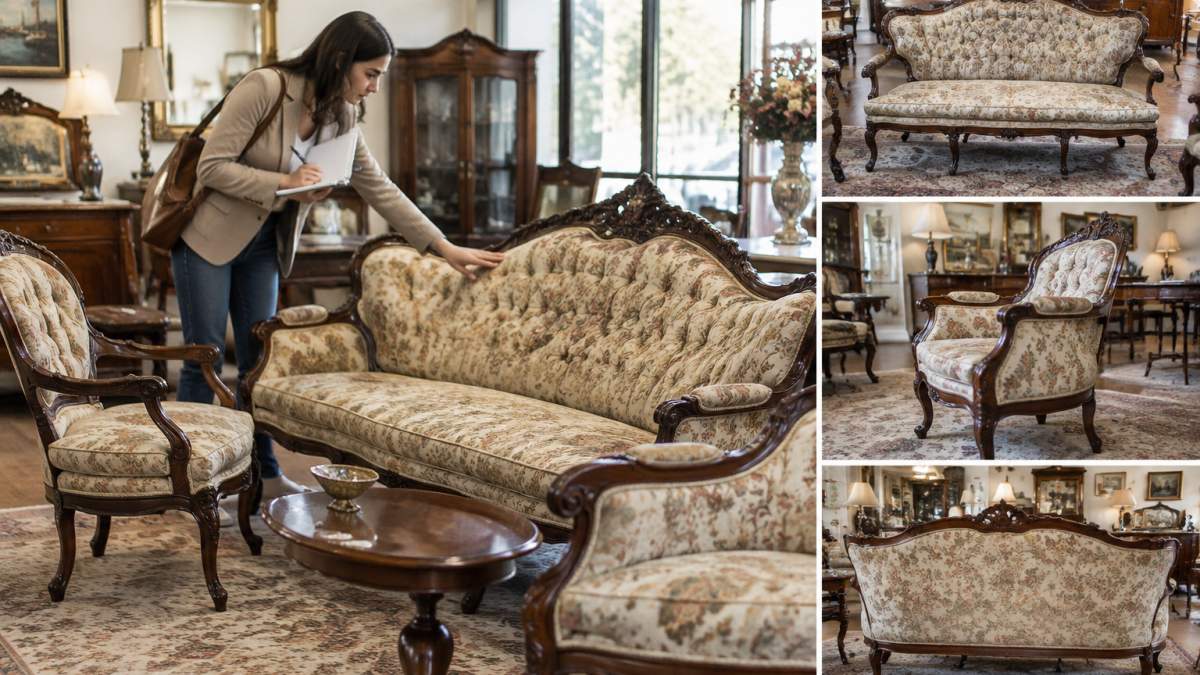
Pricing on the current listings runs from $575.00 for a set of four hand-painted Breton plates to $3,127.45 for a large Italian Renaissance Revival trestle dining table. Most furniture pieces sit between $1,300 and $1,800.
The store's own listings describe door-to-door delivery and state that shipping options are available on request, so buyers should confirm delivery terms before committing.
Pieces Worth Visiting For: Sofas, Cabinets and Dining Tables
The strongest pieces in the current catalog are the larger case goods and seating. The Charming Italian Louis XV Style Rosewood Parlor Sofa, priced at $1,724.00, has a carved rosewood frame and cabriole legs, and the listing notes minor wear to the upholstery at the back. A matching pair of parlor chairs is also listed.

The Cabinet, Bombe, Louis XV Style, Marble-Top, Marquetry, Rosewood is listed at $1,593.75. It is a rosewood bar cabinet with a marble top, marquetry and gilt metal trim, measuring approximately 48.25 inches high, 35.75 inches wide and 20.5 inches deep.
For dining, the Antique Dining Table, Large Italian Renaissance Revival, Trestle, 104" L is the largest item, at $3,127.45. It is a carved wood trestle table with grotesque masks and paw feet, and the listing measures it at about 104 inches long and 41 inches wide. Buyers with a large dining room or a library should measure before visiting these antique furniture stores' showrooms.
Price points in the current catalog
How to Identify Authentic Antique Furniture Before You Buy
Most top-ranking store guides stop at "check the joinery and ask for provenance." That is not enough to protect a buyer spending $1,300 to $3,100 on a single piece.
1. Start with joinery, not surface. Turn the piece over or pull out a drawer. Hand-cut dovetails from the 18th and early 19th centuries are irregular, with pins and tails of uneven width and saw marks that wander. Machine-cut dovetails, common from the late 19th century on, are uniform and evenly spaced.
2. Read the secondary wood. Makers used cheap, locally available wood for drawer sides, backs, and seat frames. On a French or Italian piece, expect secondary woods consistent with the region; a mahogany-veneer table with pine drawer sides is more likely American than European.
3. Test the hardware and fasteners. Original brass pulls usually show wear at the points where hands actually touched them, and screw holes will match the pull's spacing. If the holes are elongated, plugged, or doubled, the hardware has been moved or replaced.
4. Map the wear pattern. Genuine wear follows use: the front edge of a seat, the lip of a drawer, the corners of a table, the base of a leg where a foot rested.
5. Check the finish under raking light. Hold a flashlight at a low angle across the surface. Original finish shows fine, irregular crazing and a patina that pools in corners and recesses.
**6. A listing that names a specific era, such as the Italian Renaissance Revival trestle table in this catalog, gives you something concrete to verify against construction, hardware, and wear.
7. Ask for the disclosure in writing. Repairs, replacements, and restorations are normal on pieces this old; the problem is undisclosed ones. Ask directly: What has been repaired or replaced? Has the piece been refinished? Are the upholstery and hardware original?
Watch out: A convincing patina can be applied in an afternoon with stain and steel wool, so never let finish alone carry an authenticity call, construction and fasteners are the harder evidence to fake.
Antique Furniture Buying Tips for Condition, Pricing and Delivery
This is where most antique guides go quiet, and where buyers lose the most money. The three decisions, condition, price, and transport, are linked: a repair you can live with may justify a lower offer, and a piece that will not fit through your door is not a bargain at any price.
Condition: separate structural from cosmetic. Structural issues change what a piece can do: wobbly legs, loose or split joints, cracked panels, sagging seat rails, missing veneer over a structural member, and hardware that no longer holds. Cosmetic issues change how it looks: scratches, faded finish, minor veneer chips, worn upholstery. Cosmetic wear is expected on pieces of this age and is often part of the appeal.
Pricing: know the range before you ask. In this catalog, prices run from $575.00 for a set of four hand-painted Breton plates to $3,127.45 for the large Italian Renaissance Revival trestle dining table, with most furniture between roughly $1,300 and $1,800. Use those numbers as a benchmark: a comparable Louis XV-style parlor sofa at $1,724.00 or a bombe marble-top cabinet at $1,593.75 tells you what this seller charges for that class of piece. Compare against other listings for the same period, style, and condition, not against new furniture, which is a different market.
Negotiation: ask specifically, not generally. "Will you take less?" invites a no. A better approach names the reason: visible wear, a disclosed repair, a missing key, or a piece that has been listed for a while. Many sellers respond to a specific, evidence-based offer; few respond to a vague one.
Taxes and fees: confirm the out-the-door price. Sales tax treatment varies by state and by whether the seller has a physical presence or economic nexus where you live. Ask for a written total that separates the item price, tax, delivery, and any packing or crating fee. A price that looks competitive before tax and delivery can lose that advantage after.
Delivery and loading: plan for the piece, not the room. A 104-inch dining table and a carved parlor sofa are not car-friendly. Before you buy, measure the piece, then measure the narrowest path it must travel: exterior door, stairwell, hallway, elevator, and the turn into the room. Add two inches of clearance on each side for wrapping. Ask three questions: Is delivery door-to-door or curbside? Does the price include blanket-wrap or crating?
Watch out: Upholstered antiques can hide frame damage, pest activity, or odor that photos never show, so request close-up images of the seat deck, the back, and the underside before buying a sofa or chair sight unseen, and confirm the return policy in writing before you pay.
What Antique Furniture Is Worth Today and How to Judge Value
Value depends on period, maker, condition and demand. A complete, well-preserved 19th century cabinet with original hardware is generally worth more than a similar piece with missing parts or heavy restoration. Rarity and provenance can add to value, but many antiques are bought for their look and craftsmanship rather than as investments.
Be realistic about resale. Antique furniture often sells for less than its purchase price, and the market for specific styles changes over time. Buy a piece because you want to live with it, and treat any future value as a bonus rather than a guarantee.
To judge value, compare similar pieces with the same period, style and condition. Look at completed sales where possible, and note whether a price includes delivery or restoration.
Pros, Cons and Who Should Visit Which Type of Store
Old Europe Antique Home Furnishings suits buyers looking for statement pieces with a clear European period, especially Louis XV, Italian Renaissance Revival and 19th century Spanish furniture. The catalog is curated, with pieces focused on a few styles.
The trade-offs are real. The inventory is limited compared with a large multi-vendor mall, and the listings are weighted toward a few categories. Delivery terms vary by location and piece size, so buyers should confirm costs early.
Interior designers and collectors looking for specific period pieces may find a focused catalog useful. Casual shoppers looking for low-cost decor may find more options in a general antique mall or consignment shop.
The article's comparison of who suits each kind of store, based on the store's own traits, can be scanned at a glance.
| Store trait | What it means for buyers | Who it suits |
|---|---|---|
| Curated catalog | Pieces focus on a few styles | Interior designers and collectors |
| Limited inventory | Fewer options than a large mall | Buyers wanting a specific period |
| Delivery terms vary | Costs depend on location and size | Buyers who confirm costs early |
| Multi-vendor mall | Broader range and lower prices | Casual shoppers on a budget |
Booking Your Visit and Making Your Next Purchase
If you plan to see pieces in person, contact Old Europe Antique Home Furnishings ahead of time to confirm availability and visiting arrangements. Bring measurements for the room where the piece will go, and photograph any details you want to check later.
When you are ready to buy, review each listing's condition notes, confirm the total price including delivery, and ask any questions about provenance or repairs before you commit. Browse the current catalog at Old Europe Antique Home Furnishings and compare the parlor sofa, the bombe cabinet and the trestle dining table against your room's dimensions and your budget.
Frequently Asked Questions
Where is the best place to buy vintage furniture?
Specialty antique dealers, estate-focused showrooms and vetted consignment shops usually offer the most consistent selection of vintage furniture. Compare the inventory by era and style, ask whether pieces come with a written description of condition, and check recent customer reviews for how the staff handle questions. Visiting in person lets you judge wood, joinery and upholstery directly, which matters more for furniture than for smaller decor items.
Is antique furniture worth anything anymore?
Value depends on period, maker, condition and demand rather than age alone. Some 19th-century pieces with original finish and sound construction hold strong prices, while many mass-produced mid-century and later pieces sell for far less than buyers expect. Before paying a premium, look at comparable sales, ask the seller for a written description of condition, and assume that any restoration lowers collector value.
How can you tell if antique furniture is authentic?
Check the construction first: hand-cut dovetails, irregular saw marks and pegged joints usually indicate older work, while uniform machine screws and staples point to later production. Look at wear in places a reproduction would not show it, such as the underside of drawers and the inside of feet. Ask for provenance records, and treat any piece sold without a clear description of its age and origin with caution.
What should you check before buying antique furniture?
Inspect the structure before the finish. Wiggle chair legs and tabletops, open every drawer and door, and look for loose joints, split wood and past repairs. Confirm the dimensions against your space, ask whether delivery and loading are included, and get the condition details, including any tears to upholstery or flaking paint, in writing before you pay.
