


5 Antique European Decorative Objects for Narrow Hallways
Quick Summary
The best antique European decorative objects for a narrow hallway are shallow, slim or wall-mounted pieces that leave walking space clear. Good options include a gilt wall mirror, a small repousse pine mirror, a pair of brass wall sconces, a walnut hall pedestal and a carved plant stand, with each placed to protect a 30-inch passage.
- Keep at least 30 inches of walking clearance in a narrow hallway.
- Anything projecting more than about 6 inches from the wall can catch elbows and bags.
- Hang the large Italian gilt mirror with its lower edge 48 to 54 inches from the floor.
- Mount the pair of French brass sconces 60 to 66 inches above the floor.
- Place the walnut pedestal where the hallway widens, since its depth is 18.5 inches.
Table of Contents
- Why a Narrow Hallway Needs Smaller, Smarter Antique Pieces
- 1. Italian Style Gilt Wall Mirror With Flame Finial
- 2. Continental Repousse Pine Mirror, 1800s
- 3. Pair of French Early 20th Century Leaf-Form Brass Wall Sconces
- 4. Italian Renaissance Revival Walnut Hall Pedestal
- 5. French Breton Carved Wood Plant Stand
- Narrow Entryway Decorating Ideas: Placement, Clearance and Hanging Height
- How to Identify Authentic European Antiques Before You Buy
- Frequently Asked Questions
Why a Narrow Hallway Needs Smaller, Smarter Antique Pieces
Last Updated: October 29, 2026
A narrow hallway punishes oversized furniture. Every piece competes for the same few feet of walking space, so each object has to earn its spot.
The good news is that European antiques suit narrow spaces well.
This guide covers five antique European decorative objects that fit a narrow hallway, with approximate dimensions, depth and clearance, plus how to hang and place them and how to verify authenticity.
Narrow hallways have three practical limits:
- Walking clearance: Keep at least 30 inches free so people can pass comfortably.
- Depth: Anything projecting more than about 6 inches from the wall can catch elbows and bags.
- Visual weight: Too many heavy pieces in a short run make the space feel closed in.
1. Italian Style Gilt Wall Mirror With Flame Finial
Mirrors are often used in narrow hallways. A well-placed mirror can reflect light from a doorway or window and make the corridor feel longer.
Its frame projects only slightly from the wall, leaving the walking path open.
The paint shows light scratches and crazing, consistent with the condition noted in the listing. Check the condition closely before you buy.
Antique Wall Mirror, Italian Style Gold and Hand Painted Floral Design, Finial
2. Continental Repousse Pine Mirror, 1800s
If your hallway is very tight, this smaller mirror is a better fit.
Repousse brass work is raised from the reverse side of the metal, giving the surface its sculptural texture. The mounts catch light in a dim corridor and add warmth.
The listing notes wear and imperfections from age, use and movement. Confirm the glass is intact and the frame is stable before hanging anything heavy.
Antique Mirror, Ornate, Continental Repousse, Pine, 1800s
3. Pair of French Early 20th Century Leaf-Form Brass Wall Sconces
Lighting often separates a welcoming hallway from a gloomy one. A pair of wall sconces places light at eye level on both sides of the corridor, balancing the space and avoiding dark corners.
Mount them on opposite walls at a height that sits above head height.
These sconces are sold as decorative pieces. Their functionality has not been tested, so any rewiring should be done by a qualified electrician before use.
Two Cast Brass Metal Leaf-Form Wall Sconces, Early 20th Century

4. Italian Renaissance Revival Walnut Hall Pedestal
A pedestal gives a narrow hallway a grounded, sculptural anchor.
The 18.5-inch depth is the limit for a narrow corridor. Place it where the hallway widens, such as beside a doorway or at the end of a run, so it does not block the walking path.
The dark walnut finish of this late 19th century piece adds depth to a light-colored wall. Look closely at the carving and paw feet for structural cracks or repairs before you buy.
Antique Pedestal, Stand, Hall, Italian Renaissance Revival Walnut
Antique Wall Mirror, Italian Style Gold and Hand Painted Floral Design, Finial!! →
5. French Breton Carved Wood Plant Stand
For a softer touch, a carved pedestal plant stand brings greenery and sculptural interest to the floor.
Because the top is compact, it suits a narrow hallway better than a wide plinth would. Place it in a corner or at the end of a run, and keep the base close to the wall.
Check the figural carving for splits and confirm the base is solid before you move it. The listing notes wear from age and movement.
Antique Plant Stand, Pedestal, French Breton, Figural, Carved Wood
Narrow Entryway Decorating Ideas: Placement, Clearance and Hanging Height
Choosing the right objects is only half the job. Placement determines whether a hallway feels calm or cluttered, and in a narrow corridor the margin between the two is small. The guidance below turns the five objects above into a workable plan using measured clearances, mounting methods, and traffic-flow logic.
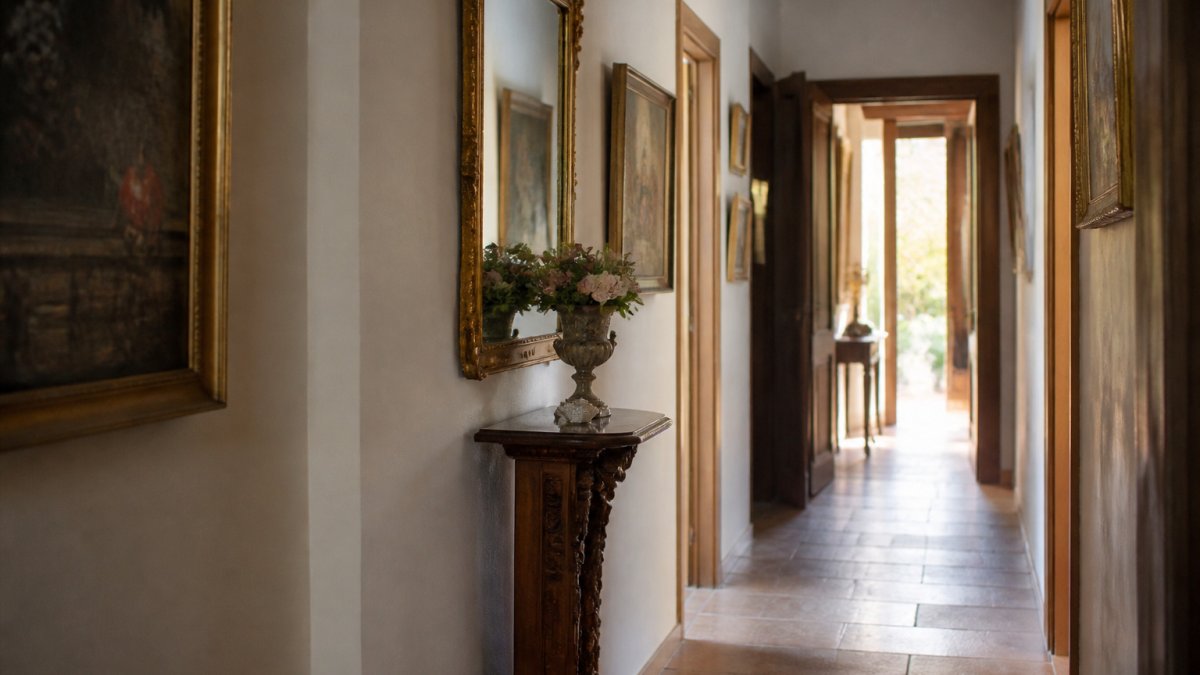
Start with a measured floor plan
Measure the corridor at its narrowest point, not its widest. Note the width of every doorway, the swing of each door, and the height of the wall run where you plan to hang something. Then mark a clear walking lane down the center of the floor.
For wall-mounted pieces, treat protrusion as the number that matters most. A mirror frame that sits flush or projects 1 to 2 inches is effectively invisible to traffic.
Hanging heights that clear heads and bags
Center wall art at roughly 57 to 60 inches from the floor, the standard eye-level range for most adults. Adjust for the object rather than applying the number blindly:
- Large mirrors: A tall mirror such as the 62-inch Italian gilt piece can hang with its lower edge at 48 to 54 inches, which keeps the reflective surface at eye level while the finial rises above head height.
- Small mirrors: The 28-by-17-inch repousse pine mirror works best centered at eye level, then grouped with one or two small objects so it does not float alone on a long wall.
- Sconces: Mount at 60 to 66 inches above the floor so the candle arms sit above passing heads. At 12 inches of projection, position them where the hallway widens or above a point people do not walk directly beneath.
- Pedestals and plant stands: These are floor pieces, so the relevant number is depth, not height. The 18.5-inch-deep walnut pedestal and the 15-inch-deep Breton stand should sit against the wall at a widening, a corner, or the end of a run.
Secure mounting in a high-traffic corridor
A narrow hallway is a high-traffic corridor, and anything that protrudes can be bumped. Use wall anchors rated for the weight of the piece, and for heavy mirrors attach to wall studs wherever possible. A mirror that weighs more than a few pounds should never hang from a single drywall anchor alone. For sconces, secure the backplate to a stud or use a rated anchor, and route cords so they do not cross the walking lane.
Compose around one focal point
In a narrow hallway, one strong focal point usually works better than several small ones. A large mirror with a single pedestal and one pair of sconces creates a balanced composition without visual clutter. Place the mirror opposite a window or doorway so it bounces light down the length of the hall, and keep floor pieces to the ends of the run rather than the middle.
Check the traffic flow before you commit
Before hanging anything, walk the corridor carrying a bag or a laundry basket. If you brush the wall, the object is too deep or too low. Mark the proposed position with painter's tape, live with it for a day, and adjust before you drill. This simple test catches most placement mistakes that measurements alone miss.
The table below summarises the clearance and hanging heights for each object so you can check them at a glance.
| Object | Dimensions | Placement note |
|---|---|---|
| Italian gilt wall mirror | 62 in high, 41 in wide | Lower edge 48-54 in from floor |
| Continental repousse pine mirror | 28 by 17 in | Eye height, grouped with small objects |
| French brass wall sconces (pair) | 12 in high, 14 in wide, 12 in deep | Mount 60-66 in above floor |
| Italian walnut hall pedestal | 41.5 in high, 18.5 in deep | Place where hallway widens |
| French Breton plant stand | 47 in tall, 15 in deep | Corner or end of a run |
How to Identify Authentic European Antiques Before You Buy
Buying antiques online means you cannot inspect a piece in person, so the questions you ask before you commit do most of the work. The checklist below covers the European provenance, period cues and material care that matter for the five object types in this guide.
Ask for provenance and period evidence
"Antique" is a broad word. In the United States, the common trade convention treats an antique as an object at least 100 years old, while "vintage" usually means roughly 20 to 99 years old. Ask the seller to state the approximate date or period and to explain what evidence supports it. Useful evidence includes construction details (hand-cut dovetails, square-cut nails, hand-planed surfaces), labels or maker's marks, and any known history.
Read the period cues for each object type
- Mirrors: Look at the glass. Old mirror glass can show signs of age such as waviness or desilvering at the edges, and it is reasonable to ask whether the glass is original. Check whether the frame's joinery and finish match the stated period, and ask whether the mirror plate is original or a later replacement.
- Repousse brass: Raised repousse work is formed from the reverse side of the metal, so the decoration should feel sculptural and slightly irregular. Ask for close photographs of the mounts and the reverse side to see how the brass is attached.
- Sconces: Ask whether the piece has been wired, rewired, or left as a decorative-only item. Many older sconces were made for candles, and later wiring may be amateur. Have any electrical work checked by a qualified electrician before use.
- Pedestals and plant stands: Look at the carving and the feet for structural cracks, repairs, or replaced sections. Ask whether the piece is fully assembled and whether any joints have been reglued.
Confirm condition in writing
Request exact dimensions, including depth, and check them against your clearance plan. Ask about condition in writing, including paint loss, cracks, repairs, restorations, and any replaced parts. Request additional photographs of marks, signatures, labels, and the reverse side. For painted or gilded pieces, ask whether the finish is original or restored, since restoration affects both value and care.
Plan for material care
European antiques are made from materials that respond to their environment. Wood pieces such as the walnut pedestal and the Breton plant stand prefer stable indoor humidity and should be kept out of direct sun and away from heating vents. Gilt and painted finishes should be dusted gently with a soft brush rather than wiped with water. Brass mounts can be left with their patina or polished, but aggressive polishing can remove surface detail, so clean conservatively.
Know what you are buying
Some pieces are decorative rather than functional. The listings for the sconces above, for example, are sold as decorative only, and their functionality has not been tested. Read the condition notes carefully and budget for rewiring or restoration where needed.
Old Europe Antique Home Furnishings offers a curated selection of European antiques, and questions about any listing can be directed to the seller before you buy.
Frequently Asked Questions
What antique objects work best in a narrow hallway?
Slim, vertical pieces work best: a tall mirror, a wall sconce pair, and a pedestal or plant stand under about 16 inches deep. These keep the walkway clear while adding height and visual interest. Measure the corridor width and leave at least 30 inches of clear walking space before choosing anything with projection beyond the wall.
How do you choose the right size antique decor for a hallway?
Match the object's depth to the hallway's width. Wall-hung pieces should project no more than a few inches, and freestanding pieces should stay close to the wall. Mirrors around 28 to 62 inches tall suit most hallway walls, and a pedestal around 41 inches high gives a strong focal point without crowding.
How can you tell whether an antique European piece is authentic?
Check construction first: hand-cut joinery, irregular tool marks, and wear consistent with age and use are stronger signs than polish. Examine the back of mirrors and frames, look for patina in the gilt, and ask the seller for a written description of age, materials and any restoration. Every listing should state condition clearly, including imperfections.
Can antique wall sconces work in a narrow hallway?
Yes, if they are mounted at a height that avoids head clearance problems and project only a few inches from the wall. A pair placed symmetrically on either side of a mirror creates balance. Note that sconces sold as decorative may not have tested wiring, so have a licensed electrician check any electrical use before installation.
