


How to Style an Antique Tapestry in a Modern Room
Quick Summary
Hang an antique tapestry on the wall people see first, like the sofa or entry wall, at about two-thirds the wall width with open space around it. Keep the room's palette calm, pulling one shade from the tapestry into a cushion, rug, or lamp. Keep it out of direct sun and off exterior walls.
- Pick the focal wall people see first, usually facing the entry or sofa.
- Fill about two-thirds of the wall width above a sofa or bed.
- Hang the bottom edge 8 to 12 inches above the furniture beneath it.
- Support the full top edge with a batten of at least 1 inch thick.
- Leave a 1 to 2 inch air gap behind the piece to prevent mildew.
Table of Contents
- Why an Antique Tapestry Works in a Modern Room
- Step 1: Choose the Right Focal Wall
- Step 2: Size and Place the Tapestry Proportionally
- Step 3: Hang It Safely Without Damaging Fragile Textiles
- Step 4: Pair Colors and Furniture With Clean-Lined Interiors
- Tapestry Ideas for the Bedroom and Living Room
- Modern Tapestry Wall Hanging Styling Mistakes to Avoid
- Booking a Styling Consultation for Your Tapestry
- Frequently Asked Questions
Why an Antique Tapestry Works in a Modern Room
Last Updated: November 19, 2026
Most people assume an antique tapestry belongs in a castle or a formal library. That assumption is wrong. A genuine antique tapestry can anchor a clean, contemporary room better than almost any piece of modern art, because it brings texture, history, and warmth that new décor often lacks. Read more about authentic antique decor for modern interiors for guidance on blending eras. A single well-chosen antique tapestry can soften a room of straight lines and neutral walls.
The contrast is the point. Modern interiors tend toward smooth surfaces, pale palettes, and simple shapes. A tapestry adds depth. Its woven patterns catch light differently from paint or printed canvas, and its hand-made irregularities keep the eye moving.
Antique tapestry in a modern room also signals intention. A room with one carefully chosen historical piece reads as curated rather than assembled from a catalog. That is the effect most homeowners want when they mix eras.
Here is what makes the pairing work:
- Texture balances hard surfaces. Glass, steel, and polished concrete feel cooler when a textile softens them.
- Color connects the room. Pull one shade from the tapestry into a cushion, rug, or lamp.
- Scale creates drama. A large piece turns an empty wall into a focal point.
- Age adds character. Wear and muted dyes look richer beside sleek new furniture.
Watch out: an antique tapestry is a textile, not a painting. Hanging it in direct sun or against a damp exterior wall can fade and weaken the fibers quickly, so plan its location before you buy.
Step 1: Choose the Right Focal Wall
The right wall decides everything else. Pick the wall people see first when they walk into the room, usually the one facing the entry or the sofa. Compare a large framed continental tapestry in landscape to see how a wall-scale piece reads. That wall gives the tapestry a clear job.
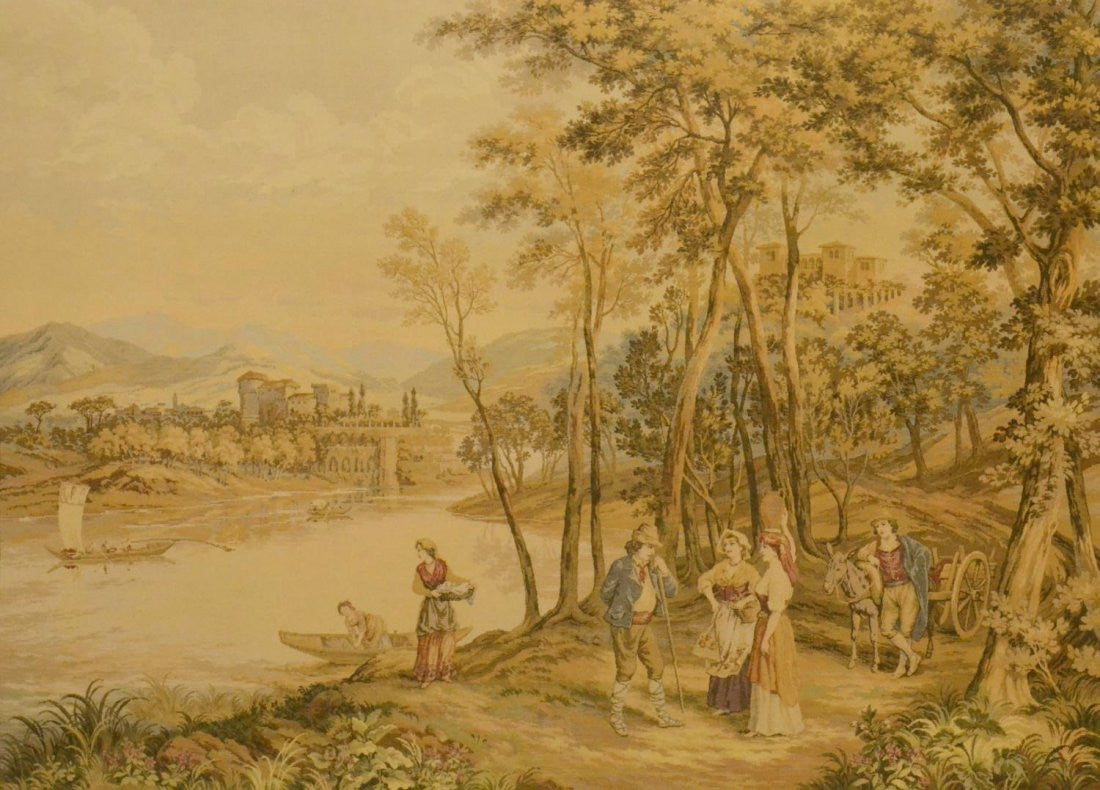
Avoid walls that split up with windows, doors, or heavy built-ins. A tapestry needs open space around it so its pattern can read.
Consider these questions before you choose:
- Does the wall get direct sunlight for hours each day?
- Is the wall an exterior wall that may hold moisture?
- Will the tapestry sit above furniture, or stand alone?
- Does the wall have enough clear space for the piece's full width?
Many homeowners pick the living room sofa wall because it already anchors the seating area. That placement works well, but a bedroom headboard wall or a dining room wall also suits a tapestry if the room has enough visual calm.
Step 2: Size and Place the Tapestry Proportionally
Scale is where most styling goes wrong. A tapestry that is too small looks lost, and one that is too large overwhelms a modest room.
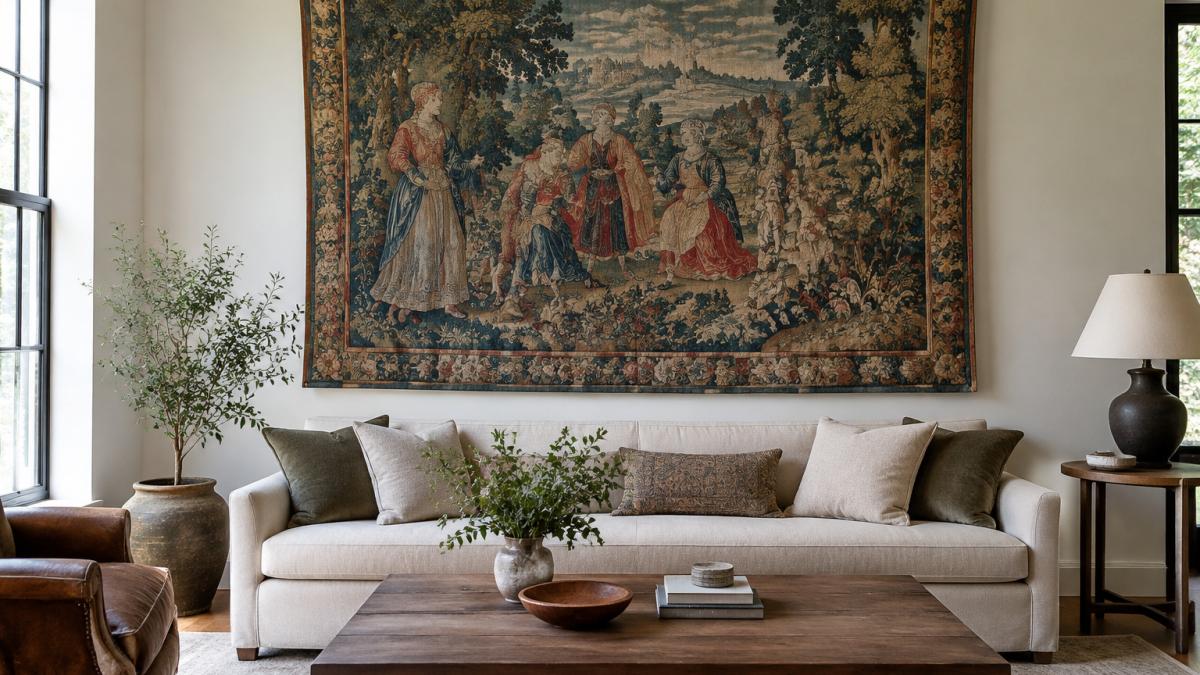
A useful rule is to leave clear space on either side of the piece. You can view a large Aubusson tapestry with floral farming scenes to gauge how a big piece fills a room. Aim for a tapestry that fills roughly two-thirds of the wall width above a sofa or bed. Hang it so the bottom edge sits about 8 to 12 inches above the top of the furniture beneath it. This keeps the tapestry connected to the furniture without crowding it.
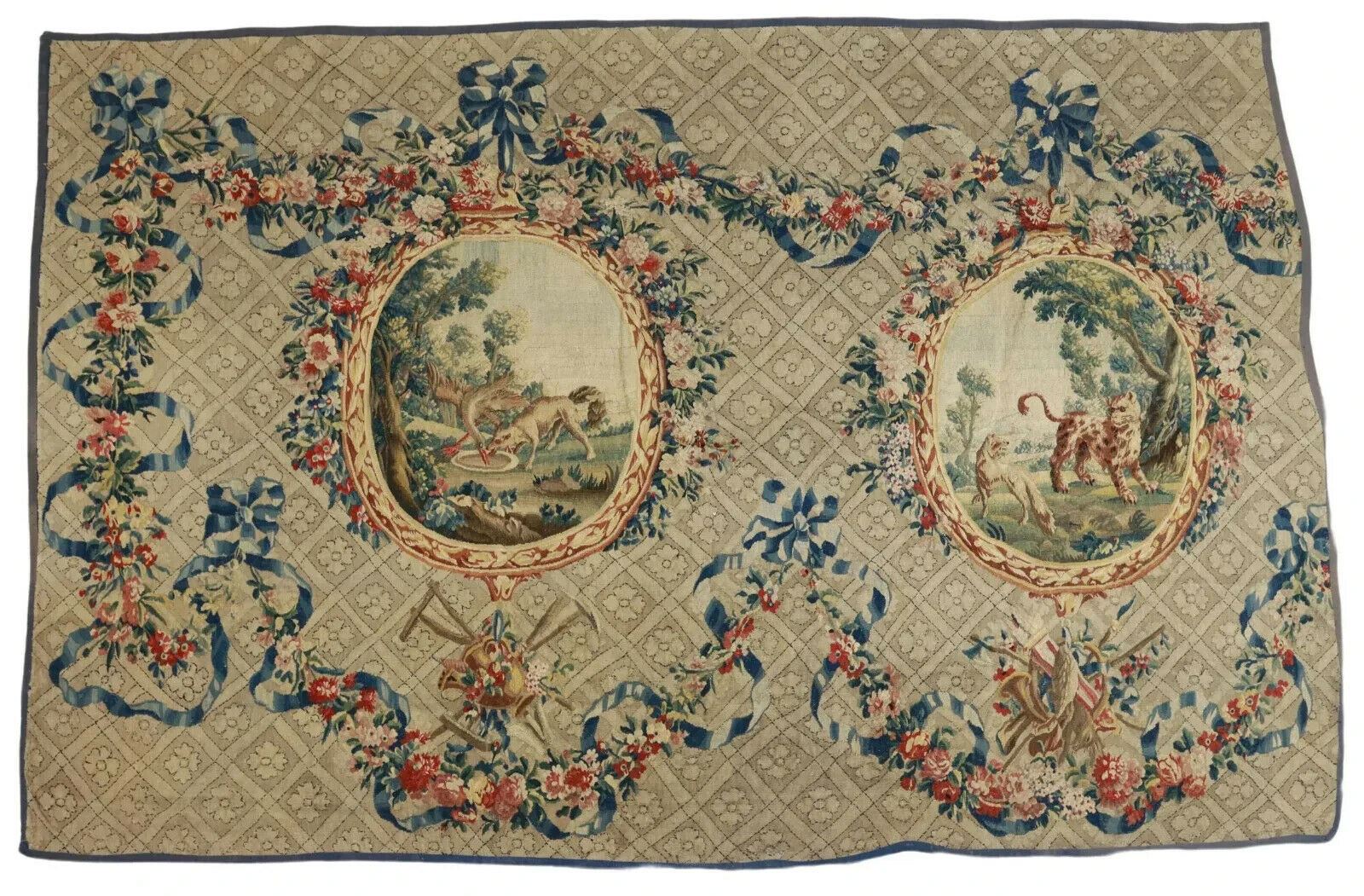
For wall-only displays, center the tapestry at about 57 to 60 inches from the floor to its midpoint, which matches standard gallery height and keeps the eye level comfortable.
Pairs of smaller tapestries work well on two walls or flanking a window. Keep the pair matched in height and hang them at the same level for balance.
Step 3: Hang It Safely Without Damaging Fragile Textiles
Antique tapestries are fragile in ways that are not obvious from the front.
Use a full-width support system. The safest method is a sleeve or a Velcro system that distributes load across the entire top edge.
Pad every contact point. Where the textile meets a rail or batten, use acid-free felt or washed cotton padding.
Leave an air gap. Hanging a tapestry flat against the wall traps moisture and can cause mildew, especially on exterior walls.
Manage light and environment. Direct sunlight fades dyes and weakens fibers. Keep the tapestry out of direct sun and use UV-filtering glazing on nearby windows where practical.
Handle and store with care. Support the full width when lifting; never pick a tapestry up by one corner.
Watch out: a common mistake is choosing hardware by the tapestry's visual weight rather than its actual weight.
The table below summarises the hanging and care specifications given in this step, so you can check them at a glance before mounting your piece.
| Item | Value | Note |
|---|---|---|
| Batten thickness | At least 1 inch | Supports the full top edge |
| Brackets for wide pieces | Three for pieces over 6 feet | Stops the batten from bowing |
| Gap behind the piece | 1 to 2 inches | Lets air move and prevents mildew |
| Indoor relative humidity | Roughly 45 to 55 percent | Range most conservators recommend |
| Load capacity | At least twice the piece's weight | Aged fibers have less margin |
| Cleaning | Soft brush on low suction | Leave wet cleaning to a conservator |
Step 4: Pair Colors and Furniture With Clean-Lined Interiors
Clean-lined rooms need warmth to avoid feeling sterile, and the tapestry supplies it. But the furniture and palette around it should stay disciplined so the textile leads. This is where most styling guides stop at 'pull a color from the tapestry.' The practical version is more specific.
Build the palette from the tapestry, not from a paint deck. Lay the piece flat in daylight and identify three color roles: the dominant field color (usually the background or border), one mid-tone that appears in the narrative or foliage, and one accent that appears in less than about a tenth of the surface. Most antique European tapestries run warm, ochre, madder red, sage, indigo, and undyed wool, so the dominant field is often a muted gold, blue, or green rather than a bright hue. Photograph the piece in indirect daylight and sample the colors digitally; dye lots shift under incandescent light, so sample in the room where it will hang.
Assign each color a job. Use the dominant field color as the room's base on walls and large upholstery, a warm white, greige, or soft gray that sits one or two steps lighter than the tapestry field. Use the mid-tone as the anchor in one or two substantial accents: a rug border, a pair of curtains, or a single upholstered chair. Use the accent color sparingly in small objects, a lamp base, a ceramic vase, a throw, so the eye travels back to the tapestry rather than competing with it.
Pair with specific furniture silhouettes. Low-profile sofas with exposed tapered legs in oak or walnut sit well because the visible floor line keeps the wall from feeling heavy. To find pieces that suit a modern-classic look, browse Gothic revival hardwood carved chairs and living room pieces.
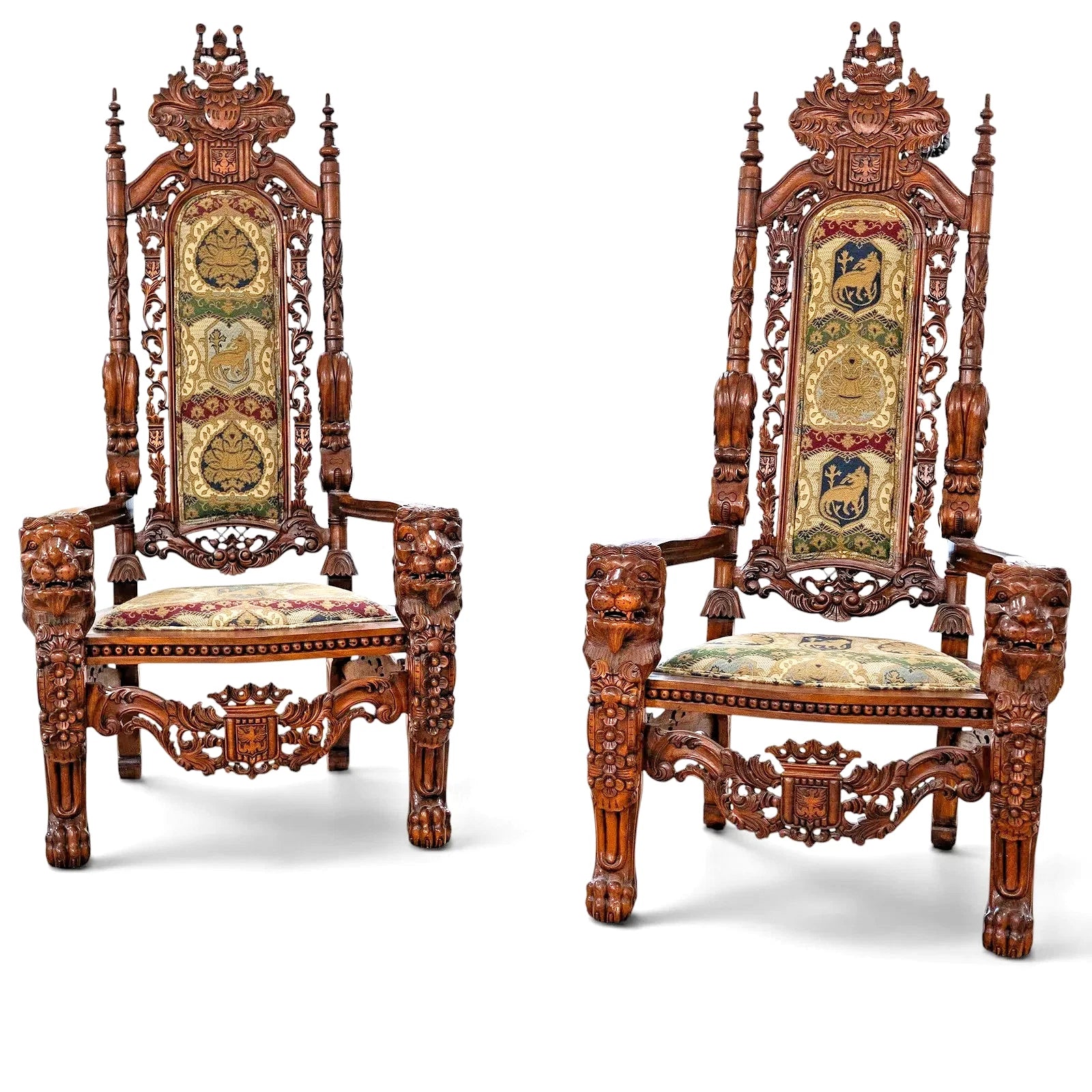
Control pattern mixing. Keep one pattern dominant. If the tapestry is busy, choose solid upholstery, a flat-weave or subtly textured rug, and plain window treatments.
Light the tapestry, not just the room. Use two adjustable picture lights or wall washers aimed at roughly 30 degrees from the wall so light grazes the weave and reveals texture without hot spots. Keep the light source on a dimmer and avoid cool-white bulbs above about 3000K, which flatten the warm dyes. Never aim a spotlight directly at the face for long periods; concentrated light and heat accelerate fading.
Watch out: matching a paint color exactly to a tapestry dye usually looks flat because the textile's color shifts with the weave angle. Choose a paint one or two steps lighter and less saturated than the sampled color, and let the tapestry supply the intensity.
Tapestry Ideas for the Bedroom and Living Room
In the living room, hang a large tapestry above the sofa and flank it with two modern lamps. The seating anchors the composition, and the tapestry provides the backdrop.
In the bedroom, a tapestry above the bed works well when the bedding is calm. Choose linens in one or two solid colors, and let the tapestry's pattern provide the detail. Keep the headboard simple. A tufted upholstered headboard in a neutral fabric pairs well with an antique piece.
Smaller tapestries suit bedrooms with less wall space. Hang one at the foot of the bed or on a side wall where it can be seen from the pillows.
For ideas on mixing antiques into contemporary rooms more broadly, the National Trust guide to period interiors offers useful reference photography, though its advice leans traditional.
You can browse our full range of antique home furnishings to find pieces that suit these rooms.
Modern Tapestry Wall Hanging Styling Mistakes to Avoid
Several errors come up again and again when homeowners first hang an antique tapestry in a modern room.
- Hanging it too high. Tapestries look best at eye level or just above furniture. Placing them near the ceiling makes them feel distant.
- Overcrowding the wall. Adding gallery frames, mirrors, and shelves around the tapestry dilutes its impact.
- Ignoring light. Bright, direct light fades dyes. Use indirect lighting or position the piece away from windows.
- Choosing the wrong size. A small piece on a large wall rarely works. Go bigger rather than smaller.
- Skipping the test. Before you commit, tape a paper outline of the tapestry's dimensions to the wall and live with it for a few days.
A less obvious mistake is cleaning the tapestry at home. Dust gently with a soft brush on low suction, and leave deeper cleaning to a textile conservator.
Booking a Styling Consultation for Your Tapestry
If you are unsure which piece suits your room, an in-person conversation can save time and money. Share your questions about placement, scale, and color with us before you buy.
Browse our collection and find an antique tapestry that makes your modern room feel complete.
Frequently Asked Questions
How do I make an antique tapestry look classy in a modern room?
Keep the surrounding palette restrained. Pair the tapestry's dominant colors with solid neutrals such as cream, warm gray or oak, and let it be the only pattern on the wall. Clean-lined furniture with simple silhouettes lets the textile read as a deliberate focal point rather than clutter. Good lighting, such as a picture light or a warm lamp, also brings out the weave and makes the piece feel curated instead of dated.
Where should you hang a tapestry in a bedroom?
Most people hang a tapestry above the headboard, centered on the bed and roughly 8 to 12 inches above the top of the headboard. Leave enough space so the textile does not touch the pillows. If the bed is low or against a window, a tapestry on the adjacent wall works well. Make sure the wall is interior and out of direct sunlight, since light is one of the main causes of fading in antique textiles.
How do you choose a wall for an antique tapestry?
Choose an interior wall away from direct sunlight, heating vents, fireplaces and exterior doors, all of which can cause fading, dust and temperature swings. A wall that anchors the room, such as the one facing the main seating area or the bed, gives the tapestry a clear purpose. Measure the wall first so the piece fills roughly two-thirds of the width of the furniture beneath it, which helps it feel proportionate.
How can you protect an antique tapestry from light and damage?
Limit exposure to direct sunlight and strong artificial light, and use UV-filtering window treatments where possible. Hang the tapestry on a sturdy support that distributes weight evenly, such as a rod sleeve or a padded hanger, rather than pinning through the fabric. Keep humidity and temperature stable, and have a professional textile conservator inspect any piece before cleaning, since improper cleaning can cause lasting damage.
