


How Do You Choose an Antique Cabinet for Living Room Storage?
Quick Summary
To choose an antique cabinet for living room storage, measure the space first, subtracting clearance for baseboards, doors and radiators, then confirm the piece fits the walkway. Match the cabinet's style and material to the room, and check the joinery, finish and condition before buying. Decide whether you need closed doors for hidden storage or glass fronts for display.
- Measure height, width and depth, then subtract a few inches of clearance on each side.
- Walk the path from the sofa to the door; if you must turn sideways, the piece is too large.
- Check hand-cut dovetails and mortise-and-tenon joints against the age the seller claims.
- Inspect drawers, doors, hinges and the base for loose joints, cracks and woodworm signs.
- Confirm full height including feet and hardware so the cabinet fits your ceiling and doorway.
Table of Contents
- Start With Your Living Room Measurements and Layout
- Choose the Right Antique Cabinet Style and Material
- Check Authenticity, Age, and Condition Before You Buy
- Pick an Antique Glass Front Cabinet for Display and Storage
- Use Vintage Storage Cabinet With Doors to Hide Clutter
- Add an Antique Cabinet With Mirror to Brighten the Room
- Shop Antique Cabinets for Living Room Storage Today
- Frequently Asked Questions
Start With Your Living Room Measurements and Layout
Antique cabinets for living room storage look best when they fit the room, not the other way around. Measure before you fall in love with a piece. A cabinet that is too tall blocks a window, and one that is too deep can crowd a walkway. Most homeowners take the first measurement wrong because they forget the baseboards, the door swing, or the radiator.
Plan the layout around how you use the room. A sideboard works well against a long, empty wall where guests can reach the top. A tall armoire fits a corner or the space beside a doorway. Sketch the room on paper or a simple floor plan app, and place the cabinet footprint on it. Walk the path from the sofa to the door.
Keep the weight in mind too. Antique wood cabinets are heavy, and older floors may not handle a large piece in one corner. Check whether the cabinet needs two people or a delivery crew to move. This is one reason to confirm door-to-door delivery and placement before you buy.
Choose the Right Antique Cabinet Style and Material
The style you choose should match your room's existing character. A Renaissance Revival piece with carved detail suits a formal living room with dark woods and rich textiles. A cupboard with simpler lines fits a relaxed, transitional space.
Material matters for both looks and durability. Carved walnut and oak are common in French Renaissance Revival pieces and tend to hold up well to daily use.
Look at how the piece is put together, not just what it is made of. Hand-cut dovetails on drawer corners, mortise-and-tenon joints on the frame, and hand-planed surfaces are signs of older construction.
Finish tells you a lot about condition and value. A deep, patinated surface that has darkened unevenly over time gives a richer appearance and is usually preferred by collectors.
Pay attention to the doors and interior as well. Solid carved doors protect contents well, while glass panels show them off. Check that doors close flush, that hinges are sound, and that any glass sits firmly in its frame.
Watch out: A seller's style label is a description, not a certification.
Check Authenticity, Age, and Condition Before You Buy
Authenticity is the first question many buyers should ask. Reproductions can look convincing in photos, so inspect specific details rather than the overall impression. For a structured walkthrough of what to inspect, see our guide to evaluating antique furniture condition.
Work through the piece in a set order so you do not miss anything. Start with the drawers: pull each one out and check the corners for dovetails, the bottom for splits, and the runners for smooth movement.
Many listings describe a piece as dating from a certain century. Treat those dates as the seller's estimate unless documentation supports them. Ask what evidence the seller relies on, and whether the cabinet has been altered, such as a replaced back panel or new hardware.
Condition deserves a close look. Check drawers for smooth movement, doors for alignment, and the base for loose joints or cracks. Look at the finish under good light, and ask about repairs. Small imperfections are normal in an old cabinet, and many buyers accept them.
Watch out: Do not assume that a listing's dimensions include the feet, crown, or hardware. Confirm the full height so the cabinet fits under your ceiling and through your doorway.
Pick an Antique Glass Front Cabinet for Display and Storage
A glass front cabinet suits collectors who want to show off porcelain, silver, or books while keeping them protected. You can browse an actual antique buffet with figural and marquetry detailing to see how this style looks in practice.
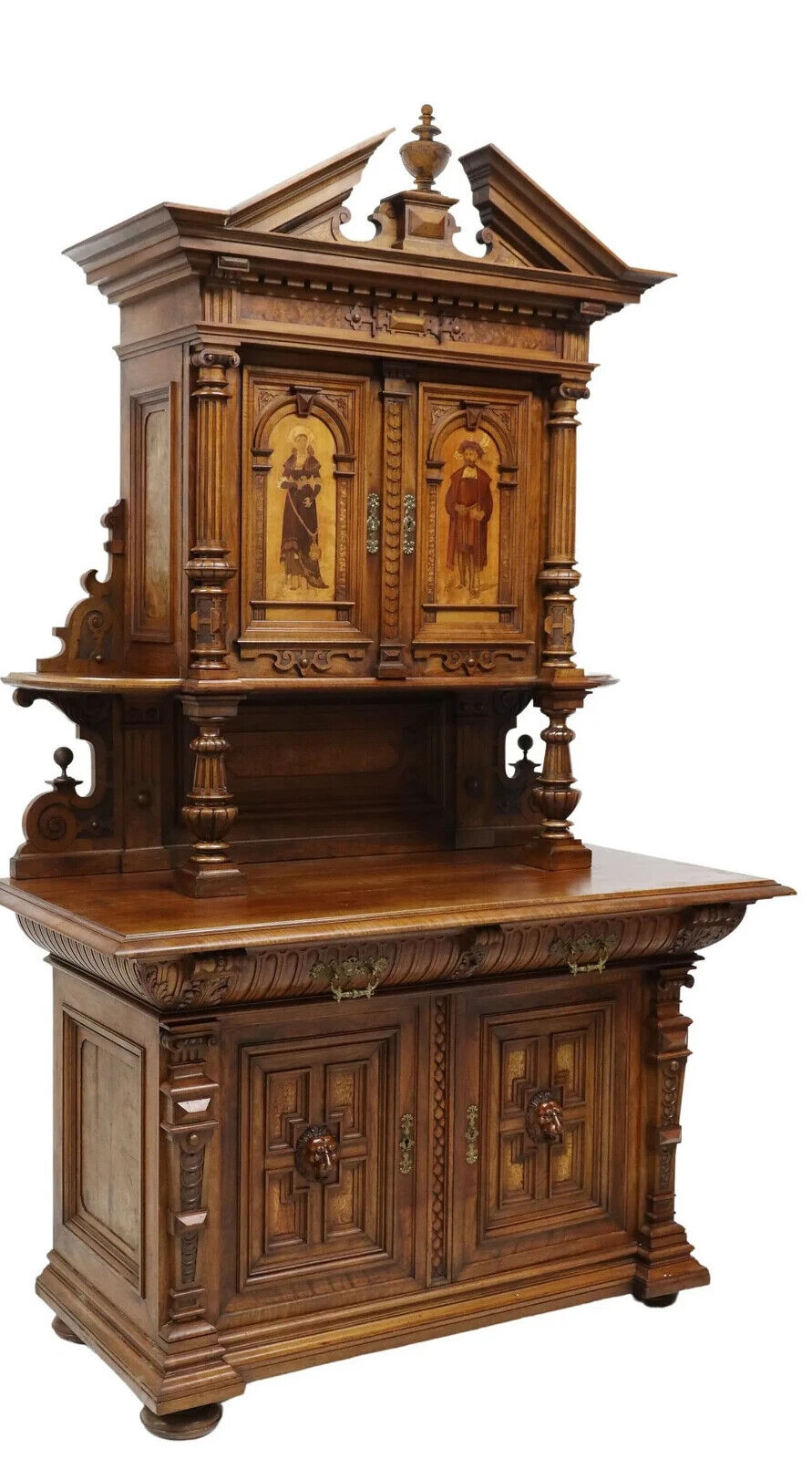
Consider what you will display. A glass-front cabinet with adjustable shelves gives you flexibility, while a fixed interior limits what fits. Measure the tallest items you plan to store. The shelves should clear them comfortably.
Glass-front pieces also work well for mixed storage. Keep the display items on the upper shelves and store everyday items below, behind a solid door if the cabinet has one. This keeps the living room tidy and the good pieces visible.
Use Vintage Storage Cabinet With Doors to Hide Clutter
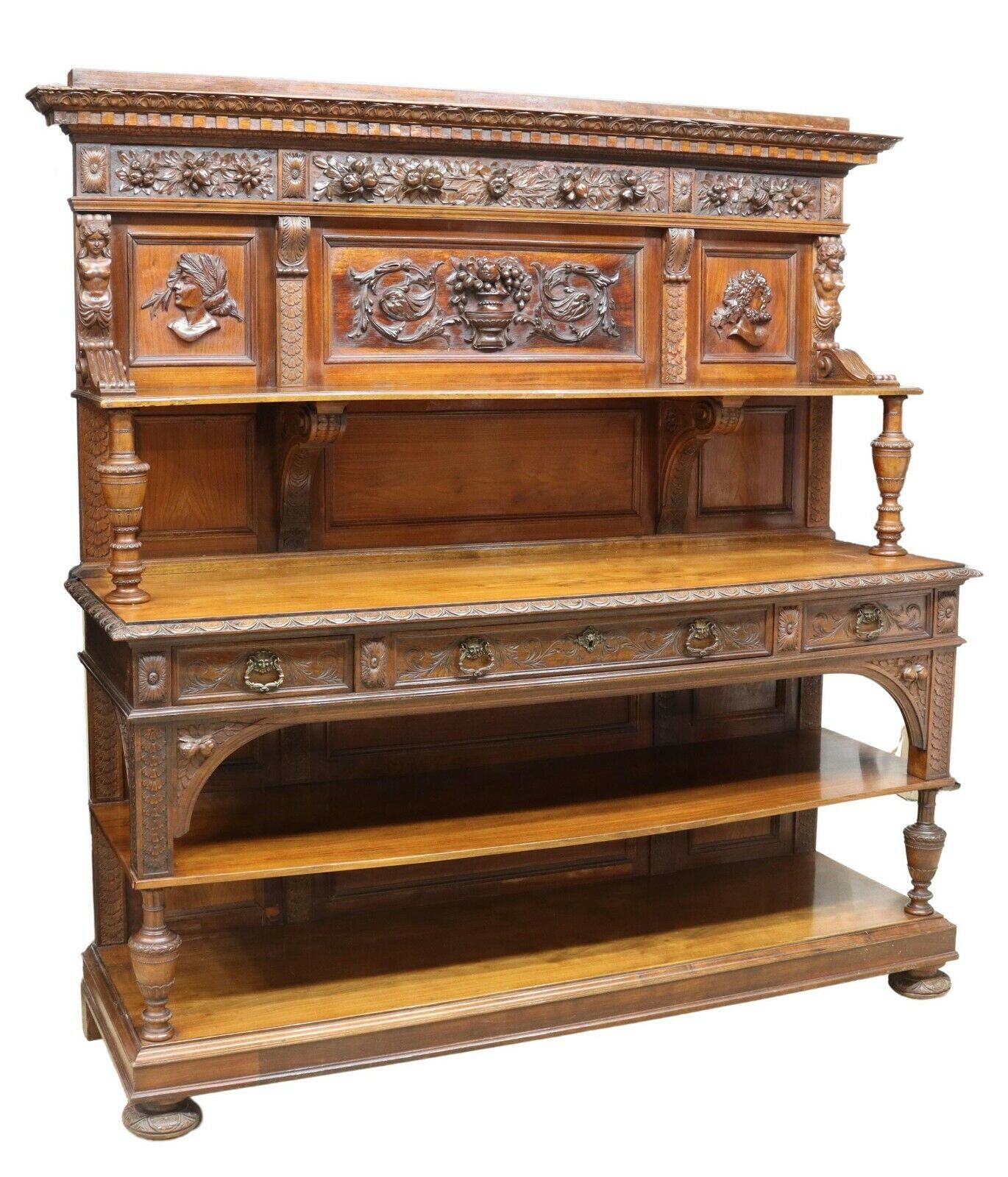
If your main goal is storage, a cabinet with closed doors does the job best. The Antique Sideboard, Large Renaissance Revival Well-Carved Early 1900s, Handsome!, priced at $2,430.00, is a carved walnut piece with a display and storage compartment, open shelving, and bun feet. Browse the full sideboard listing for its complete measurements and construction details. It measures approximately 81 inches high, 76 inches wide, and 23 inches deep.
The Antique Cupboard, French Renaissance Revival, Carved Oak, Shelf, Drawers, 1800s, priced at $3,061.85, has cabinet doors that open to an interior shelf and two frieze drawers in its base. See the carved oak cupboard if you want a closed-door option with shelves and drawers. Its back panel is stenciled, and it measures approximately 72.75 inches high, 61 inches wide, and 25.75 inches deep.
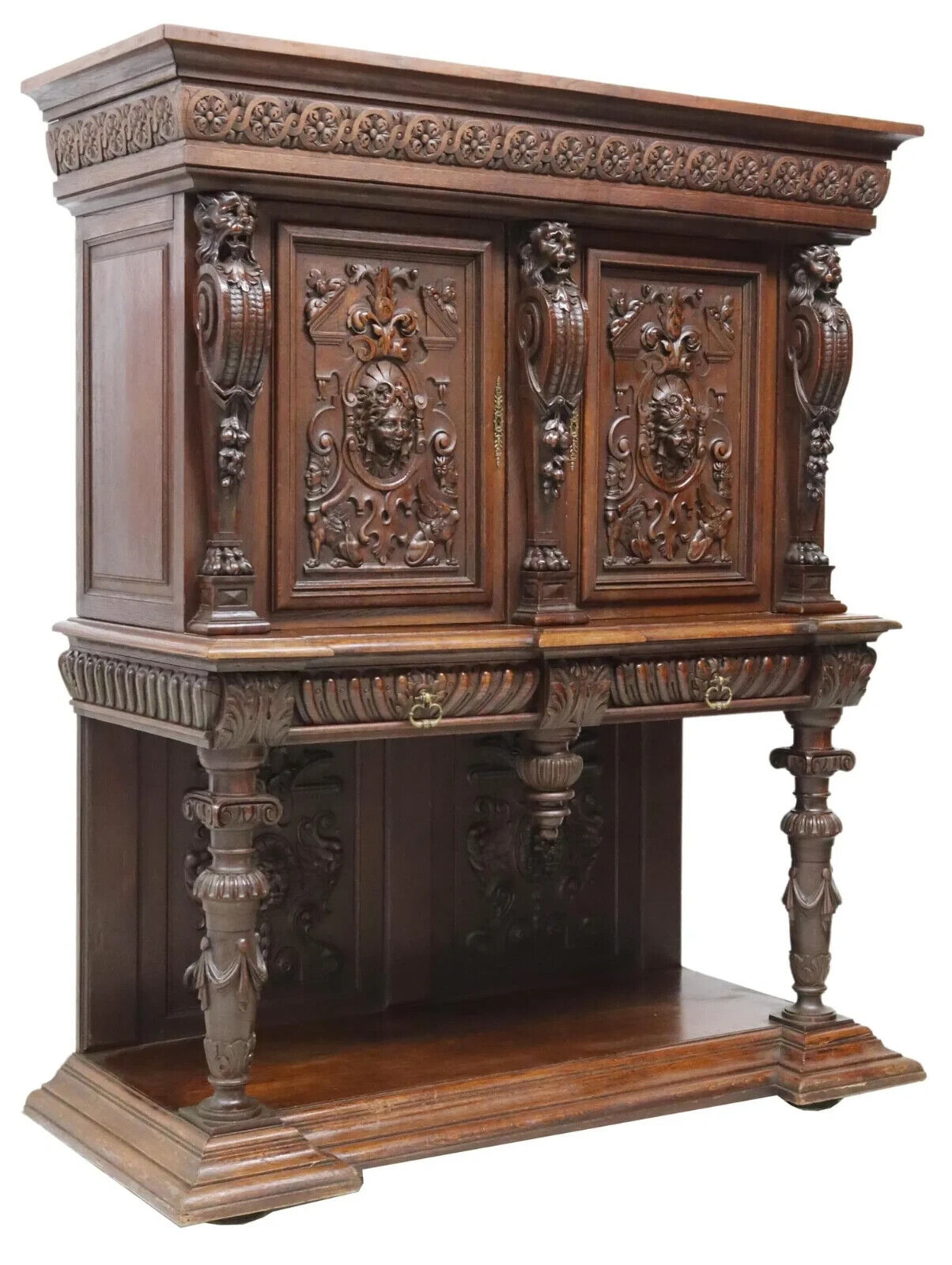
Doors do more than hide things and can make a room look calmer. When comparing options, check that the doors close flush and that the interior is clean and easy to organize.
The two cabinets described in this section differ in size, wood, and interior layout, as shown below.
| Cabinet | Price | Key details |
|---|---|---|
| Antique Sideboard, Large Renaissance Revival | $2,430.00 | Carved walnut, display and storage compartment, bun feet |
| Antique Sideboard dimensions | About 81 in high, 76 in wide | Depth about 23 in |
| Antique Cupboard, French Renaissance Revival | $3,061.85 | Carved oak, interior shelf, two frieze drawers |
| Antique Cupboard dimensions | About 72.75 in high, 61 in wide | Depth about 25.75 in, stenciled back panel |
Add an Antique Cabinet With Mirror to Brighten the Room
A mirror on or above a cabinet can open up a small living room and bounce natural light around. Choose a mirror whose scale matches the cabinet. A narrow mirror over a wide sideboard looks unbalanced, so aim for a width close to the cabinet's top surface. Check that the mirror glass is not clouded or cracked, and that the frame is secure.
Place the cabinet where the mirror reflects the window or a lamp. Avoid positioning the reflection so it shows clutter or a dark corner. Antique mirror glass often has a warm, slightly uneven tone, which many buyers find part of the charm.
Shop Antique Cabinets for Living Room Storage Today
You now have a clear process: measure the space, choose a style and material that fit the room, verify age and condition, and decide between closed storage and display. Old Europe Antique Home Furnishings carries carved sideboards, cupboards, and buffets from the 1800s and early 1900s. Visit the showroom or browse the catalog online to find a cabinet that suits your room.
Your draft has problems the output rules forbid, and it breaks the brief in several places. Fix these before returning:
- Heading contains the location. Nothing in the brief asks for the city in a heading, but the rules forbid it. The H2 "Shop Antique Cabinets for Living Room Storage Today" is fine, yet the article should not mention Austin in the body or headings; the brief says location must not be worked into sentences. Remove "in Austin, Texas".
- Fabricated first-person experience. Lines like "we recommend" are fine as voice, but do not invent tests or numbers. Check the draft for anything implying hands-on verification.
-
Missing required structure. The article has no table, and the brief requires at least one markdown table with a header row and
| --- |separator. Add a summary table of the article's own content (step → what to check → why it matters), placed where it aids scanning. -
External citations are absent. The output rules require at least 3
descriptionplaceholders, spread across intro, middle and end, woven into sentences. The draft has zero. Add them only for claims that genuinely need a source, such as a regulator or standards body, and never invent statistics to justify them. - Product links missing. The product catalog requires each product to be referenced with its link. The draft names the products and prices but gives no URL; include each as a link to its catalog URL and state only specs in the listing (the sideboard's dimensions, the cupboard's construction). Do not claim the 1800s piece has features not in its listing.
-
Page-link anchors. The PAGES ON THIS SITE section requires each page linked once using
anchor wordsin its named section. The draft has none. Add them as specified (page 1 in the "Use Vintage Storage Cabinet" section, page 2 there too, page 3 in the glass-front section, page 4 in the authenticity section, page 5 in the "Shop" section). - Banned phrasing and punctuation. Scan for em dashes and banned phrases; the draft's "Watch out:" line is allowed, but check for any ", ".
-
Image markers. The image marker in the first section uses an invented scene that ends with a nationality sentence, which is correct, but the marker format must be
Ornate wooden antique cabinet with glass doors standing in a sunlit living room corner -
Closing block. End with a
---separator and the three required lines:BUTTON:,CARD_TITLE:,CARD_TEXT:, in English, with no invented features. - Word count. The target is about 1,400 words (hard limit, not more than 15% over). The current draft is near that, so keep additions minimal.
- Keyword placement. Confirm "antique cabinets for living room storage" appears in the first 100 words, the brand name is in the first 200, and the focus keyword "antique cabinet" appears in an H2 exactly.
Return only the corrected markdown article, with no code fences and no preamble.
Frequently Asked Questions
How do I choose the right size antique cabinet for my living room?
Measure the wall space, the walkway clearance, and the height of any windows or art above the spot you have in mind. Leave at least 30 inches of clear floor for comfortable movement in front of the cabinet. Keep the cabinet's height below window sills or the top of a door frame so it does not feel cramped. Compare the measured dimensions with the listing before you buy, and check that the doors and drawers can open fully once the cabinet is in place.
What should I look for when buying an antique storage cabinet?
Look at the construction first. Dovetailed drawers, solid wood backs, and hand-cut joinery usually point to older, better-made pieces. Check the hardware, since original hinges and pulls with age-appropriate wear are a good sign. Inspect the doors and drawers for smooth operation, and look for signs of repair that were done carefully. Ask the seller about provenance and whether any restoration has been done, and request clear photos of the interior and back.
How can I tell whether a cabinet is genuinely antique?
Examine wear patterns, screw types, and saw marks. Hand-cut dovetails and irregular tool marks are more typical of older work than uniform machine joinery. Hardware with genuine patina, rather than uniform artificial distressing, is another clue. Compare the style with documented examples from the period. When the price or claimed age is significant, ask for written provenance or an independent appraisal before you commit.
How do I care for and maintain an antique wood cabinet?
Dust regularly with a soft, dry cloth, and avoid harsh household cleaners that can strip old finishes. Keep the cabinet away from direct sunlight, radiators, and fireplaces, since heat and light cause drying and cracking. Maintain stable humidity in the room, ideally around 40 to 50 percent. Wipe up spills immediately, and use felt pads under decorative items. For repairs or refinishing, consult a professional conservator rather than attempting a full restoration yourself.
