


Best Expertly Sourced Antique Items for Authentication Checks
Last Updated: November 11, 2026
Quick Summary
Expert sourcing matters for antique authentication because subtle reproduction signs rarely settle the question alone. Buyers should weigh physical evidence, documented provenance and specialist review together rather than relying on a single feature or a seller's story.
- Tool marks, wear, paper stock and printing methods change over time, so weigh several evidence lines together.
- Where a seller produces no paperwork, the burden of proof falls on the buyer.
- A visual identification app suggests an era but cannot replace physical examination.
- Ask sellers for written descriptions, date basis, prior ownership and conservation history before buying.
- For high-value purchases such as the celestial globes, get an independent credentialed appraisal.
Table of Contents
- Why Expert Sourcing Matters for Antique Authentication
- How We Evaluated Each Antique Item
- Antique Map, North and South America, Circa 1840
- Antique Map, Sweden and Norway, 1765: Authenticating an 18th-Century Map
- Antique Map, North America and Russian Alaska, 1843
- Antique Celestial Globes, British, Early 1800s: Provenance Documentation
- Using an Antique Identification App Before You Commit
- Your Next Step: Requesting Authentication Documentation for Your Purchase
- Frequently Asked Questions
Why Expert Sourcing Matters for Antique Authentication
Antique authentication is the process of confirming that an object is genuinely as old as it claims to be, made where it claims to be made, and not a later reproduction or forgery. This guide focuses on the sourcing decisions that most affect whether a piece holds up under scrutiny.
Antique authentication is the act of verifying an object's age, origin and maker against physical evidence and documented history. An expert sourcing decision is a choice about where that evidence comes from: a specialist appraiser, a documented provenance chain, or a visual check by someone without the training to spot reproductions.
Expertise matters because the signs of a reproduction are often subtle. Tool marks, wear patterns, paper stock and printing methods all change over time, and a single feature rarely settles the question. Smithsonian Institution guidance on evaluating historical objects recommends weighing several lines of evidence together rather than relying on one.
Provenance is the other half of the picture. A documented ownership history, previous auction records or a dealer's bill of sale gives a buyer something to test, while a story told without paperwork gives nothing to check. Where a seller can produce none, the burden of proof falls on the buyer.
Authentication services and identification tools also differ in what they can actually confirm. A visual identification app can suggest an era or style, but it cannot replace a physical examination. We explain where each approach fits later in this guide.
How We Evaluated Each Antique Item
The pieces in this guide are drawn from the current catalogue. Each was reviewed against four criteria, and it is worth being precise about what those criteria can and cannot establish.
The first criterion is completeness of the written description. We checked whether the listing names the object type, maker or publisher where one is stated, materials, and the physical dimensions. A complete description does not prove authenticity, but an incomplete one leaves a buyer nothing to test.
The second criterion is the specificity of the date or publication reference. We looked for an imprint, publication line, maker's label or dated inscription that a buyer could check against an external catalogue. A bare phrase such as 'circa' with no supporting detail was recorded as weaker than a stated edition or dated label.
The third criterion is the condition detail given by the seller. We favored listings that describe specific wear, repairs, restoration or losses over those that offer general statements. Specific condition notes are more useful to a buyer because they indicate where to look for evidence of age and where later intervention may have occurred.
The fourth criterion is clarity of pricing. A listed price with a clear basis makes it easier to judge whether a piece is priced in line with its described age and rarity.
These criteria sort listings by how much checkable information they contain. They do not confirm that any object is what its description says. The review was an editorial examination of catalogue information only. The evidence standard that would support a conclusion of authenticity is different. It rests on physical examination of construction and materials, a documented provenance chain, comparison with dated reference examples and, where relevant, scientific analysis. Where those elements are absent, the honest result is a stated level of uncertainty rather than a confident verdict.
Readers who need a formal determination should treat these criteria as a checklist of what to request from any seller, and should obtain an independent written report for any purchase where the price or purpose makes error costly.
The four review criteria sort listings by how much checkable information they contain.
| Criterion | What we checked | Why it matters |
|---|---|---|
| Completeness of description | Object type, maker or publisher, materials, dimensions | Gives a buyer something to test |
| Date or publication reference | Imprint, publication line, maker's label, dated inscription | Can be checked against external catalogues |
| Condition detail | Specific wear, repairs, restoration or losses | Shows where to look for evidence of age |
| Clarity of pricing | Listed price with a clear basis | Helps judge price against age and rarity |
Antique Map, North and South America, Circa 1840
This framed map is listed at $789.00 and depicts a Western Hemisphere view published under the Society for the Diffusion of Useful Knowledge, engraved by J and C Walker. The listing describes Texas, New Mexico, Arizona and California as part of Mexico. Sight measurements are 12.25 inches high by 11 inches wide, with overall dimensions of 19 by 17.75 inches and a weight of 4 pounds.
A buyer checking this map should compare the boundary labels against published atlases from the period. Wear and imperfections are noted in the listing as commensurate with age and use.
Antique Map, North and South America, Circa 1840 offers the full listing for comparison.
Antique Map, Sweden and Norway, 1765: Authenticating an 18th-Century Map
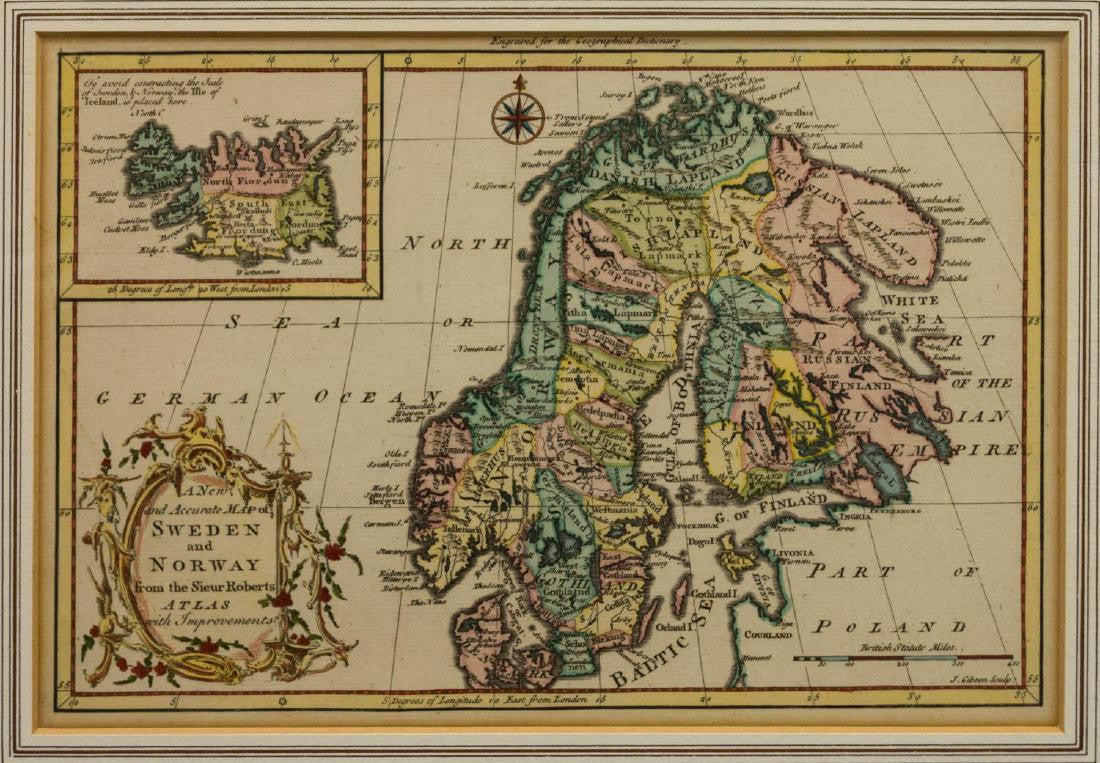
This hand-colored framed map is listed at $945.00 and is described in the listing as a c. 1765 map from a Sieur Roberts atlas, with the engraver credited as J. Gibson. It includes an inset map of Iceland at upper left. Sight dimensions are 8 by 11.875 inches, and overall dimensions are 14.5 by 17.75 inches.
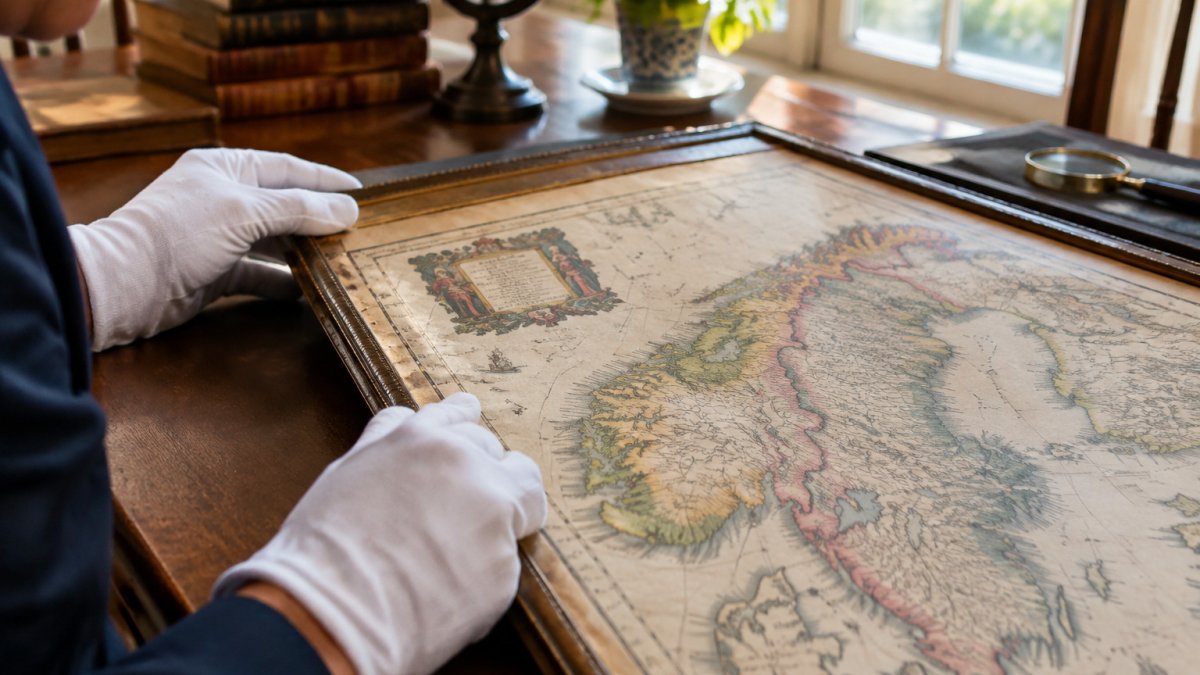
Authenticating an 18th-century map usually means checking the engraver's imprint, the paper's watermark and the hand-coloring method. Hand color applied over engraved lines looks different from later stencil or printed color, and the plate edge should show the expected wear for a sheet printed in that period. A specialist print dealer can compare the imprint against reference catalogues.
Readers who want to see the piece itself can view the Antique Map, Sweden and Norway, 1765 listing.
Antique Map, North America and Russian Alaska, 1843
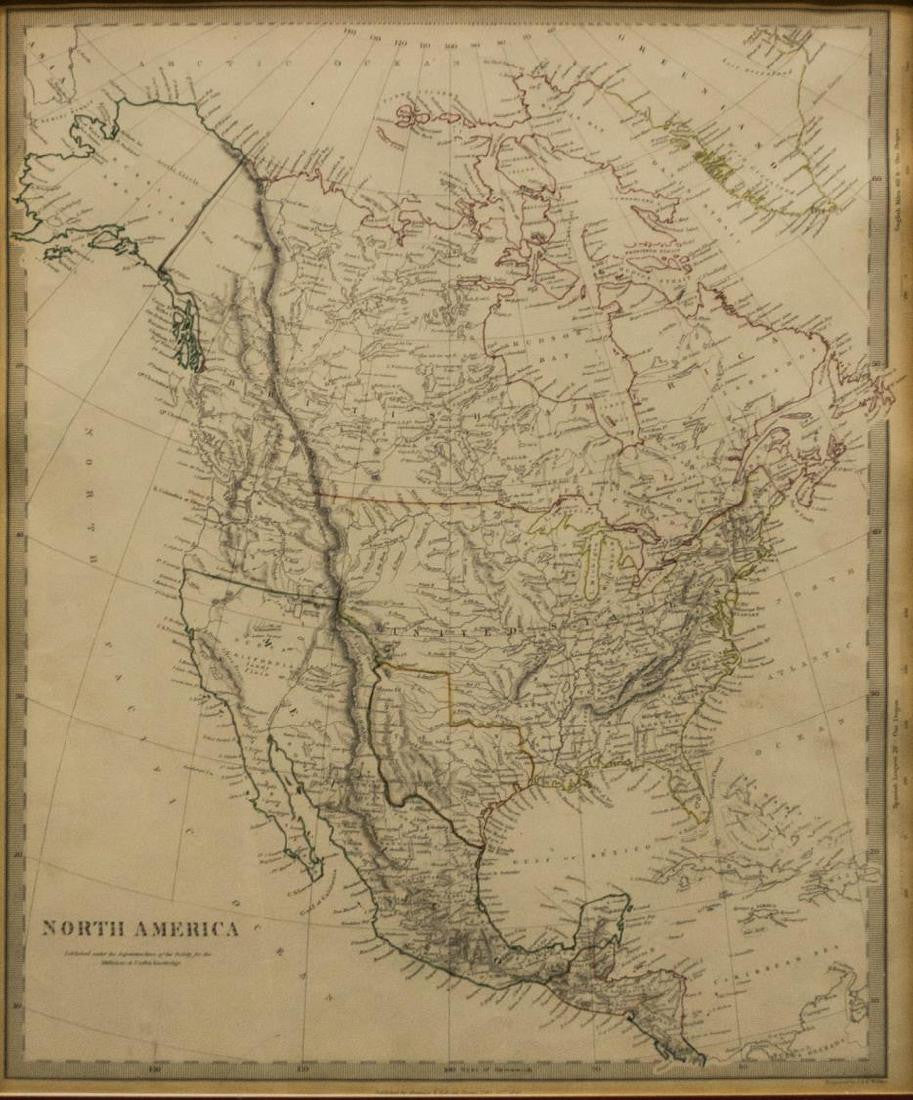
This framed map is listed at $795.00. The imprint states it was published under the Society for the Diffusion of Useful Knowledge, with a publication line dated February 25, 1843, and it labels Alaska as Russian America and California as Nueva California. Sight dimensions are 15.5 by 12.5 inches, and overall dimensions are 22 by 19.25 inches.
The naming conventions are the most useful authentication check here. Labels such as Russian America and Nueva California were replaced as political boundaries changed, so a reproduction that copies a modern political map will often get them wrong. A buyer can confirm the publication line against an atlas catalogue.
The complete listing is available as Antique Map, North America and Russian Alaska, 1843.
Antique Celestial Globes, British, Early 1800s: Provenance Documentation
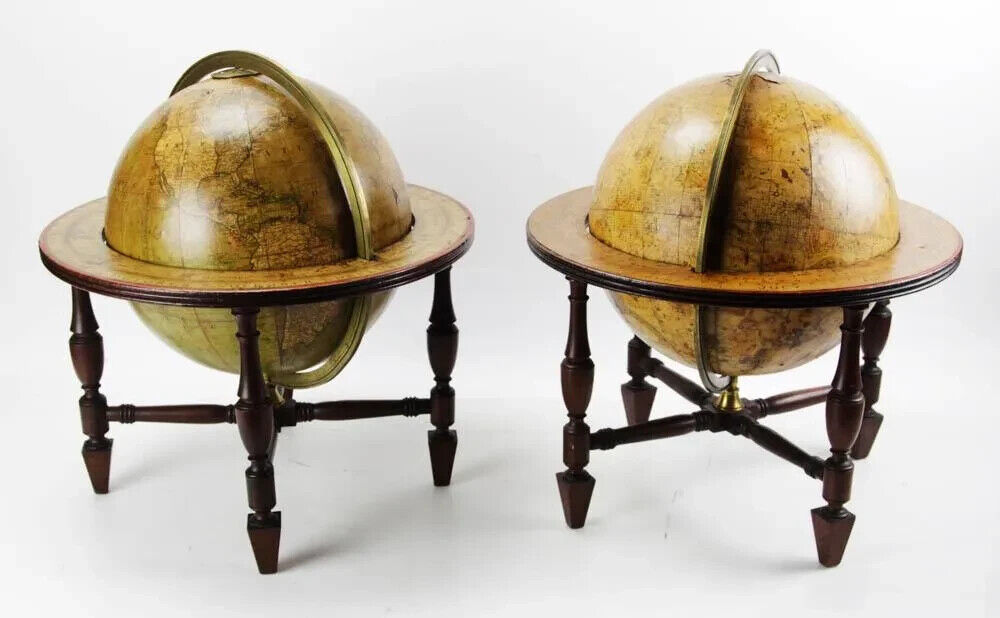
This pair of 12-inch globes is listed at $10,212.00. The description identifies a British terrestrial globe dated 1802 by T. M. Bardin of Salisbury Square, London, and a celestial globe dated 1800 referencing observations by Dr. Herschel. Overall the pair measures 21 by 17 inches. The seller notes wear and imperfections from age and use.
For globes, provenance matters more than most objects, because the printed gores and maker's labels are the core evidence of date. Ask the seller for any prior ownership records, auction receipts or conservation history. A globe whose maker's label and dates match a documented edition is far easier to defend than one that lacks paperwork.
Given the price, a formal appraisal before purchase is advisable. Our Antique Celestial Globes, British, Early 1800s listing includes the full description for your reference.
Using an Antique Identification App Before You Commit
An image-based identification tool can narrow a piece to a style, a likely country of origin or a rough era within seconds. For a buyer who has just photographed a chair, a vase or a print, that first screen is useful. It tells you whether the object is in the right family to justify further effort. What it cannot do is examine construction, weigh materials, read a label in the hand or check a paper trail, so its output should be treated as a hypothesis rather than a conclusion.
The value of any app depends on the item type. Image recognition works reasonably well on objects with strong visual signatures, such as transferware patterns, common furniture silhouettes and standard map styles. It works poorly on objects whose key evidence is hidden or internal, such as the joinery of a case piece, the tooling on the back of a frame, or the ink chemistry of an engraving. For those categories, a photograph-based answer tends to be generic.
A practical sequence keeps the tool in its place:
- Photograph the maker's mark, any signature or label, the underside or back, and close-ups of joints, edges and hinges, all in even natural light.
- Run the photographs through one or two identification tools and record the candidate era, region and style each returns.
- Check the strongest candidate against a documented reference, such as a published catalogue, a museum collection database or a dealer's archive of comparable sales, and note whether the features you photographed actually match.
- Escalate to a credentialed appraiser when any of these conditions applies: the item is above your personal risk threshold, a maker's mark or label does not match a reference, the tool returns conflicting eras, the object is intended for insurance or resale, or the seller's description depends on a date you cannot verify.
Watch out: a high-confidence app result on a common decorative form can coexist with a later reproduction made to the same visual template, so a confident answer is not evidence of age.
Recording each step in writing matters as much as the answer itself. A short log of the photographs taken, the candidates returned and the reference checked gives a later appraiser something concrete to confirm or correct, and it makes clear which conclusions rest on visual similarity alone and which rest on documented evidence.
Your Next Step: Requesting Authentication Documentation for Your Purchase
Before buying any of the pieces above, ask the seller for written documentation covering the item's description, date basis, prior ownership and any conservation work. Request a copy of any appraisal and confirm who prepared it and when. For higher-value purchases such as the celestial globes, consider an independent appraisal from a credentialed specialist.
Contact Old Europe Antique Home Furnishings with the item you are considering and ask which documents are available for it before you commit.
Frequently Asked Questions
How can you tell if an antique is authentic?
Start with the physical evidence: examine construction, materials, wear consistent with age, and any engraver or publisher marks. Check whether the wear matches use rather than artificial distressing. Compare the piece against documented examples from reputable sources. Visual inspection alone rarely settles authenticity, so pair it with written provenance and, for higher-value items, a professional appraisal before you buy.
Can an app authenticate an antique from a photo?
An antique identification app can suggest a likely period, style or maker from a photo, which is useful for narrowing your research. It cannot authenticate an item. Authentication requires examining the object in person, including materials, construction and condition. Treat app results as a starting point and confirm important findings with a qualified appraiser.
What documents help prove an antique's provenance?
Useful provenance documents include original bills of sale, prior auction or dealer invoices, exhibition or publication records, and any family or estate paperwork tracing ownership. Old photographs showing the item in a known setting also help. The strength of provenance depends on how continuous and verifiable the chain of ownership is, so keep copies of every record that connects the piece to its past owners.
When should you get an antique professionally appraised?
Get a professional appraisal before buying a high-value piece, before insuring a collection, or when provenance is unclear and a claim of authenticity matters to the purchase. An appraisal is also worth getting before selling, settling an estate or resolving a dispute. Look for an appraiser with recognized credentials in the item's category, and ask whether the appraisal is for insurance, sale or identification, since each purpose can produce different value estimates.
