


7 Steps to Clean 17th Century Leather Book Bindings Safely
Last Updated: November 3, 2026
Quick Summary
Clean 17th-century leather book bindings by assessing the material first, then dusting gently with a soft natural-bristle brush and lint-free cloths, working with the grain from the spine outward. Skip oils, solvents, water, and conditioners, and refer any red rot, mold, pest damage, or loose joints to a conservator.
- Identify vellum, alum-tawed skin, and tanned leather before cleaning, since each needs different handling.
- Test any dry brush or cloth on a hidden spot such as the inside of a board first.
- Brush in small sections with the grain, starting at the spine and working outward.
- Stop immediately if leather flakes, feels tacky, or leaves reddish-brown powder on the cloth.
- Never use household glue, tape, or rubber bands on loose joints or detached boards.
Table of Contents
- Why a 17th-Century Binding Is a Conservation Object, Not Ordinary Leather
- Step 1: Assess Condition and Identify the Material Before Touching Anything
- Step 2: Dust and Dry-Clean the Surface With Soft Brushes and Cloths
- Signs of Red Rot in Antique Books and What They Mean for Cleaning
- Step 3: Remove Surface Grime Without Oils, Solvents, or Excess Moisture
- The Best Leather Conditioner for Rare Books Is Often None at All
- Step 4: Stabilize Loose Joints, Hinges, and Detached Boards
- How to Store Antique Leather Books to Prevent Future Damage
- Frequently Asked Questions
Why a 17th-Century Binding Is a Conservation Object, Not Ordinary Leather
A 17th-century volume with leather book bindings is a historical artifact of aged animal skin, glue, thread, and paper that requires conservation-minded handling, not the routine leather care you would give a modern jacket.
The leather has spent centuries oxidizing, losing plasticizers, and reacting with the acids in the paper it wraps. What looks like "dryness" is often chemical breakdown no oil can reverse.
If you are new to collecting at this level, our guide to how to purchase authentic 17th century antique books covers what to look for before you buy, so you know what condition you are starting from.
Treat the binding as a patient, not a piece of furniture.
Step 1: Assess Condition and Identify the Material Before Touching Anything
Before any cloth touches the book, document its condition and confirm what the covering material is. Leather, vellum, and alum-tawed skin each demand different handling, and a wrong assumption can cause irreversible damage in seconds.
A Practical Identification Decision Tree
Work under good, diffuse light with a magnifier if you have one. Answer these questions in order and stop at the first clear match.
- Is the covering pale cream, ivory, or yellowish, stiff, and slightly translucent at worn edges? That points to vellum or parchment, untanned skin that reacts badly to moisture and should not be cleaned with water-based methods. Set it aside for dry brushing only and consult a conservator.
- Is the covering whitish, soft, slightly translucent, and suede-like or rubbery rather than like tanned leather? That suggests alum-tawed skin, made with alum salts rather than tannins. It is more vulnerable to water and can turn brittle with age. Dry methods only.
- Is the covering brown or black, with a visible grain, ranging from smooth to cracked or powdery? That is tanned leather, which covers most 17th-century trade bindings. Proceed with dry cleaning and the stop conditions below.
- Does the surface look suspiciously uniform, plastic-like, or peel in sheets? That may be a later repair, a reback, or a synthetic dressing. Do not treat it as original leather; document it and get a conservator's opinion.
Check for Red Rot, Mold, and Pest Damage
Look for reddish-brown powder on the surface or in the joints, which indicates red rot and active leather breakdown. Check for fuzzy or powdery growth in the joints and along the spine, a musty odor, and small holes, frass, or live insects. Any of these changes the plan: isolate the book in a breathable box away from the collection and consult a conservator before cleaning.
Document What You See Before Treatment
Photograph every side, the spine, the joints, and any damage in good light before you begin, because treatment changes the evidence. Note the material, color, surface powder, state of joints and hinges, whether boards are attached, and any staining, mold, or pest signs.
To see what an authentic period binding looks like up close, browse a real example like our 1659 Essays of Michel de Montaigne in French, a 17th-century leather-bound volume showing the characteristic grain and wear of the era. Our 1684 Saint Augustine of Hippo Letters is a leather-bound volume from the period.


Test Any Method on an Inconspicuous Area First
Before cleaning a visible area, test your dry brush or cloth on a small, hidden spot such as the inside of a board or a lower corner. If the surface flakes, discolors, or feels tacky, stop. A test that fails on a hidden area has saved the visible one.
Step 2: Dust and Dry-Clean the Surface With Soft Brushes and Cloths
Dusting is generally considered the safest cleaning step for many 17th-century volumes. The goal is to lift loose particulate without abrading the surface, driving dirt into the grain, or disturbing flaking leather.
Set Up a Clean, Contained Work Zone
Work on a clean, dry table covered with unprinted white paper or a clean cotton cloth. The paper catches what comes off so you can see the color and quantity of the debris, which is diagnostic: gray dust is ordinary; reddish-brown powder suggests red rot; gritty dark specks may be pest frass.
Wear nitrile gloves if the binding has mold, pest debris, or red rot, and wash your hands afterward. Do not eat or drink at the work surface.
Choose the Right Tools
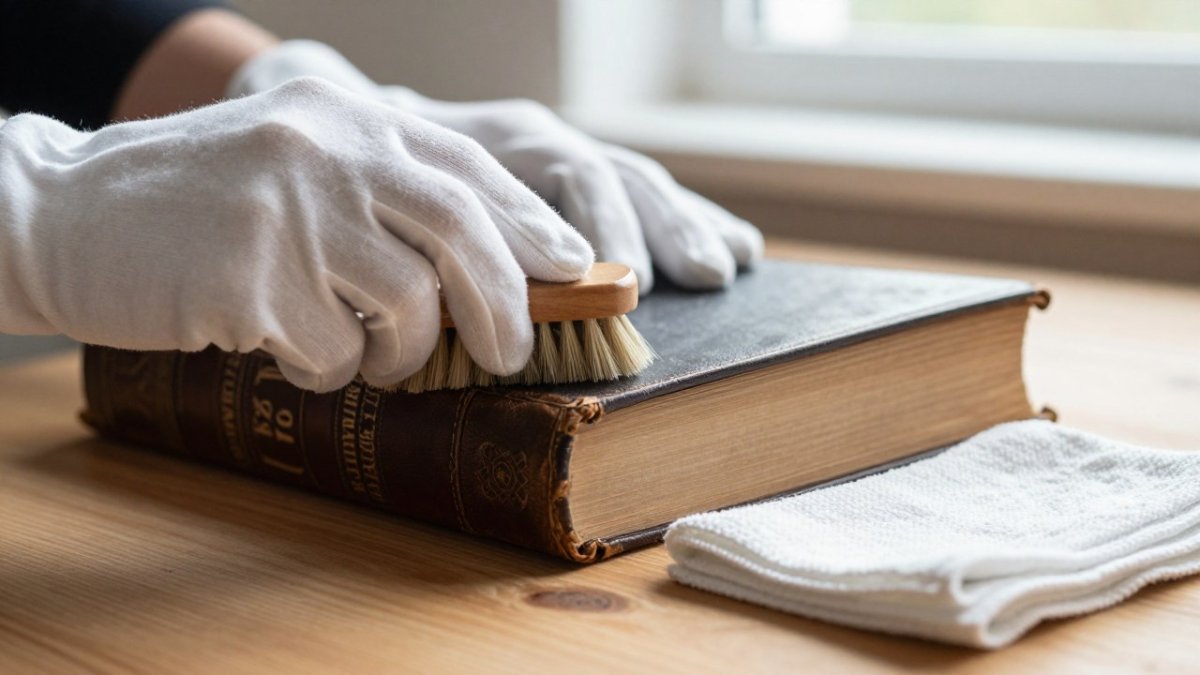
- Soft natural-bristle brush: a 1-inch to 2-inch brush with soft, dense bristles is the workhorse. A clean, dry paintbrush or soft shaving brush works; avoid stiff scrub brushes, toothbrushes, and synthetic bristles that generate static and drag.
- Lint-free microfiber cloths: keep several, folded into pads, so you can turn to a fresh face rather than spreading dirt.
- A soft brush for the page edges: a separate, clean brush kept only for text-block edges prevents cross-contamination.
Do not use feather dusters (they scratch and redistribute dirt), paper towels (abrasive), or household cleaning wipes.
Brush With the Grain, From the Spine Outward
Work in small sections, roughly the size of a playing card, and brush in one direction with the grain of the leather rather than back and forth.
After each section, tap the brush clean against the edge of a waste bin or wipe it on a cloth, and turn the cloth to a fresh face. Work from the least-damaged areas toward the most fragile ones so you do not carry grit onto sound leather.
Know When to Stop
Stop immediately and reassess if any of the following occurs:
- The leather begins to flake or shed visible flakes onto the paper.
- The surface feels tacky or sticky, which can indicate a previous dressing or active deterioration.
- You see red or reddish-brown powder on the cloth or paper.
Watch out: brushing harder never fixes flaking or red rot; it removes the leather itself, and the damage is irreversible.
What Dry Cleaning Cannot Do
Dry brushing removes loose dust and light surface soil, but it will not lift bonded grime, staining, or embedded dirt. That is where owner-level work ends. Do not escalate to water, solvents, or conditioners to chase a cleaner look; a stable binding with honest surface dirt is worth more than a damaged one that looks brighter.
Unique 1684 Saint Augustine of Hippo Letters Jerome Pope, 17th C. (1800s)!! →
Stop brushing and reassess the moment any of these signs appear.
| Warning sign | What it suggests | What to do |
|---|---|---|
| Leather flakes or sheds onto the paper | Surface layer failing | Stop immediately and reassess |
| Surface feels tacky or sticky | Previous dressing or active deterioration | Stop immediately and reassess |
| Red or reddish-brown powder on cloth | Red rot | Stop; dry dusting is the limit at home |
| Cloth lifts color that is not dust | Surface layer lifting | Stop immediately and reassess |
| Mold, pest debris, or worsening musty odor | Mold or pest problem | Isolate in a breathable box; consult a conservator |
Signs of Red Rot in Antique Books and What They Mean for Cleaning
Red rot is the powdery, reddish-brown breakdown of leather caused by acid hydrolysis and oxidation, and it means the leather has lost structural integrity at the surface.
Cleaning red rot is not a matter of brushing harder. The powder is the leather itself coming apart.
For volumes with red rot, dry dusting with a soft brush is the limit of what you should do at home.
Step 3: Remove Surface Grime Without Oils, Solvents, or Excess Moisture
Surface grime on a 17th-century binding should be removed with the gentlest mechanical method that works, and nothing more. That usually means a soft brush, a lint-free cloth, and patience.
Grime that has bonded to the leather is often there because the leather itself has degraded.
Work in small sections, use a soft brush or a slightly textured lint-free cloth, and test any method on an inconspicuous area first.
The Best Leather Conditioner for Rare Books Is Often None at All
For most 17th-century leather book bindings, conservators generally advise against conditioners.
Here is what most guides miss: the leather on a 17th-century volume is not "thirsty." It is chemically altered.
If a conservator determines that rehydration is appropriate, that work is done with controlled humidification, not a bottled conditioner. For collectors, the practical rule is simple: do not condition a historic binding yourself.
Step 4: Stabilize Loose Joints, Hinges, and Detached Boards
Loose joints and detached boards should be stabilized so the book is not damaged further during handling, but permanent repair belongs to a conservator. Your job at home is to stop the damage from getting worse, not to reattach anything with adhesive.
Support the book on a proper surface so the boards are not bearing weight. A book stand takes the strain off a fragile binding while you inspect it, and our adjustable Victorian book stand is exactly the kind of support that keeps a loose board from tearing further.
Never use household glue, tape, or rubber bands. These cause damage that a conservator then has to undo, and the cost of reversal is far higher than the cost of a proper repair.
How to Store Antique Leather Books to Prevent Future Damage
Proper storage is the most effective thing you can do to protect an antique leather book, and it costs far less than treatment.
Store books upright and supported, or flat if the binding is weak, in a room with stable conditions.
Check stored books periodically for mold, pests, and new cracking. When you are ready to add to your collection, our selection of rare antique European books is a good place to see what well-preserved period bindings look like.
Cleaning a 17th-century leather book binding safely comes down to restraint: assess first, dust gently, skip the conditioner, and refer anything structural to a conservator.
Frequently Asked Questions
Is it safe to use household leather cleaners on 17th century leather book bindings?
No. Household leather cleaners often contain oils, surfactants, or solvents that can darken, soften, or stain historic leather book bindings. A 17th-century binding is a conservation object, and its leather has already changed chemically over centuries. Water-based or oil-based cleaners can penetrate the surface and cause staining, loss of surface finish, or further weakening. Stick to dry cleaning with a soft brush and lint-free cloth, and consult a professional book conservator before applying any liquid product.
What are the signs of red rot in antique books, and can I still clean the binding?
Red rot shows as powdery, reddish-brown dust on the leather surface, often with a suede-like texture where the top layer has broken down. The leather may feel weak or crumble at the edges. If you see these signs, avoid wet cleaning and avoid brushing hard, because the surface will shed. Light dry dusting with a very soft brush is usually acceptable, but red rot is a sign of chemical breakdown that needs a conservator's assessment. Store the book flat and dry until then.
Do I need to use a leather conditioner on a 17th century book?
Most conservators advise against it. Historic leather is not the same as modern upholstery leather, and conditioners can leave sticky residues, attract dust, darken the surface, or interfere with future conservation treatment. The best leather conditioner for rare books is usually none. If the leather feels dry or brittle, the safer route is controlled humidity storage and a professional assessment rather than applying oil or cream yourself.
How should I store antique leather books to protect them after cleaning?
Keep them in a stable, dry room with moderate humidity, out of direct sunlight and away from radiators or damp walls. Store books upright and supported, or flat if the binding is weak, and use acid-free boxes for fragile volumes. Avoid plastic bags, which trap moisture. Check the spines and joints every few months for new cracking, and keep pests away by maintaining a clean, dry environment. When in doubt about a fragile 17th-century volume, ask a conservator for storage advice.
