


How to Purchase Authentic 17th Century Antique Books!!
Old Europe Antique Home Furnishings
How to Purchase Authentic 17th Century Antique Books
Learn how to purchase authentic 17th century antique books with confidence. Expert guidance on verification, provenance, and leather-bound collections.
Table of Contents
Understanding 17th Century Antique Books
What Makes a Book Truly Antique
Leather-Bound and Decorative Bindings of the Era
How to Verify Antique Book Authenticity
Physical Markers of Genuine 17th Century Books
Authentication Guide for Beginners
Provenance and Documentation
Identifying First Editions and Rare Manuscripts
Edition Variations and Rarity Indicators
Condition Reports and Grading Standards
Best Practices for Storing Rare Books
Climate Control and Environmental Conditions
Handling and Display Guidelines
Value of 17th Century Leather Bound Books
Factors That Determine Valuation
Investment Grade Collections
Where to Purchase Authentic 17th Century Antique Books
Evaluating Dealers and Sellers
What to Ask Before Buying
Antiquarian Terms and Glossary
Frequently Asked Questions
Last Updated: October 3, 2026
Understanding 17th Century Antique Books
Purchasing authentic 17th century antique books means entering a world where history, craftsmanship, and investment converge. Understanding what makes these pieces genuinely antique, rather than later reproductions, is your first line of defense against costly mistakes.
The difference between a genuine 17th century manuscript and a skilled reproduction often comes down to details most casual buyers never notice: the specific patina on leather, the exact composition of paper, and the way ink has aged into the fibers.
What Makes a Book Truly Antique
A book qualifies as genuinely antique when produced before 1800, though 17th century pieces occupy a special category. These weren't mass-produced; each represented significant labor and skill. The leather-bound volumes most collectors seek were luxury items, often owned by scholars, clergy, or wealthy families.
What separates authentic 17th century books from later imitations is evidence in their physical structure. Seventeenth-century papermakers used linen and cotton fibers, creating sheets with distinct feel and appearance that modern papers, even artificially aged, cannot replicate. Binding materials, leather tanned using period methods and hand-spun or early machine-made thread, show wear patterns that cannot be convincingly replicated.
Leather-Bound and Decorative Bindings of the Era
Leather-bound books from the 17th century represent the pinnacle of bibliophile collecting. Bookbinders used full leather covers decorated with embossed patterns, gilt edges, and raised spine bands that served both aesthetic and structural purposes.
Decorative elements, embossed designs, gilt tooling, and leather, are where authentication becomes critical.
Vellum used in premium bindings presents another authentication marker.
How to Verify Antique Book Authenticity
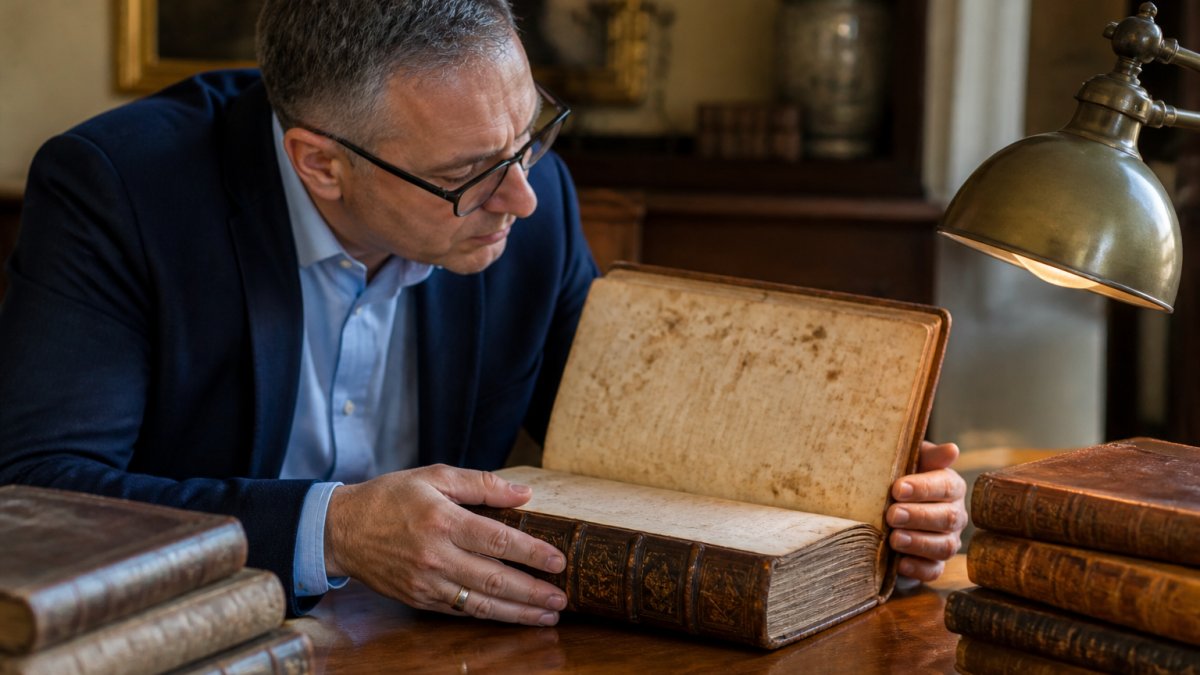
Professional carefully examining an open leather-bound antique book, showing aged paper with visible foxing and embossed spine details under natural light from a desk lamp
Professional carefully examining an open leather-bound antique book, showing aged paper with visible foxing and embossed spine details under natural light from a desk lamp
Verifying authenticity requires systematic examination. Handle the book with clean hands and examine the binding for signs of age. Press gently on the leather; genuine aged leather has specific resistance and flexibility that modern leather cannot replicate.
Physical Markers of Genuine 17th Century Books
Authentic 17th century paper shows specific aging characteristics. Foxing (brown spots) follows predictable patterns based on iron content and environmental exposure, appearing organic and varying in intensity.
Authentic paper has distinct thickness and texture with slight irregularities that modern papermaking has eliminated.
Examine the binding structure. Signatures (folded sheets sewn together) are visible along the spine. Binding thread shows age, discoloration, brittleness, or partial deterioration.
Authentication Guide for Beginners
Examine the title page for period typography characteristics, typefaces, spacing, and ink application differ from later printings.
Check for a colophon (publisher's mark or printer's information) at the book's end, which can be cross-referenced with historical records.
Inspect binding boards for consistent wear patterns. Leather should not be uniformly colored; genuine aging creates variation.
Provenance and Documentation
Provenance (documented ownership history) is crucial when purchasing authentic 17th century antique books. Books with clear provenance command higher value and confidence than those with unknown history.
Auction catalogs, exhibition records, and library stamps establish provenance. Books appearing in major auction catalogs have stronger documentation than privately sold copies. Museum and institutional collection records provide excellent provenance markers.
This documentation supports investment value.
Identifying First Editions and Rare Manuscripts
First editions command premium prices among collectors. Understanding edition variations helps identify truly rare copies.
Edition Variations and Rarity Indicators
First editions are distinguished by specific characteristics on the title page: date, printer's information, and sometimes notes about being the "first edition" or "editio princeps." Not all first editions are labeled as such.
Examine the colophon and printer's mark. Different printers in different cities created distinct editions; the first printing typically holds greater value.
Rarity indicators include surviving copy numbers. Some 17th century books were printed in only 500-1,000 copies; many were damaged or lost. A book with 30-40 surviving copies is exponentially rarer than one with hundreds remaining.
Condition Reports and Grading Standards
Professional condition grading uses standardized terminology. "Fine" shows minimal wear with intact binding and clear text. "Very good" allows some wear while maintaining structural integrity.
Grades reflect condition relative to age and rarity, not modern standards.
When examining a book in person, assess condition directly. Look for water damage (staining and warping), binding structural damage, and loose or missing pages.
Best Practices for Storing Rare Books
Once you've purchased authentic 17th century antique books, proper storage becomes essential to preservation. Environmental conditions directly impact the longevity of these fragile objects.
Climate Control and Environmental Conditions
Temperature and humidity are primary preservation concerns. Fluctuating conditions cause leather expansion, paper brittleness, and ink fading. Maintain constant temperature between 60-70°F with 30-40% relative humidity.
Avoid basements and attics where conditions fluctuate seasonally. Use climate-controlled interior rooms away from exterior walls, or verify storage facilities maintain consistent year-round conditions.
Light exposure degrades paper and leather; ultraviolet light is particularly damaging. Store books away from direct sunlight or display them with UV-filtering glass in indirect light.
SHOP NOW! →
Handling and Display Guidelines
Handle rare books with clean, dry hands to prevent oil transfer. Support the spine gently when opening, never forcing it beyond its natural angle. Use cotton gloves for very fragile volumes.
Display books upright with bookends to prevent binding stress. Never stack horizontally; if temporary horizontal storage is necessary, limit stacks to three volumes.
For long-term storage, wrap books individually in acid-free paper and store in acid-free boxes. Avoid plastic wrapping, which traps moisture.
Value of 17th Century Leather Bound Books
Understanding what determines value helps you make informed purchasing decisions and recognize genuine investment-grade pieces.
Factors That Determine Valuation
Multiple factors influence value. Rarity is paramount; books with few surviving copies command significantly higher prices. Author recognition matters; works by famous philosophers, theologians, or scientists are more sought after.
Condition directly impacts value. Fine condition books with intact binding are worth substantially more than poor condition copies.
The language and subject matter influence collector interest. Scientific treatises, theological works, and early printed books on exploration command premium prices.
Investment Grade Collections
Some collectors approach 17th century books as investments, seeking pieces likely to appreciate over time.
Building an investment-grade collection requires patience and expertise. Rather than acquiring numerous common books, collectors focus on acquiring fewer pieces of exceptional quality and rarity.
The antiquarian book market has shown resilience over decades. Collectors recognize that authentic, rare books represent tangible historical artifacts with limited supply. As long-term holdings, they provide both aesthetic enjoyment and potential financial appreciation.
Where to Purchase Authentic 17th Century Antique Books
Finding reliable sources for authentic 17th century antique books is critical. Not all sellers provide the authentication and documentation that protect your investment.
Evaluating Dealers and Sellers
Reputable dealers specialize in rare books and maintain detailed records of provenance. They belong to professional organizations and often provide certificates of authenticity with purchases.
Online marketplaces offer convenience but require careful vetting. Look for sellers with extensive positive feedback and detailed product descriptions. Authentic dealers provide high-resolution photographs showing binding details, paper condition, and any damage or repairs.
Old Europe Antique Home Furnishings maintains a curated selection of authenticated 17th century books.
What to Ask Before Buying
Before committing to a purchase, ask specific questions about authentication. How was the book authenticated? What documentation supports its dating and origin?
Request detailed provenance documentation. Ask whether the book has appeared in auction catalogs, museum collections, or published bibliographies.
Inquire about the dealer's expertise. How long have they specialized in rare books? Are they members of professional antiquarian book associations? Can they provide references from other collectors or institutions?
Antiquarian Terms and Glossary
Foxing, Brown spots appearing on aged paper, caused by oxidation and mold growth.
Gilt, Gold leaf applied to book edges or decorative elements.
Manuscript, A handwritten document, or in rare book terms, a book produced before printing.
Provenance, The documented history of ownership and location of an object.
Quarto, A book size created by folding a sheet of paper twice, producing four leaves.
Purchasing authentic 17th century antique books requires knowledge, patience, and access to reliable sources. The market rewards collectors who invest time in understanding authentication, condition assessment, and provenance documentation. Old Europe Antique Home Furnishings offers collectors access to investment-grade pieces with verified provenance. Visit our showroom to examine curated selections in person, or explore our collection of authenticated 17th century leather-bound volumes to begin building your own antiquarian library. SHOP NOW!
Frequently Asked Questions
How can you verify the authenticity of a 17th-century book?
Authentic 17th century antique books display specific physical markers: hand-made paper with visible fiber variations, period-appropriate binding techniques, natural aging patterns like foxing, and typography consistent with the era. Examine the title page for printing methods used before industrial presses, check for provenance documentation, and assess the leather binding's patina. Reputable dealers provide condition reports and authentication certificates. If purchasing online, request detailed photographs of the spine, title page, and any damage before committing to the purchase.
What should I look for when buying leather-bound antique books?
Leather-bound books from the 17th century should show authentic aging characteristics: natural cracking and patina on the leather, hand-tooled or embossed decorative elements, and period-appropriate binding structures. Examine the spine for the original hand-stitching and check that the leather has the appropriate feel and color for its age. Avoid books with uniform, artificially darkened leather or overly perfect bindings, which may indicate recent restoration or reproduction. Verify the binding technique matches the stated date and origin of the book.
Are books from the 1700s worth anything?
Yes, 18th century books can hold significant value depending on several factors: first editions of notable works command premium prices, leather-bound collections in good condition appeal to bibliophiles and collectors, and historically significant manuscripts fetch substantial sums. Rarity, provenance, condition, and subject matter all influence valuation. Have valuable pieces appraised by a qualified antiquarian dealer to determine their true market value.
What is the difference between an antiquarian book and a rare book?
Antiquarian books are old books, typically defined as those printed before 1900, valued for their age, historical significance, and craftsmanship. Rare books are scarce or limited in number, regardless of age. A book can be antiquarian without being rare (many 19th century volumes exist in quantity), or rare without being old (a limited modern first edition). When purchasing 17th century antique books, you're acquiring pieces that are both antiquarian and typically rare, which increases their collectible value and investment potential.
SHOP NOW!