


How Can You Restore Antique Furniture Without Losing Value?
Last Updated: October 25, 2026
Quick Summary
To restore antique furniture without losing value, return pieces to original condition while keeping original materials intact through careful cleaning, repair, and stabilization rather than refinishing. Maintain stable humidity between 40 to 45 percent relative humidity and avoid rapid environmental changes that cause wood damage.
- Restoration preserves original material and patina, while refinishing strips away the original finish and permanently reduces value.
- Stable humidity between 40 to 45 percent relative humidity is more important than absolute humidity level in preventing wood damage.
- Never use water directly on antique wood or commercial furniture polish, instead use a barely damp microfiber cloth with distilled water.
- Warning signs of humidity damage include gaps between boards, loose joints, lifting veneers, sticking drawers, and finish cracking in grain patterns.
- Hire a professional conservator for structural failure, veneer separation, deep finish damage, wood warping, or inlay damage.
Table of Contents
- Understanding the Difference: Antique Furniture Restoration vs Refinishing
- Why Humidity and Wood Damage Matter for Antique Furniture
- How to Clean Antique Wood Furniture Safely
- Maintaining Stable Indoor Humidity to Protect Your Pieces
- Protecting Antique Furniture During Storage and Display
- What to Do After Water Damage or Humidity Spikes
- When to Hire a Professional Conservator
- Start Your Restoration Journey with Expert Guidance
- Frequently Asked Questions
Understanding the Difference: Antique Furniture Restoration vs Refinishing
Restoration and refinishing are not the same thing, and the difference matters enormously when you're trying to preserve value.
Refinishing means stripping off the existing finish and applying a new one. This sounds simpler, but it's destructive.
Here's what most people get wrong: they assume a piece that looks worn needs refinishing. In reality, worn finishes often add value.
The real skill is knowing when to restore and when to leave well enough alone.
Why Humidity and Wood Damage Matter for Antique Furniture
Wood moves. It expands when moisture increases and contracts when air dries out. This is not a flaw in old furniture, it's the nature of solid wood.
Antique furniture is particularly vulnerable because the wood has already aged for decades or centuries. The grain structure is less flexible than new wood.
The Smithsonian Institution's guidance on wood furniture conservation emphasizes that stable humidity is the single most important factor in preventing wood damage.
Recognizing Early Signs of Humidity Damage
Catch humidity damage early and you can often stabilize it without major intervention. Wait too long and you're looking at expensive restoration work.
Watch for these warning signs:
- Gaps appearing between boards or panels where wood has shrunk
- Joints becoming loose where glue has lost its grip as wood shifted
- Veneers lifting or bubbling at the edges or corners
- Drawers sticking or binding in ways they didn't before
- Finish cracking in a pattern that follows the wood grain
- Visible warping in tabletops or door panels
- A musty smell indicating excess moisture has entered the wood
If you notice any of these, humidity fluctuation is likely the cause. The good news: you can stop the damage right now by stabilizing your environment. The bad news: existing damage usually requires professional attention to repair properly.
Watch for these warning signs that humidity fluctuations are damaging your antique pieces.
| Warning Sign | What It Indicates |
|---|---|
| Gaps between boards or panels | Wood has shrunk from low humidity |
| Joints becoming loose | Glue has lost grip as wood shifted |
| Veneers lifting or bubbling | Moisture causing veneer separation |
| Drawers sticking or binding | Wood warping from humidity changes |
| Finish cracking in grain pattern | Stress from wood movement |
| Visible warping in tabletops | Uneven moisture absorption |
| Musty smell | Excess moisture has entered the wood |
How to Clean Antique Wood Furniture Safely
Cleaning is restoration's first step. But there's a right way and a wrong way, and the wrong way can damage finish and wood alike.
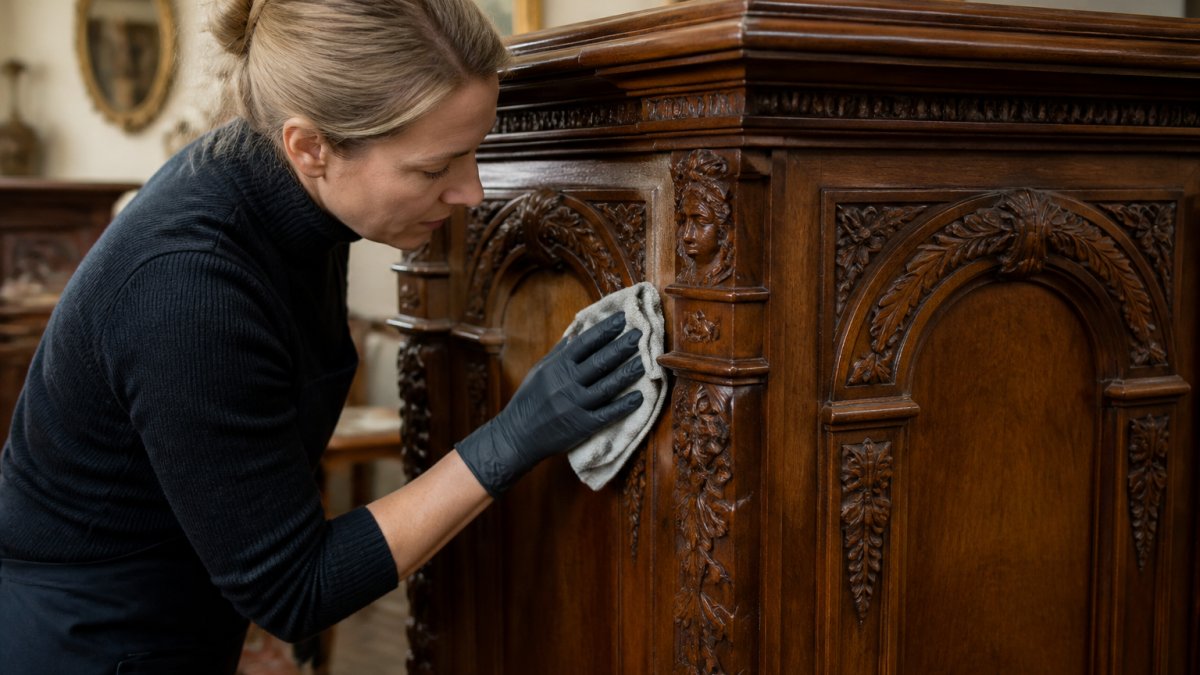
Never use water directly on antique wood. Water raises the grain, softens old glue, and can cause swelling or staining. Never use commercial furniture polish or spray cleaners.
Here's the correct approach:
- Use a soft, lint-free cloth (microfiber works well). Dampen it very slightly with distilled water, not wet, barely damp.
- Wipe gently in the direction of the wood grain. Never scrub or apply pressure.
- Dry immediately with a second clean cloth to prevent water from soaking in.
- For built-up grime, use a cloth dampened with a 1:1 mixture of distilled water and white vinegar. The acidity cuts through old wax and dirt without harming finish.
- For carved details, use a soft brush (an old toothbrush works) to reach crevices. Keep it dry or barely damp.
- Never use oil-based products on antique finishes unless a conservator has approved it for that specific piece.
The goal is to remove dust and surface grime without changing the appearance of the finish.
Maintaining Stable Indoor Humidity to Protect Your Pieces
Humidity stability matters more than absolute humidity level. A piece can survive in a consistently dry environment or a consistently humid one.
The American Alliance of Museums' conservation standards recommend a target range of 35 to 45 percent relative humidity for wood furniture.
But here's what many collectors miss: gradual changes are acceptable. Slow seasonal shifts from 40 percent in winter to 45 percent in summer cause minimal stress.
Finding the Right Relative Humidity Range
The 35 to 45 percent range is a target, not a law. Different woods and construction methods have slightly different tolerances.
Below 30 percent and wood becomes brittle. Joints weaken. Veneers separate. Finishes crack.
Above 50 percent and you risk mold, mildew, and wood swelling. Metal hardware can corrode. Upholstered pieces can develop musty odors.
The sweet spot is 40 to 45 percent.
Using a Hygrometer to Monitor Conditions
You can't control what you don't measure. A hygrometer is your first tool. It's inexpensive, reliable, and essential.
Buy a digital hygrometer that displays both temperature and relative humidity. Place it in the room where your most valuable pieces live.
If your readings consistently show 50 percent or higher, you need a dehumidifier.
Avoid ultrasonic humidifiers around antiques. They produce mineral-laden mist that deposits on furniture. Use evaporative humidifiers instead.
Seasonal Adjustments and Gradual Changes
Winter heating dries out homes. Summer humidity spikes. These seasonal swings are normal and manageable if you adjust gradually.
Antique Cabinet French Neoclassical, Carved, Walnut, On Stand, Figural, E. 1900s →
In fall, as heating season approaches, begin monitoring humidity weekly. If it starts dropping below 40 percent, turn on your humidifier.
In spring, as outdoor humidity rises, monitor for the opposite problem. If readings climb above 50 percent, run your dehumidifier. Again, adjust gradually rather than making sudden changes.
This slow approach, shifting your humidity target by 5 to 10 percent over a week or two rather than overnight, is far gentler on antique wood than rapid swings. Your pieces will thank you with stable joints and intact finishes.
Protecting Antique Furniture During Storage and Display
Where you keep your pieces matters as much as how you maintain them. The wrong environment accelerates damage. The right one extends the life of your collection indefinitely.
Never store antique furniture in an uncontrolled space. Basements, attics, and garages experience wild humidity swings.
If storage is necessary, use a climate-controlled unit. Yes, it costs money. But it's far cheaper than restoring pieces damaged by humidity extremes.
Choosing Storage Environments: Basements, Attics, and Climate-Controlled Spaces
Basements are the worst choice. They're damp by nature. Concrete floors wick moisture from the ground. Pipes leak. Flooding happens.
Attics have the opposite problem. They're dry in winter and can get extremely hot in summer.
Climate-controlled storage units are the professional choice. They maintain stable temperature and humidity year-round.
When moving pieces to storage, wrap them in acid-free paper or cloth. Never use plastic wrap, it traps moisture against the wood.
What to Do After Water Damage or Humidity Spikes
Water damage happens. A pipe bursts. A window leaks. Humidity spikes during a heat wave. Your first instinct might be to panic. Your second should be to act deliberately.
Do not attempt to dry the piece quickly. Rapid drying causes more damage than the water itself.
Instead:
- Move the piece to a stable, moderate-humidity environment (around 50 percent relative humidity). A climate-controlled room is ideal.
- Allow it to dry slowly over several weeks. This gives moisture time to migrate evenly through the wood without creating stress.
- Use a hygrometer to track humidity. As the environment stabilizes, the piece will gradually release moisture.
- Do not apply heat. No hair dryers, heaters, or direct sunlight. These force rapid drying and cause damage.
- Document the damage with photos. If you eventually need professional restoration, the conservator needs to understand what happened.
After the piece has dried completely (this can take 4 to 8 weeks depending on severity), assess the damage. Minor water staining on the finish might disappear as the wood stabilizes. Swelling usually subsides. But warping, splitting, and joint failure often require professional repair.
This is where you can explore a related article on humidity protection if you want deeper guidance on maintaining stable conditions year-round.
When to Hire a Professional Conservator
Some restoration work is beyond the scope of home care.
Hire a conservator if you see:
- Structural failure: joints that won't tighten, drawers that don't align, legs that wobble
- Veneer separation: lifting, bubbling, or missing sections of veneer
- Finish damage beyond surface scratches: deep gouges, water rings that won't come out, areas where finish has flaked away
- Wood movement: warping, splitting, or grain separation
- Inlay or marquetry damage: loose or missing decorative elements
- Upholstery issues: sagging, torn fabric, or failing springs
A conservator can assess whether a piece is worth restoring and what approach makes sense. They understand the difference between restoration and refinishing.
To find a qualified conservator, ask local antique dealers for referrals. Check credentials with the American Institute for Conservation. Ask for references and examples of past work.
Understanding the distinction between restoration and preservation helps you make better decisions. Learn how to identify whether furniture has already been refinished so you understand what you're buying and what work might be needed.
Start Your Restoration Journey with Expert Guidance
Restoring antique furniture without losing value comes down to one principle: stabilize the environment, minimize intervention, and know when to call a professional.
Most damage happens not from use but from neglect of humidity control. A piece that's been in your family for generations can deteriorate rapidly in the wrong conditions.
Old Europe Antique Home Furnishings specializes in sourcing authentic European antiques, pieces like the Antique Cabinet French Neoclassical, Carved, Walnut, On Stand, Figural, E. 1900s ($1,689.00), that deserve proper care.

Frequently Asked Questions
How can you restore antique furniture without reducing its value?
Focus on stabilization and gentle cleaning rather than refinishing. Preserve the original finish, wood grain, and patina whenever possible. Use reversible methods: soft cloths, mild soap solutions, and careful dust removal. Address humidity fluctuations to prevent warping and cracking. Only refinish if the piece is already damaged beyond repair. When in doubt, consult a professional conservator who specializes in antique furniture. Collectors value authenticity and originality far more than a "like new" appearance.
What humidity level should antique furniture maintain?
Most antique wood furniture thrives in a relative humidity range of 35 to 45 percent. This stable environment prevents the wood from expanding and contracting excessively, which causes warping, splitting, and cracking. Rapid humidity swings are more damaging than a consistently higher or lower level. Use a hygrometer to monitor your home's humidity. In dry climates, a humidifier helps; in damp climates, a dehumidifier or moisture absorber works better. Avoid placing furniture near radiators, fireplaces, or direct sunlight, which accelerates moisture loss.
How can humidity damage antique furniture?
Wood absorbs and releases moisture based on relative humidity levels. When humidity spikes, wood swells; when it drops, wood shrinks. This repeated expansion and contraction stresses the wood grain and finishes, causing warping, splitting, and cracking. High humidity also encourages mold and rot, especially in solid wood and joinery. Low humidity dries out the finish and can cause veneer to lift or separate. Seasonal changes compound this risk. Antique pieces with intricate joinery, marquetry inlay, or hand-painted panels are especially vulnerable. Stable humidity between 35 and 45 percent minimizes these risks.
When should you hire a professional furniture conservator?
Hire a conservator if your antique furniture shows active damage such as deep cracks, severe warping, loose joinery, water stains, or mold. If the piece has significant historical or monetary value, professional assessment is worth the investment. Conservators use reversible techniques that preserve authenticity and resale value. Do not attempt major repairs yourself if the piece is rare or valuable. For minor dust and surface cleaning, gentle home care is fine. For anything involving structural repair, finish restoration, or pieces over 100 years old, professional expertise protects your investment.
The difference between a piece that appreciates and one that deteriorates lies in how you treat it today. Start with humidity monitoring, establish stable conditions, and you've already protected your investment. Add professional guidance when complexity arises, and you're ensuring your antiques remain beautiful and valuable for generations to come.
