


How to Spot Quality Antique Writing Desks
Last Updated: November 22, 2026
Quick Summary
Quality antique writing desks show hand-cut dovetails with slight irregularity, original hardware with matching screw holes, flat veneer with no lifting, and a writing surface with honest, even wear. A sound case resists racking when you push opposite corners, and drawers glide without sticking or wobble.
- Pull out a drawer and flip it: hand-cut dovetails are slightly irregular, while even machine-cut ones signal a reproduction.
- Original brass pulls sit slightly proud or sunken, and extra screw holes mean the hardware was swapped.
- Old wood smells dry and sweet inside drawers; new wood and fresh glue do not.
- Request six photos before buying online, including the removed drawer and the back and underside.
- Score condition, originality, and provenance from 1 to 5 each, then add the three scores before negotiating.
Table of Contents
- Why Antique Writing Desks Reward a Careful Eye
- How to Identify Antique Desk Styles
- Types of Antique Desks and What Each One Demands
- Wood, Veneer, and the Materials That Signal Quality
- Craftsmanship Checks: Joinery, Hardware, and Structure
- How to Inspect an Antique Desk in Person
- Antique Desk Value: Condition, Originality, and Provenance
- Buying Online: A Photo-Based Inspection Guide
- Frequently Asked Questions
Why Antique Writing Desks Reward a Careful Eye
Quality in an antique writing desk shows up where photos rarely reach: the feel of a drawer sliding home, the sound of a hinge, light across a hand-polished surface. Learning to read the signs of quality antique writing desks pays off before you spend a dollar.
You need a flashlight, a tape measure, and patience, not an appraiser's training.
Below, we cover desk styles, materials, joinery, and a photo-based method for buying online.
How to Identify Antique Desk Styles
Start with the silhouette. A desk's shape tells you its period and purpose before you open a drawer.
Antique desk styles fall into a few broad families, each with its own construction logic where quality hides.
- Writing desks: a flat or slightly sloped surface, often with a single drawer. Simple, honest, and easy to fake badly.
- Secretary desks: a drop-front panel that folds down into a writing surface, with drawers or cubbies above.
- Roll-top desks: a curved tambour shutter that slides back over pigeonholes and small drawers.
Period Clues: Victorian, Edwardian, and French Influences
Victorian desks tend to be heavy and ornate, with carving, turned legs, and abundant drawer space. Edwardian pieces slim down: lighter lines, restrained ornament, and a preference for mahogany and satinwood.
French influences run their own course. Louis XV style brings serpentine curves and cabriole legs. Louis XVI tightens into straight tapered legs, fluted columns, and geometric brass inlay.
A real Victorian cylinder secretary shows these traits in the wood itself, not just the outline. You can browse a Victorian walnut cylinder secretary to see how the period's proportions and hardware actually look together.
Reading the Writing Surface and Interior Layout
The writing surface is the most-used, most-worn part of any desk, and the most honest.
Look for a leather inset with tooled borders, or a wood surface with a warm, uneven sheen from decades of use. Original leather usually shows fine crazing and a soft edge where wrists rested.
Then open it up. Count the compartments, check that small drawers sit flush, and confirm pigeonholes are square.
Types of Antique Desks and What Each One Demands
Different desk types fail in different ways, so your inspection should shift with the style.
Types of antique desks each carry a specific weak point. Know the weak point, and you know where to look first.
| Desk Type | Key Feature | Main Weak Point | What to Check |
|---|---|---|---|
| Secretary | Drop-front writing panel | Hinge and support arms | Panel opens level, no sag |
| Roll-top | Tambour shutter | Shutter track and canvas backing | Smooth glide, no binding |
| Slant-front | Hinged sloping lid | Lid hinge and interior dividers | Lid holds firm when open |
| Bureau plat | Flat leather top | Leather and ormolu mounts | Leather intact, mounts tight |
| Bonheur du jour | Raised back with shelves | Upper gallery and mirror plates | Gallery secure, glass unbroken |
Secretary, Roll-Top, and Slant-Front Desks
The secretary desk lives or dies by its drop-front. Open it slowly; it should settle level and stay there without wobble. Weak support arms are common and repairable, but a warped panel is not.
Roll-top desks demand a smooth tambour. You can browse an antique cylinder roll-top desk to see how the tambour and pedestal base come together. Slide the shutter back and forth.
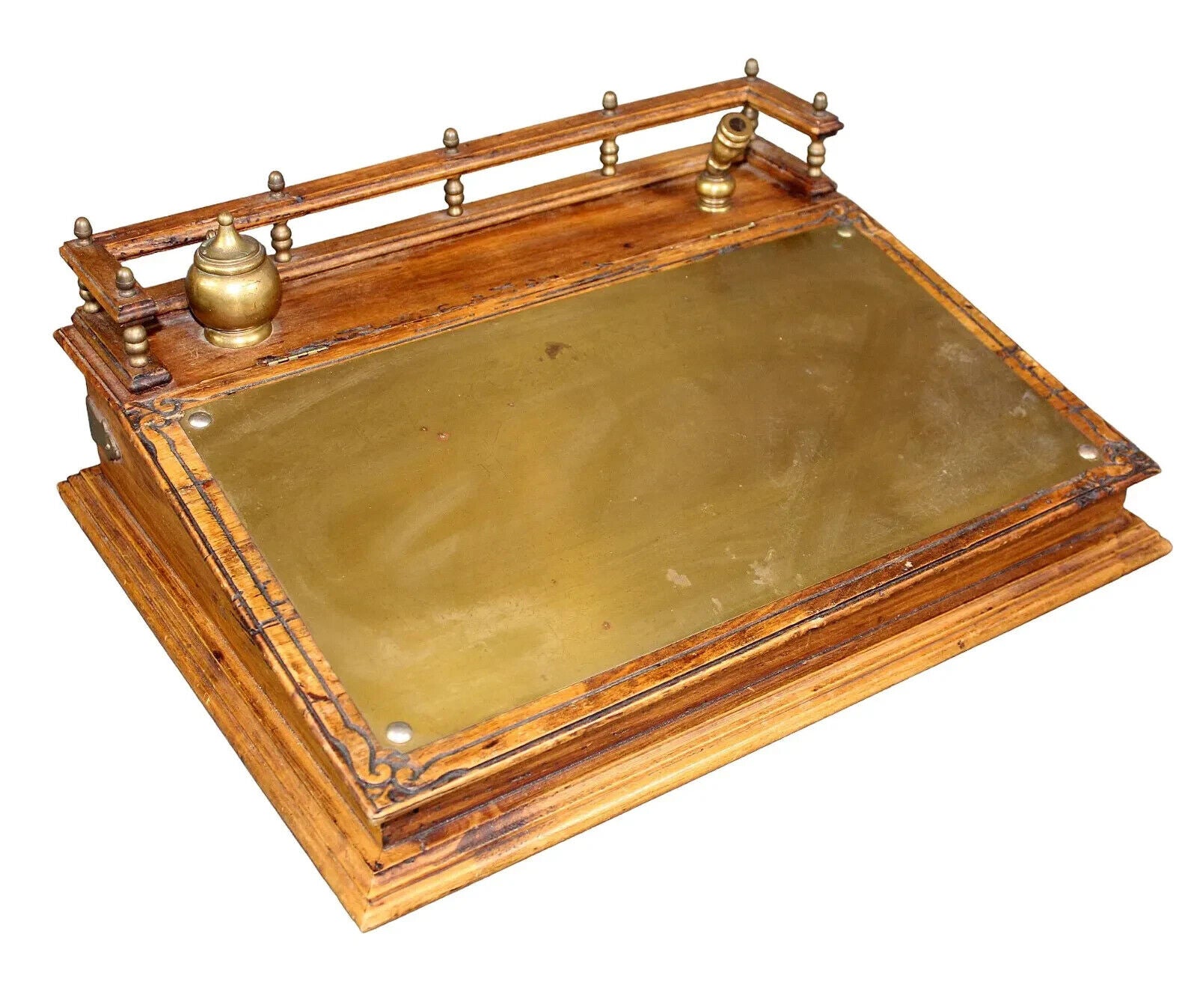
Slant-front desks are the most portable of the group, and small ones were built to travel. You can view a portable slant-front desk with brass inkwell to see how the lift-top mechanism and interior compartments were arranged.
Wood, Veneer, and the Materials That Signal Quality
Run your hand across the top. Then look at the grain from a low angle with a light.
Solid wood shows continuous grain that wraps around edges and follows the same pattern on adjacent surfaces. Veneer is not a downgrade in itself.
Good veneer sits flat with no lifting, bubbles, or dark lines where glue has failed.
Mahogany, walnut, and oak are the workhorses; burlwood and floral marquetry are the showpieces. You can examine a Dutch floral marquetry slant-front desk to see how thin the veneer slices are and how precisely the pattern pieces meet.
Watch out: heavy, opaque finish can hide veneer lifting and old repairs. If the surface looks plastic and uniform, ask what is underneath.
Craftsmanship Checks: Joinery, Hardware, and Structure
Pull out a drawer and turn it upside down. This is the single most revealing move you can make.
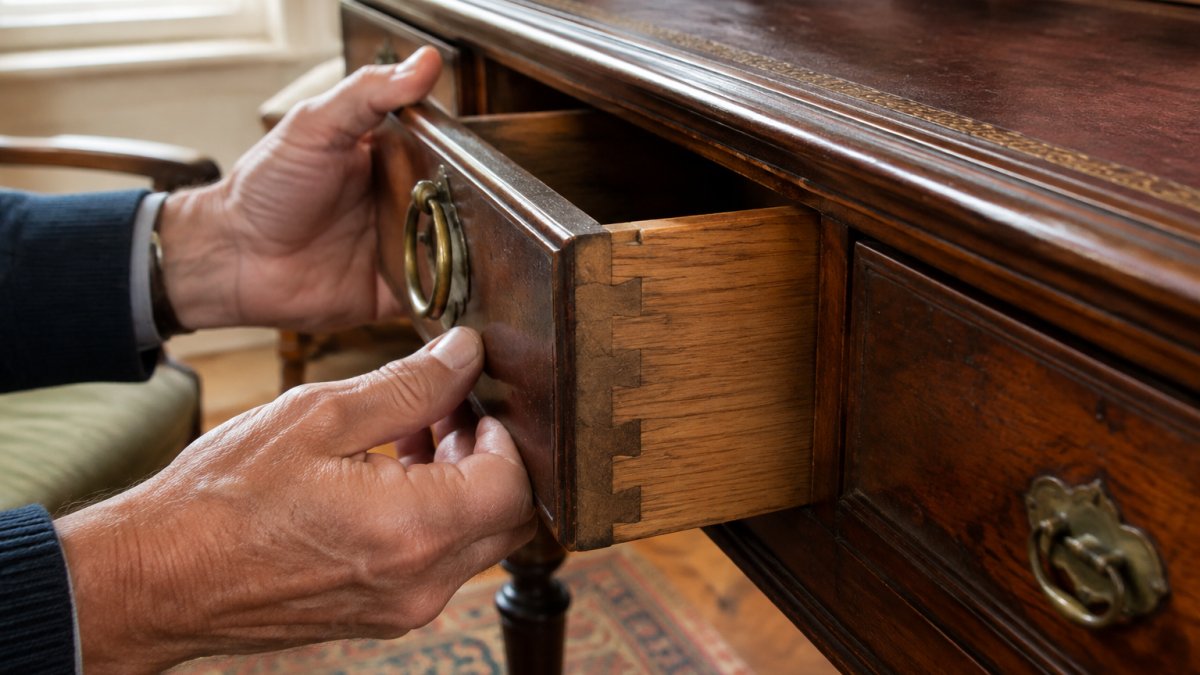
Dovetail joints should show interlocking pins and tails cut by hand, with slight irregularity.
Hardware tells its own story. You can examine a bureau plat with bronze doré ormolu mounts to see how original mounts sit against the wood.
Then check structure. Push gently on opposite corners. A sound case resists racking.
A Quality Checklist for Writing Desks
Use this list on every desk you evaluate.
- Drawer bottoms are solid wood, not thin plywood
- Dovetails are hand-cut and slightly irregular
- Hardware is original, with matching screw holes
How to Inspect an Antique Desk in Person
Bring a flashlight, a small tape measure, and a rag. Work from the ground up, and test the desk the way it will actually be used.
- Check the feet and legs first. Look for spliced legs, replaced feet, or wobble at the joints. Sight down each leg from behind; one that kicks out or in usually means a repaired break or replaced foot.
- Open every drawer and compartment. Smell inside, old wood has a dry, sweet scent; new wood and fresh glue do not. Run a finger along the drawer bottom and dust board; grit and a dark, even film are period signs, while clean white pine or fresh plywood is not.
- Inspect the back and underside. Saw marks, hand-planed surfaces, and old dust are good signs; fresh plywood, uniform circular saw marks, and modern staples are not. A replaced backboard often hides a rebuilt case.
- Test the writing mechanism. Open and close it several times; it should move the same way every time. On a secretary, the drop-front should settle level without a prop; on a slant-front, the lid should hold firm when raised.
- Look for the maker's mark. Labels, stamps, and brand marks often sit on drawer sides or the back rail. A yellowed, lifting paper label is more convincing than a crisp reproduction decal.
- Check for active woodworm or rot. Fine dust under a leg or soft wood near the base needs attention. Probe the bottom of a leg with a fingernail; if it dents easily, the wood is compromised.
Test Structure, Not Just Appearance
A desk can look sound and still flex. Push gently on opposite corners, then press down on the writing surface as if leaning on it to write; a sound case resists racking and the surface does not deflect.
Check the joints you can see. Tight dovetails, pegged mortise-and-tenon joints, and attached glue blocks are good signs. Daylight through a seam, wood-putty filler, or a metal-bracket reinforcement all point to a repair.
Restoration Versus Original Condition
A professionally restored desk with replaced leather can be a fine buy, but it should be priced as restored, not original. Learn to recognize the common interventions:
- Replaced veneer: a patch that does not match the surrounding grain, a hard line where it meets the old surface, or a glued-and-clamped bubble.
- Refinishing: a surface too even in color, a finish that fills the grain, or a uniform sheen across a top that should show wear. Refinishing strips patina, and patina is a large part of what you are paying for.
- Repaired joints: reglued and clamped joints leave squeeze-out and a mismatched finish line; pinned or screwed joints show fresh holes.
Ask directly what has been replaced, and ask for receipts if the seller has them. Honest sellers tell you, and a documented restoration is easier to live with than a hidden one.
Watch out: a heavily refinished desk with modern hardware can still be usable, but it should not be priced as an untouched original.
Antique Desk Value: Condition, Originality, and Provenance
Antique desk value rests on three pillars: condition, originality, and provenance. Score each desk on the criteria below and write the scores down before you negotiate.
Condition (score 1-5)
- 5: Structurally sound, original finish with honest wear, working locks with keys, no active woodworm or rot, writing surface intact or sympathetically replaced.
- 3: Sound but refinished, or with a replaced leather, or with one repaired joint that was done well.
- 1: Racking case, replaced legs or feet, active woodworm, missing hardware, or a writing surface that has been sanded through.
Originality (score 1-5)
- 5: Original hardware, original finish where possible, original writing surface, original feet and legs.
- 3: Original case with replaced leather and one or two replaced pulls, or a period-correct but later finish.
- 1: Replaced legs, replaced backboard, modern hardware throughout, or a case that has been rebuilt.
Provenance (score 1-5)
- 5: Receipts, auction records, family history, or maker documentation that ties the piece to a known maker or collection.
- 3: A plausible maker's mark or label with no paper trail.
- 1: No marks and no history, which is common and not disqualifying, but it caps the score.
Add the three scores.
Quality Relative to Intended Use
Collectible quality and everyday usability are not the same thing. A desk that scores high on originality may still be too small, too low, or too shallow for daily work.
A restored desk with a replaced leather top can be the better buy for daily use, while an untouched original is better for a collection.
Watch out: a high originality score does not offset a structural problem, and a low originality score does not automatically mean a low price if the piece is rare or well documented.
Buying Online: A Photo-Based Inspection Guide
Photos can tell you more than most sellers realize, if you ask for the right ones.
Request these six shots before you commit:
- The drawer, removed and flipped. This shows joinery better than any other photo.
- The writing surface at a low angle in raking light. This reveals veneer lifting and surface wear.
- The back and underside. Saw marks and construction details live here.
- A close-up of hardware and screw holes. Original versus replaced becomes obvious.
- The full piece from front, side, and back. Proportions and any structural lean show up here.
- Any labels, stamps, or marks. Ask for a clear, well-lit close-up.
Then ask three questions in writing: What has been repaired or replaced? Are the keys present? What is the return policy if the piece does not match the photos?
Watch out: listings with only styled room shots and no detail photos are the ones to skip.
The real challenge with antique writing desks is not finding one. It is knowing which one deserves your money.
At Old Europe Antique Home Furnishings, we offer a curated selection of European antiques, including pieces dating back to the 16th century.
Frequently Asked Questions
How can you tell whether an antique desk is solid wood or veneer?
Look at the edges and any exposed secondary surfaces. Solid wood shows continuous grain wrapping around corners, while veneer shows a thin layer over a different core, often visible at drawer edges or under a lifted corner. Veneer itself is not a flaw: many high-quality antique writing desks use veneer over solid wood for decorative effect. Check the underside and drawer bottoms for grain that matches the top, and look for lifting, bubbling, or patches where veneer has been replaced.
What are five signs of a valuable antique writing desk?
Five reliable signals are original hardware such as brass pulls and locks, hand-cut dovetail joints, a maker's mark or manufacturer's label, documented provenance, and a surface with honest patina rather than a fresh refinish. Rarity of form matters too: a secretary desk or a French bureau plat with ormolu mounts will often carry more value than a plain table desk. Condition and originality weigh heavily, so compare any restoration against the piece's age and intended use.
Are secretary desks considered writing desks?
Yes. A secretary desk is a writing desk with a drop-front writing surface and upper storage, often with cubbies and small drawers inside. The form dates to the 18th century and remained popular through the Victorian period. When assessing one, test the drop-front hinge, check that the interior compartments are intact, and confirm the writing surface has not been replaced. A secretary with original brass hardware and a sound fall-front is a strong example of quality antique writing desks.
How do I inspect an antique writing desk I am buying online?
Request photos of the drawer sides and dovetails, the underside, the back, and any maker's mark or label. Ask for close-ups of hardware, hinges, locks, and the writing surface, plus a straight-on shot of the whole piece for proportion. Ask specifically about repairs, replaced parts, and whether the finish is original. A seller who documents condition honestly, such as noting wear consistent with age and use, gives you far more confidence than one who only shows styled room shots.
